


Magnesium Carbonate Minerals Market Forecast 2026–2036: Market Expansion Driven by Industrial Applications
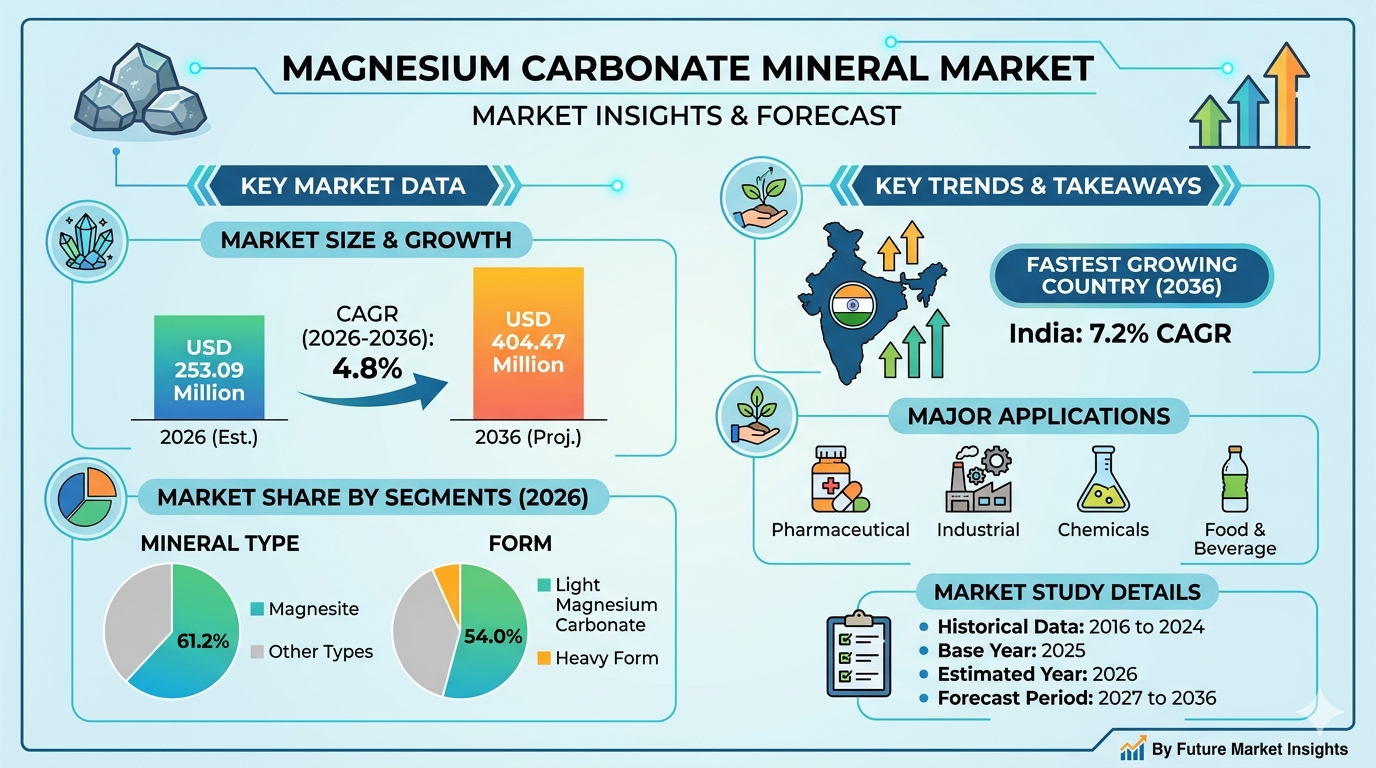
The global magnesium carbonate minerals market is projected to witness strong expansion over the next decade, supported by sustained demand from refractory brick manufacturers servicing steelmaking furnaces and expanding pharmaceutical excipient requirements. The market is expected to grow steadily, reaching approximately USD 404.47 million by 2036, registering a CAGR of 4.8% from 2026 to 2036, according to the latest analysis by Future Market Insights (FMI).
Market growth is being shaped by increasing global demand for over-the-counter digestive health products, growing consumer awareness regarding pharmaceutical quality, and rapid adoption of advanced manufacturing technologies. Magnesium carbonate minerals have evolved from raw industrial materials into highly precise, essential regulatory-compliant components across multiple key industries. While traditional industrial uses like refractory bricks and steel metallurgy flux continue to dominate installations, manufacturers are increasingly integrating advanced systems to satisfy pharmacopoeial standards and high-purity specifications.
Magnesium Carbonate Minerals Market Snapshot (2026–2036)
Market size outlook toward 2036: USD 404.47 million
Forecast CAGR (2026-2036): 4.8%
Dominant mineral category: Magnesite (61.2% market share in 2026)
Fastest-growing segment: Light (Precipitated) Magnesium Carbonate (~54.0% form share in 2026)
Key growth countries: Japan, United Kingdom, United States
Primary demand channel: Refractory Bricks & Kilns, Pharmaceuticals & Personal Care
Incremental Opportunity: USD 151.38 million
Momentum in the Market
Beginning from steady global adoption levels, the magnesium carbonate minerals market demonstrates accelerated growth throughout the forecast period as strict quality compliance becomes mandatory across multiple countries. Between 2026 and 2036, expanding industrial production and rising healthcare needs are expected to significantly boost demand for integrated mineral formulations. Increasing urbanization and higher industrial activity are encouraging governments and manufacturers to prioritize high-grade feedstock technologies.
From 2036 onward, innovation in high-purity chemical processing and integration with advanced synthetic manufacturing platforms is expected to further strengthen market expansion. Highly precise mineral grades capable of adapting processing based on particle size consistency and morphological characteristics are emerging as key differentiators in new commercial applications.
The Reasons Behind the Market’s Growth
Demand for magnesium carbonate minerals is rising due to multiple structural and technological factors reshaping the global industrial and pharmaceutical ecosystem.
Sustained Demand from Refractory Brick Manufacturers
Heavy industries across major nations are maintaining high production capacities, requiring reliable refractory materials to service steelmaking furnaces and kilns. Magnesium carbonate minerals are increasingly becoming a non-negotiable component in stabilizing thermal manufacturing processes.
Expanding Pharmaceutical Excipient Requirements
The rise of consumer wellness and over-the-counter pharmaceuticals is creating steady demand for specific antacid and laxative formulations. High-purity grades that neutralize stomach acid and support mineral supplementation provide excellent safety profiles for consumers.
Strict Regulatory and Quality Compliance
Procurement operations are prioritizing materials that strictly adhere to pharmacopoeial standards. This shift toward strict regulatory compliance ensures a reliable lifecycle across pharmaceutical, food, and chemical sectors.
Growth in the Global Steel and Metallurgical Sector
Rapid expansion of processing hubs is driving large-scale industrial adoption of magnesium carbonate as a metallurgical flux, accelerating use across both established and emerging economic centers.
Top Segment Application Type
Magnesite Leads Market Demand
The magnesite segment accounts for the majority of installations across global markets, supported by its established position as the preferred natural mineral source for magnesium carbonate production through calcination and carbonation processes.
Mineral Type and Form Analysis
Magnesite: Commanding a 61.2% market share in 2026, leading the mineral category.
Light (Precipitated) form: Holding a 54.0% share in 2026, preferred for pharmaceutical and specialty applications requiring controlled physical characteristics.
Heavy (Ground) form: Continues to see consistent demand backed by standard bulk industrial utilities.
Industrial end uses: Driven heavily by refractory bricks, kilns, steel flux, and specialized chemical sectors.
Regional Development: Global Manufacturing Ecosystem Drives Expansion
The global market is rapidly evolving into an interconnected hub for mineral safety and processing components, supported by cost-efficient production and expanding supplier networks.
Japan: Tracks at 3.1% growth, maintaining steady demand from its specialty ceramics and refractory sectors.
United Kingdom: Advances at 2.8% growth, with demand heavily centered on pharmaceutical and personal care grade material.
United States: Operations grow at 2.7%, supported by refractory replacement cycles in domestic steel mills.
Localized manufacturing partnerships between global suppliers and regional industrial entities are improving cost efficiency while accelerating innovation and processing technology adoption.
Challenges, Trends, Opportunities, and Drivers
Drivers
Mandatory adherence to pharmacopoeial and purity standards
Rising industrial manufacturing and steel furnace operations
Increasing global consumer demand for digestive health products
Expansion of high-purity synthetic mineral processing platforms
Opportunities
Smart and sensor-based quality monitoring systems
Ultra-pure grades for sensitive pharmaceutical applications
Lightweight and sustainably processed mineral alternatives
Integration with advanced chemical synthesis platforms
Trends
Transition toward intelligent, precise particle size deployment
Advanced morphological control in precipitation technologies
Increased adoption of multi-grade configurations for custom formulations
Sustainability-focused and lower-emission extraction innovations
Challenges
Cost pressures for entry-level bulk commodity minerals
Complex integration requirements for high-purity pharmaceutical platforms
Compliance with evolving regional and international environmental safety standards
Country Growth Outlook (Global Region)
The market’s growth trajectory is closely tied to industrialization and safety regulation implementation across major economies:
Japan: Specialty ceramics and advanced technological applications leadership.
United Kingdom: Strict pharmaceutical formulation and personal care alignment.
United States: Manufacturing capacity enhancement and steel mill modernization.
The Competitive Environment
The magnesium carbonate minerals market is moderately consolidated, with global mineral technology providers competing through innovation, localized manufacturing, and regulatory compliance. Leading companies are investing heavily in processing technologies, lightweight or pure material forms, and high-compliance safety systems while forming partnerships with industrial manufacturers to strengthen supply chains and accelerate product development.
Future Outlook: Toward Intelligent and Safer Mobility
The magnesium carbonate minerals market is entering a transformative decade shaped by automation, precise formulation requirements, and stricter purity expectations. Future chemical processing systems are expected to function as integrated production modules working alongside advanced quality control technologies. As global mineral markets mature and quality awareness strengthens, magnesium carbonate minerals will remain central to achieving more efficient and safer industrial ecosystems throughout the world.
For a comprehensive strategic outlook and detailed analysis of technological developments shaping the industry, readers can explore the full report on the official Future Market Insights website: https://www.futuremarketinsights.com/reports/magnesium-carbonate-minerals-market

 Arabic
 French
 Spanish
 Portuguese
 Deutsch
 Turkish
 Dutch
Dutch
 Italiano
 Russian
 Romaian
 Portuguese (Brazil)
 Greek
Greek