


SKF Schaeffler NSK and NTN Lead Competitive Landscape of the Expanding Automotive Hub Bearing Market
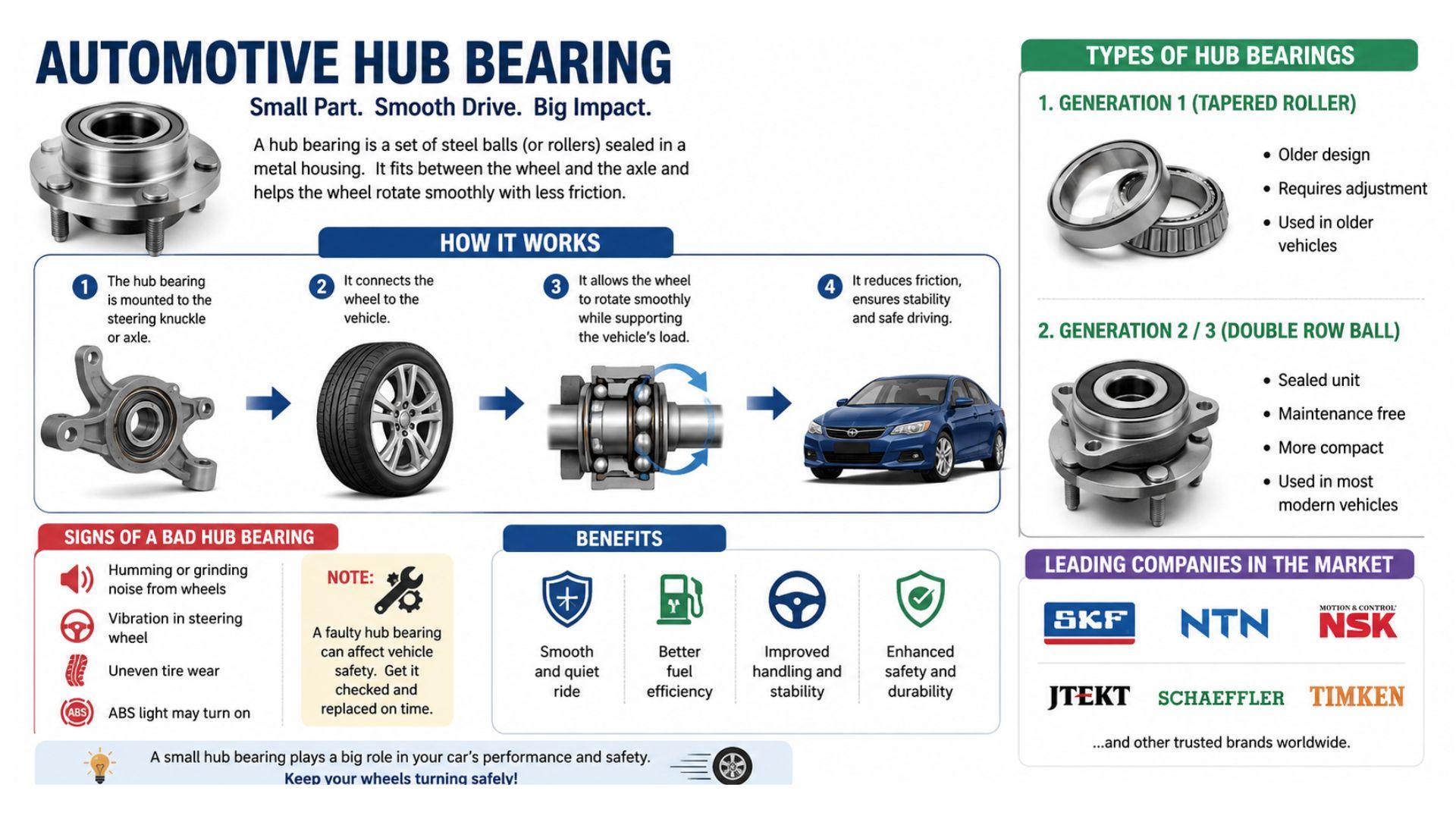
According to Persistence Market Research Insights, the global automotive hub bearing market is estimated to be valued at US$ 9.6 billion in 2026 and is projected to reach US$ 13.1 billion by 2033, expanding at a CAGR of 4.5% during the forecast period from 2026 to 2033.
The automotive hub bearing market comprises wheel hub bearing assemblies that play a critical role in supporting vehicle weight, enabling smooth wheel rotation, and enhancing overall driving stability. Hub bearings are widely used across passenger cars, commercial vehicles, and electric vehicles, making them indispensable components in modern automotive systems. Growing vehicle production, increasing demand for fuel-efficient vehicles, and advancements in wheel-end technologies are expected to drive sustained market growth through 2033.
Market Trends
A key trend influencing the automotive hub bearing market is the growing adoption of lightweight and integrated hub bearing units. Automakers are increasingly focusing on reducing vehicle weight to improve fuel efficiency and comply with stringent emission regulations. As a result, manufacturers are developing advanced hub bearing systems using lightweight materials and integrated sensor technologies.
Another notable trend is the increasing integration of smart hub bearings equipped with sensors capable of monitoring wheel speed, temperature, and vehicle dynamics. These intelligent bearing solutions support advanced driver assistance systems (ADAS), traction control, anti-lock braking systems (ABS), and predictive maintenance capabilities, enhancing vehicle safety and operational efficiency.
Market Drivers
Rising Global Vehicle Production
The steady growth in global vehicle production remains one of the primary drivers of the automotive hub bearing market. Expanding urban populations, rising disposable incomes, and increasing vehicle ownership across emerging economies continue to create strong demand for automotive components, including hub bearings.
Passenger vehicles account for a substantial share of hub bearing demand due to their large production volumes worldwide. Simultaneously, growing sales of commercial vehicles driven by logistics, e-commerce, and infrastructure development projects are further supporting market expansion.
Growing Adoption of Electric Vehicles
The rapid shift toward vehicle electrification is creating significant opportunities for hub bearing manufacturers. Electric vehicles require high-performance bearing systems capable of handling increased loads, minimizing friction, and supporting enhanced efficiency requirements.
Automotive manufacturers are increasingly investing in advanced hub bearing technologies that contribute to improved vehicle range, reduced energy consumption, and quieter operation, making them particularly suitable for electric mobility applications.
Market Restraints and Challenges
Fluctuating Raw Material Prices
One of the major challenges faced by market participants is the volatility in raw material prices. Hub bearings rely heavily on high-grade steel and specialized alloys, making manufacturers vulnerable to fluctuations in commodity markets. Rising input costs can negatively impact profit margins and increase production expenses.
Intense Market Competition
The automotive hub bearing industry is highly competitive, with numerous global and regional manufacturers competing on pricing, product innovation, and quality. This competitive environment often creates pressure on profit margins while requiring continuous investments in research and development.
Additionally, stringent automotive quality standards and regulatory requirements necessitate ongoing product testing and certification, increasing operational complexity for manufacturers.
Get Free Sample Now: https://www.persistencemarketresearch.com/samples/32523
Market Opportunities
Expansion of Connected and Autonomous Vehicles
The increasing deployment of connected and autonomous vehicles presents substantial growth opportunities for the automotive hub bearing market. Advanced vehicles require sophisticated wheel-end systems integrated with sensors and electronic monitoring technologies.
Manufacturers developing smart hub bearing solutions capable of supporting vehicle connectivity, real-time diagnostics, and autonomous driving functions are expected to gain a competitive advantage in the coming years.
Aftermarket Growth Potential
The growing global vehicle parc is creating strong demand for replacement hub bearings. Since wheel bearings experience wear over time due to continuous operation, maintenance and replacement activities generate significant aftermarket revenue opportunities for suppliers and distributors worldwide.
Segmentation Analysis
By Product Type
The hub bearing unit segment dominates the market owing to its compact design, ease of installation, and improved performance characteristics. Integrated hub bearing assemblies have become increasingly popular among vehicle manufacturers seeking enhanced reliability and reduced maintenance requirements.
The sensor-integrated hub bearing segment is expected to witness the fastest growth during the forecast period due to rising adoption of ADAS and vehicle safety technologies.
By Vehicle Type
Passenger cars represent the largest market segment, supported by high production volumes and increasing consumer demand worldwide. The growing popularity of SUVs and crossover vehicles is also contributing to demand for advanced hub bearing systems.
Commercial vehicles are projected to experience steady growth, driven by expanding transportation networks, industrial activities, and freight movement requirements.
By Sales Channel
The OEM segment maintains market leadership due to direct integration of hub bearings during vehicle manufacturing. Automakers continue to prioritize durable and high-performance bearing solutions to improve vehicle reliability.
The aftermarket segment is expected to record significant growth as aging vehicle fleets increase replacement demand across both developed and emerging markets.
By Application
Front-wheel hub bearings account for a significant market share due to their critical role in steering and vehicle control systems. Rear-wheel hub bearings also contribute substantially to overall market demand, particularly in commercial and all-wheel-drive vehicle applications.
Regional Outlook
Asia Pacific
Asia Pacific is expected to dominate the automotive hub bearing market throughout the forecast period. The region benefits from strong automotive manufacturing activity, growing vehicle ownership, and expanding electric vehicle production in countries such as China, India, Japan, and South Korea.
China remains the largest contributor due to its extensive automotive production ecosystem and aggressive investments in electric mobility.
Europe
Europe represents the second-largest market, supported by stringent vehicle safety standards, technological innovation, and increasing adoption of electric vehicles. The region's strong automotive manufacturing base continues to drive demand for advanced hub bearing technologies.
Germany, France, and the United Kingdom remain key contributors to regional growth.
North America
North America is expected to witness stable growth driven by consistent vehicle production, rising adoption of advanced automotive technologies, and strong aftermarket demand. The United States continues to lead regional market expansion owing to its large automotive industry and growing EV adoption.

 English
 Arabic
 French
 Spanish
 Deutsch
 Turkish
 Dutch
Dutch
 Italiano
 Russian
 Romaian
 Portuguese (Brazil)
 Greek
Greek