


The Real Cost of an UberEats Clone App: Pricing Breakdown for 2026
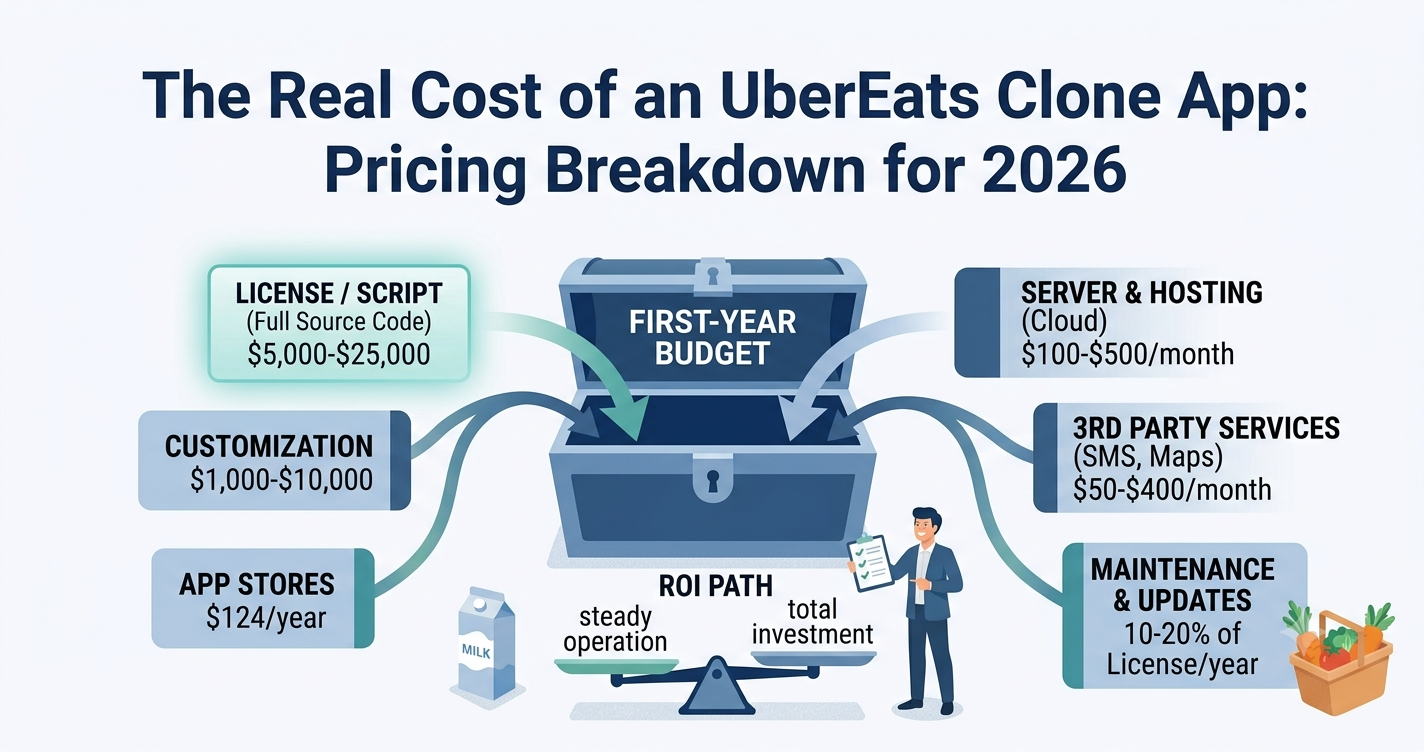
Ask five vendors what an UberEats Clone costs and you will get five answers ranging from $3,000 to $50,000. All of them can be technically true, because "cost" in this market hides a dozen line items that sellers rarely volunteer. Founders who budget only for the script price routinely discover the real first-year figure is 40-70% higher.
This breakdown lists every cost you will actually face in 2026 - license, customization, infrastructure, stores, maintenance, and marketing - plus the hidden charges that catch first-time buyers, and the ROI math that puts it all in perspective.
Why Clone Pricing Varies So Wildly
An UberEats Clone is a pre-built white-label platform, so you are not paying for development hours - you are paying for a license, branding, configuration, and support. Price differences come from what is included: number of apps (customer, driver, restaurant, admin), source code ownership, native versus hybrid builds, and how much customization the base package covers.
A $3,000 offer usually means a rented, hosted script with no source code. A $10,000-$25,000 UberEats Clone package from an established food ordering app development company typically includes full source code, all four applications, branding, and launch support. Knowing which one you are quoted is half the battle.
The Full Cost Anatomy
Here is what a realistic first-year budget looks like for a single-city UberEats Clone launch:
|
Cost Item |
Typical Range (2026) |
One-Time or Recurring |
|
License / script (full source code) |
$5,000 - $25,000 |
One-time |
|
Customization and branding |
$1,000 - $10,000 |
One-time |
|
Server and hosting (cloud) |
$100 - $500 / month |
Recurring |
|
App store accounts |
$99/year (Apple) + $25 (Google, once) |
Mixed |
|
Third-party services (SMS, maps, push) |
$50 - $400 / month |
Recurring |
|
Maintenance and updates |
10-20% of license / year |
Recurring |
|
Launch marketing (first 90 days) |
$2,000 - $10,000 |
One-time |
License and Source Code
The core purchase. Insist on full source code delivery - it is the difference between owning an asset and renting one. Rented SaaS-style clones look cheaper monthly but leave you unable to migrate, customize deeply, or resell.
Customization
Logo, color scheme, and app name are usually included. Costs rise when you change workflows: custom loyalty logic, a new payment gateway for your country, or region-specific tax rules. Get customization quoted per feature in writing before signing.
Infrastructure and Third-Party Services
Your platform needs a cloud server, and per-use services add up: Google Maps API calls, SMS OTP verification, and payment gateway fees of roughly 2-3% per transaction. At low volume this runs $150-$400 a month; budget more as orders grow.
Hidden Costs to Watch For
These are the items that inflate "cheap" quotes after you have paid:
• App store submission fees - some vendors charge $500-$1,000 extra to publish under your accounts
• Per-update charges - OS updates break unmaintained apps; check whether iOS and Android compatibility updates are included
• Payment gateway integration - a "supported" gateway is not always a "pre-integrated" one
• Licensing limits - single-domain or single-city licenses that require a second purchase to expand
• Support expiry - free support for 3 months, then $150+/hour for every bug ticket
• White-labeling fees - a few vendors charge separately to remove their own branding
None of these are dealbreakers individually. Undisclosed, together, they can double your budget.
Clone vs Custom Development: The Price Gap
For context, building the same four-app platform from scratch costs $80,000-$200,000 and takes 9-12 months with a development agency. The UberEats Clone route delivers 90% of the same functionality for 10-15% of the cost in under two months. Custom development only makes sense when your business model genuinely cannot be expressed through configuration - which is rare in food delivery.
The ROI Perspective
Cost only means something against revenue. Take a conservative UberEats Clone marketplace scenario:
- Total first-year investment: $20,000 (license, customization, hosting, marketing)
- Platform reaches 3,000 orders/month by month six, average order $25
- Revenue at 12% commission plus $2.50 average delivery fee: about $16,500/month
- After driver payouts and processing costs, platform keeps roughly $4,000-$6,000/month
On those numbers the software pays for itself in month four or five of steady operation. A restaurant using the same platform to replace 25-30% aggregator commissions on 600 monthly orders recovers the cost even faster - often within a single quarter.
How to Budget Smartly in 2026
Three rules keep projects on track. First, get an itemized quote covering everything in the table above - a serious food ordering app development company will provide one without being chased. Second, reserve 30% of your total budget for the first 90 days of marketing; the best app earns nothing without orders. Third, prefer full source code plus an annual support contract over any rental arrangement you plan to build a business on.
Frequently Asked Questions
What is the minimum realistic budget for launching in 2026?
Plan on $10,000-$15,000 all-in for a lean single-city launch: a quality script with source code, basic branding, hosting, store accounts, and a modest marketing push. Quotes far below that usually exclude source code, support, or publication - the gaps surface as invoices later.
Why do some UberEats Clone scripts cost $3,000 and others $25,000?
The spread reflects ownership and completeness. Low-end offers are typically rented code, hybrid builds, or customer-app-only packages. Higher-tier pricing includes all four applications, full source code, native performance, documented APIs, and months of support. Compare inclusions line by line, never headline prices.
Are there ongoing monthly costs after launch?
Yes. Expect $250-$900 per month covering cloud hosting, SMS and map API usage, and prorated maintenance. Payment gateways also take 2-3% per transaction. These scale with order volume, which is healthy - costs grow only when revenue does.
Does customization always cost extra?
Branding-level changes - name, logo, colors, currency, language - are normally included. Structural changes such as new user roles, custom reports, or an unusual commission logic are billed separately, usually $25-$50 per hour. Define your must-have customizations before purchase so they enter the fixed quote.
How does clone ROI compare with joining aggregators instead?
Aggregators cost nothing upfront but take 15-30% of every order forever. A one-time $15,000 platform investment equals the commission a moderately busy restaurant pays an aggregator in four to six months. Past that crossover point, the owned platform compounds savings while the aggregator model compounds costs.

 Arabic
 French
 Spanish
 Portuguese
 Deutsch
 Turkish
 Dutch
Dutch
 Italiano
 Russian
 Romaian
 Portuguese (Brazil)
 Greek
Greek