


Digital Product Strategy Consulting: Turning Business Goals Into a Product Roadmap Engineering Can Execute
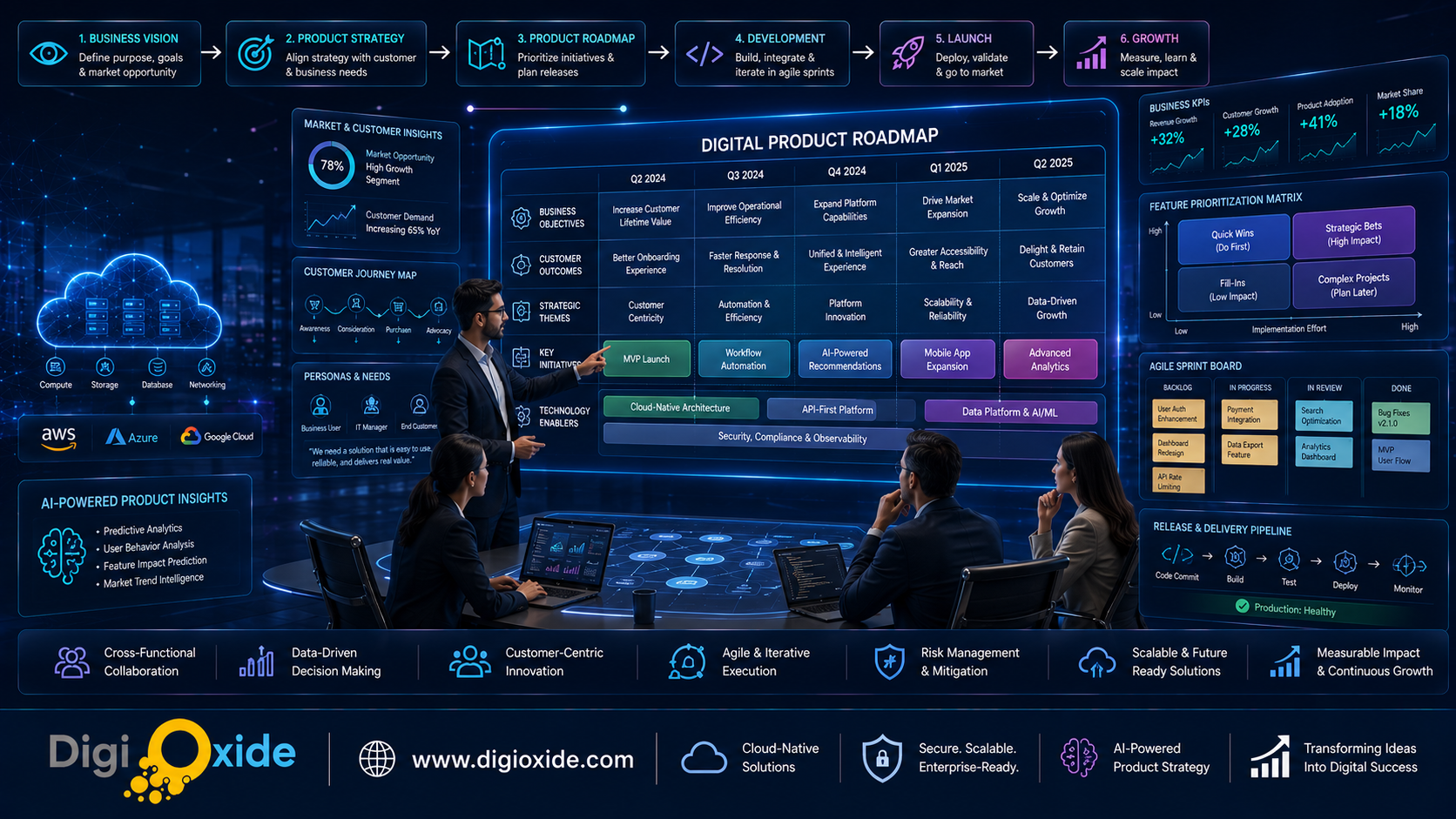
The gap between a business objective and a product roadmap that engineering teams can execute against is wider than most organizations expect. Business goals describe outcomes. Product roadmaps describe features. The work of translating one into the other, determining which features serve which outcomes, in what sequence, at what level of scope, requires a discipline that sits at the intersection of business strategy, user research, and technical feasibility. Digioxide's digital product strategy consulting helps organizations close this gap with clarity rather than assumptions, producing roadmaps that are grounded in user needs, connected to measurable business outcomes, and scoped to what engineering can realistically deliver. This article explains what product strategy consulting involves, where it is most valuable, and how to distinguish a genuinely useful engagement from one that produces an impressive document that never influences what gets built.
What Digital Product Strategy Consulting Actually Does
Digital product strategy consulting is commonly confused with two adjacent activities: digital transformation consulting, which is broader, and product management, which is more operational. Understanding the distinction clarifies what product strategy consulting can and cannot do.
Digital transformation consulting addresses how a business changes its model, processes, and organization to operate effectively in a digital environment. Product strategy consulting is narrower: it focuses specifically on the digital product or products the organization offers to users or customers, defining what those products should do, for whom, and in what priority order.
Product management is the ongoing function of making these decisions continuously throughout a product's lifecycle. Product strategy consulting is a bounded engagement that establishes the strategy framework, the product vision, the prioritization criteria, and the roadmap at a point in time, giving the product management function a foundation to work from rather than replacing it.
The deliverables of a product strategy consulting engagement vary by organization and need, but typically include a product vision statement that defines what the product is and what it is for, user research findings that ground the strategy in actual user needs rather than assumptions, a prioritized feature roadmap that sequences the work of realizing the vision, success metrics that define what the product must achieve at each stage, and a strategic rationale document that explains the logic behind the prioritization decisions.
Where Product Strategy Consulting Creates the Most Value
Product strategy consulting is most valuable in specific organizational contexts. Understanding these contexts helps organizations decide whether they need it and what form it should take.
The most common context is a new product or product line where the organization has a business objective but has not yet defined what the product should be. A business that wants to enter a new market, digitize a previously offline service, or build a platform that connects two sides of a marketplace needs to define the product before it can build it. Product strategy consulting provides the structured process for making these definitions rigorously rather than through intuition or executive preference.
The second common context is a product that has grown organically without a clear strategy and has accumulated features without a coherent vision. Products that have been built reactively, adding whatever stakeholders requested without a framework for evaluating what should and should not be built, often reach a state where they serve no user group particularly well because they have tried to serve all user groups simultaneously. Product strategy consulting provides the external perspective and structured process needed to step back from the accumulated features and define what the product should actually be.
The third context is a product at an inflection point: a pivot, a major expansion into a new user segment, or a competitive response that requires rethinking the product's positioning. Organizations at these inflection points benefit from external facilitation of the strategic conversation rather than having it managed entirely internally, where existing perspectives and organizational dynamics can constrain the range of options considered.
The Discovery Process: Understanding Users Before Defining Features
The most common failure mode in product strategy is defining features before understanding users. The result is a roadmap based on assumptions about what users need rather than evidence of what they actually do and where they struggle. A product strategy consulting engagement that does not include rigorous user research is producing a strategy that the organization believes is correct rather than one that evidence supports.
User research in a product strategy context takes several forms depending on the product and the questions that need to be answered. Qualitative research including user interviews and observational research answers questions about how users currently accomplish the jobs the product is intended to help with, what frustrations they encounter, and what they actually value. These methods produce rich understanding of user behavior but do not answer questions about how many users experience a specific problem or how representative a specific user's experience is of the broader population.
Quantitative research including surveys and analysis of existing product analytics answers questions about the distribution of user behavior and the relative frequency of specific experiences. For established products with existing users, analytics data is often the richest source of quantitative insight, revealing patterns in how users move through the product, where they drop off, and which features are actually used versus which were expected to be used.
Jobs to be done framing, which defines user needs in terms of the functional, emotional, and social jobs users are trying to accomplish rather than in terms of product features, provides a useful organizing framework for user research findings. When user needs are defined as jobs, the connection between a feature and the user need it serves is explicit, which makes trade-off decisions between features more defensible.
Prioritization Frameworks: Making Trade-Offs Explicit
The most politically fraught part of product strategy is prioritization. Every stakeholder has features they believe should be built first. Every business unit has requirements they believe are critical. Product strategy consulting provides the frameworks and the external facilitation that make trade-off decisions explicit and grounded in shared criteria rather than in organizational politics.
The most widely used prioritization frameworks in product strategy include impact-effort matrices, which plot features on two dimensions to identify high-impact, low-effort opportunities that should be prioritized over high-effort, low-impact ones; RICE scoring, which combines reach, impact, confidence, and effort into a numerical score that makes comparisons between features more systematic; and opportunity scoring, which prioritizes opportunities based on the gap between how important users rate a job and how satisfied they are with current solutions.
The right framework depends on the organization's culture and the nature of the trade-offs being made. What all frameworks share is the function of making the criteria for prioritization explicit before applying them to specific features. When the criteria are agreed upon before the features are scored, the scoring process is significantly less politically charged than when different stakeholders are applying different implicit criteria to the same decision.
Facilitated workshops that bring key stakeholders together to apply a shared prioritization framework to the product backlog produce decisions that have broader organizational buy-in than decisions made by a small product team in isolation. Stakeholders who understand and agree with the criteria used to prioritize the roadmap are more likely to support the result, even when their preferred features did not make the near-term roadmap.
Roadmap Structure: Outcomes Over Features
A product roadmap structured around outcomes rather than features is more durable, more useful, and more aligned with the organization's business goals than one structured around a list of features with dates.
Feature-based roadmaps commit the team to building specific things rather than to achieving specific outcomes. When circumstances change, as user research reveals a different need or as technical constraints change what is feasible, feature-based roadmaps become liabilities. The team is committed to building something that may no longer be the right answer.
Outcome-based roadmaps commit the team to achieving specific measurable outcomes within a defined timeframe. The features that will achieve those outcomes are determined closer to the time of building, when the team has more information about what will work. This structure is more adaptable to new information while remaining clearly connected to the business objectives the product is designed to serve.
A well-structured roadmap has three time horizons with different levels of specificity. The near-term horizon, typically the next one to three months, specifies features and deliverables at the level of detail that engineering can execute against. The mid-term horizon, three to twelve months, describes outcomes and major initiatives without committing to specific feature implementations. The long-term horizon, beyond twelve months, describes strategic bets and directional priorities without specific commitments.
This structure acknowledges a practical reality: the farther in the future a commitment is made, the less information is available to make it well. Roadmaps that are equally specific about features twelve months in the future as they are about features next month create false precision that gives stakeholders unrealistic expectations.
Aligning Product Strategy With Engineering Constraints
A product strategy that does not account for engineering constraints is not a strategy. It is a wish list. Effective product strategy consulting integrates technical feasibility assessment into the strategy development process rather than treating it as a separate constraint that limits a strategy developed independently.
Technical feasibility assessment at the strategy level does not require detailed engineering estimates. It requires enough understanding of the current technical architecture to identify which strategic directions are compatible with it and which require significant rearchitecting. A strategy that depends on real-time personalization for a product built on a batch processing architecture requires either accepting the architectural investment needed to support real-time capabilities or revisiting the strategy.
Including engineering leadership in the strategy process, rather than presenting the strategy to engineering after it has been finalized, produces strategies that are better calibrated to technical reality and that have stronger engineering buy-in. Engineers who understand why a strategic direction was chosen and what user needs it is designed to serve make better implementation decisions than engineers who receive requirements without context.
Technical debt is a relevant input to strategy. A product architecture that requires significant remediation before new capabilities can be built on top of it needs a strategy that accounts for this reality. Strategies that ignore existing technical debt consistently underestimate the timelines for achieving their objectives, because the debt must be addressed either explicitly, through deliberate remediation, or implicitly, through the slowdown it creates in delivery of new capabilities.
Measuring the Effectiveness of a Product Strategy Engagement
A product strategy consulting engagement should be evaluated not just on the quality of the deliverables but on whether those deliverables actually influence product decisions after the engagement concludes.
The most reliable indicator of effectiveness is whether the roadmap produced by the engagement is actually being followed six months later. Roadmaps that influence what gets built demonstrate that the strategy was grounded in organizational reality and had genuine stakeholder alignment. Roadmaps that are filed and ignored demonstrate that the engagement produced documentation rather than shared direction.
Decision quality is a harder metric to measure but a meaningful one. Are product decisions being made with reference to the strategic framework the engagement produced? Are new feature requests evaluated against the prioritization criteria rather than being added based on whoever made the most persuasive case? A strategy that becomes the reference point for ongoing product decisions has been effective.
User and business outcomes at the metrics defined in the strategy provide the ultimate measure of whether the strategy was correct. If the features built according to the strategy produce the user and business outcomes they were designed to produce, the strategy worked. If they do not, the strategy contained assumptions that did not hold, which is useful information for the next strategy iteration regardless of how sophisticated the analysis that produced it appeared to be.
FAQ
How long does a digital product strategy consulting engagement typically take?
A focused engagement for a single product or product line typically runs six to twelve weeks. This includes the discovery and research phase, which takes three to five weeks, the analysis and strategy development phase, which takes two to four weeks, and the roadmap development and stakeholder alignment phase, which takes one to three weeks. Engagements involving multiple products, complex organizational dynamics, or extensive user research may take longer.
How do we know if we need product strategy consulting or just product management support?
Product strategy consulting is appropriate when the organization needs to define or redefine the direction of a product and lacks the internal resources or perspective to do so effectively. Product management support is appropriate when the direction is defined and the organization needs ongoing operational execution of that direction. If the question is "what should we build?" the answer is strategy consulting. If the question is "how do we build it efficiently?" the answer is product management support.
Can digital product strategy consulting work for internal tools, not just customer-facing products?
Yes. Internal tools have users, user needs, and business objectives just as customer-facing products do, and the strategic questions, what should the tool do, for whom, in what priority order, are the same. The research methods differ slightly because internal users are more accessible for research than external customers, but the strategic framework is the same. Internal tools that are built without a strategy produce the same class of problems as customer-facing products built without one.
What should we do with the strategy if our market changes significantly after it is produced?
A strategy that was developed before a significant market change may need to be revisited. The useful components are typically the user research findings, which are durable as long as the user group remains similar, and the prioritization framework, which can be reapplied to a new set of opportunities. The specific feature roadmap should be reviewed against the new market context and adjusted where the strategic rationale no longer holds. A strategy produced by a good consulting engagement should be designed to be a living document that can be updated incrementally, not a static artifact that must be discarded when circumstances change.
How involved should executives be in the product strategy consulting engagement?
Executive involvement is most valuable at the beginning and end of the engagement: at the beginning to align on the business objectives the strategy is designed to serve, and at the end to review and endorse the roadmap before it is communicated to the broader organization. Executive involvement throughout the engagement risks anchoring the strategy to existing executive preferences rather than allowing the user research and strategic analysis to surface new perspectives. The most effective structure is an executive kickoff, a mid-point alignment check, and a final presentation, with the substantive strategy work conducted with product and engineering leadership in the middle.

 Arabic
 French
 Spanish
 Portuguese
 Deutsch
 Turkish
 Dutch
Dutch
 Italiano
 Russian
 Romaian
 Portuguese (Brazil)
 Greek
Greek