In precision machining, the material you choose for soft jaws can make the difference between producing flawless components and dealing with costly scrap. Whether you're machining aerospace parts, automotive components, medical devices, or custom prototypes, selecting the right soft jaw material directly impacts gripping force, surface finish, machining accuracy, and production efficiency.
Different workpieces require different jaw materials. While aluminum works well for general-purpose machining, plastics, brass, copper, and advanced composites each offer unique advantages depending on the application. Understanding these materials helps reduce part damage, improve repeatability, and extend the life of your workholding setup.
This guide explains how to choose the best material for special soft jaws, ensuring better performance and lower manufacturing costs.
The High Cost of Part Damage
Modern CNC machining often involves expensive materials with tight tolerances and premium surface finishes. Even a minor scratch or clamp mark can make an entire part unusable.
The Risk of Marring High-Finish Parts
Industries such as aerospace, medical, electronics, and precision manufacturing require components with exceptional surface quality. Traditional steel jaws can easily leave visible marks, dents, or pressure points on polished or finished surfaces.
When clamping delicate materials like aluminum, titanium, brass, or coated components, excessive pressure from hard jaws frequently results in:
- Surface scratches
- Cosmetic defects
- Dimensional distortion
- Expensive rework
- Complete part rejection
For high-value components, these defects quickly increase manufacturing costs.
Why Standard Steel Jaws Fail Delicate Workpieces
Steel jaws are designed for durability, not surface protection. Their hardness often exceeds that of the workpiece, concentrating clamping pressure into small contact areas.
Problems include:
- Permanent indentation
- Reduced gripping conformity
- Uneven clamping force
- Increased vibration during machining
Replacing standard jaws with appropriately selected soft jaws distributes pressure more evenly while protecting the part surface.
Material Choice Can Reduce Scrap Rates
Manufacturers that match jaw materials to their workpieces commonly report:
- 15–20% lower scrap rates
- Better dimensional consistency
- Improved surface finish
- Reduced setup adjustments
- Longer production runs with fewer defects
Material selection is one of the simplest ways to improve machining efficiency.
Aluminum Alloys for General Purpose Grip
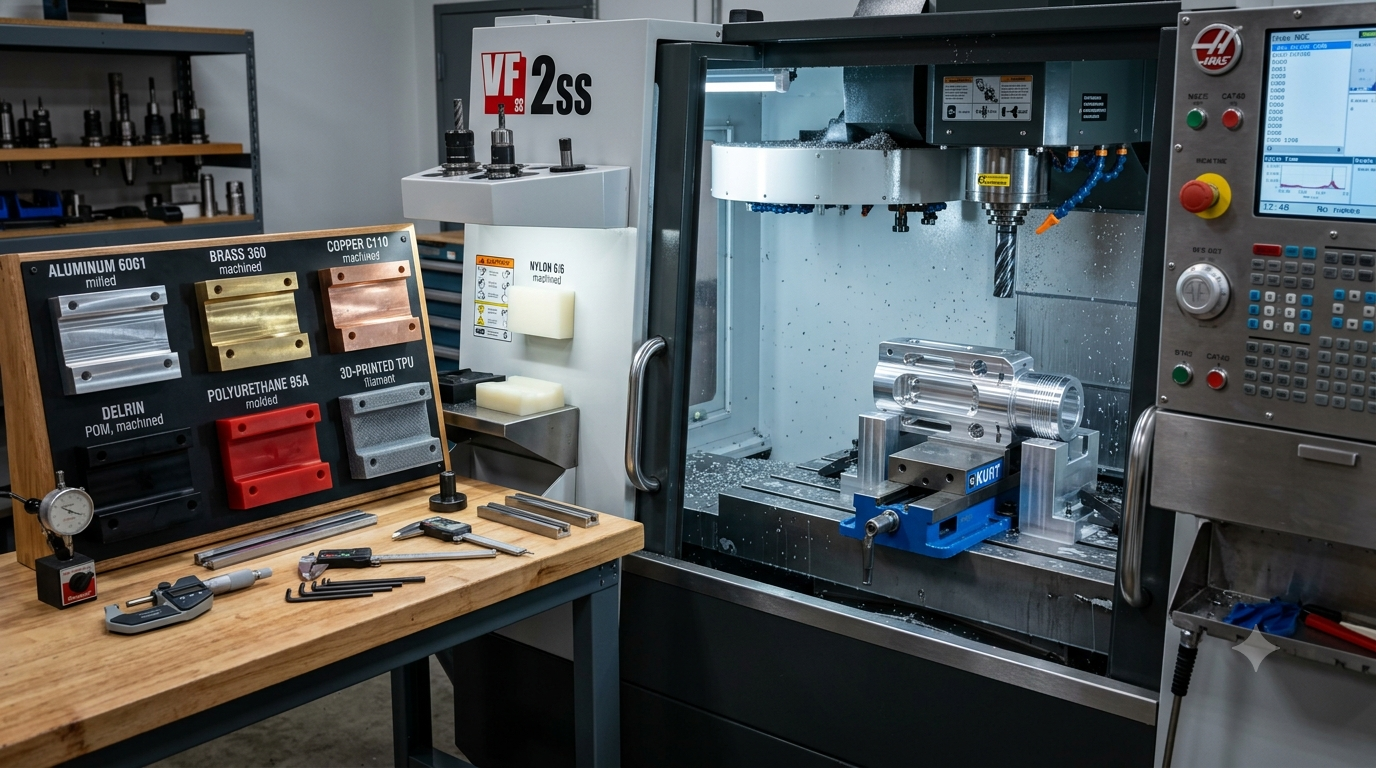
Aluminum remains the most widely used material for custom soft jaws because it offers an excellent combination of strength, machinability, and affordability.
Common 6061 and 7075 Grades
6061 Aluminum
6061 is the standard choice for most machining operations because it provides:
- Excellent machinability
- Good corrosion resistance
- Easy customization
- Lower cost
It works particularly well for:
- Production fixtures
- CNC milling
- General turning
- Prototype work
7075 Aluminum
7075 aluminum offers significantly higher strength while maintaining relatively low weight.
It is ideal for:
- Heavy clamping loads
- High-speed machining
- Larger workpieces
- Repeated production cycles
Although more expensive than 6061, it lasts longer in demanding applications.
Weight vs. Strength
Compared with steel, aluminum provides:
- Lower machine weight
- Faster setup changes
- Reduced spindle load
- Easier jaw replacement
This balance makes aluminum suitable for everyday machining operations.
When to Choose Aluminum Instead of Plastic
Choose aluminum when:
- Moderate clamping pressure is required
- Higher machining accuracy is needed
- Jaws require repeated modifications
- Production volumes are medium to high
Plastic jaws remain better for extremely delicate surfaces.
Industrial Plastics and Polymers
Plastic soft jaws are increasingly popular because they prevent cosmetic damage while still providing reliable workholding.
Nylon and Delrin for Non-Marring Applications
Nylon
Nylon offers:
- Good wear resistance
- Moderate flexibility
- Low friction
- Excellent impact resistance
It works well for:
- Aluminum parts
- Plastic components
- Finished surfaces
- Thin-wall workpieces
Delrin (Acetal)
Delrin provides:
- Better dimensional stability
- Higher stiffness
- Excellent machinability
- Moisture resistance
It performs particularly well in precision machining environments.
Polyurethane for High-Grip Applications
Polyurethane combines softness with excellent friction.
Advantages include:
- High gripping force
- Excellent vibration damping
- Surface protection
- Reduced part slippage
It is commonly used for:
- Thin tubing
- Glass components
- Composite materials
- Irregular workpieces
Understanding Shore Hardness
Industrial plastics are measured using Shore hardness.
Shore A
Used for softer materials such as:
- Rubber
- TPU
- Flexible polyurethane
Lower Shore A numbers indicate greater flexibility.
Shore D
Used for harder engineering plastics including:
- Nylon
- Delrin
- Hard polyurethane
Higher Shore D values provide better structural rigidity while maintaining surface protection.
Understanding hardness helps manufacturers choose jaws that grip securely without damaging the workpiece.
Copper and Brass for Specialty Work
Soft metal jaws provide an ideal compromise between durability and surface protection.
Preventing Surface Scratches
Copper and brass deform slightly under clamping pressure, allowing them to conform to part geometry.
Benefits include:
- Reduced marking
- Better pressure distribution
- Increased grip stability
- Improved repeatability
These materials are especially useful when machining polished metals.
Thermal Conductivity Benefits
Copper offers excellent thermal conductivity.
During machining, it helps:
- Dissipate localized heat
- Reduce thermal distortion
- Stabilize sensitive components
- Improve dimensional accuracy
This makes copper particularly valuable when machining heat-sensitive alloys.
Aerospace Case Study
Consider an aerospace manufacturer machining precision aluminum housings.
Steel jaws created visible clamp marks that required manual polishing, increasing production time.
After switching to custom copper soft jaws:
- Surface damage was eliminated
- Rework time dropped significantly
- Part consistency improved
- Production efficiency increased
Although copper jaws wore faster, the savings from reduced scrap far outweighed replacement costs.
Advanced Composites and 3D Printed Materials
Modern manufacturing increasingly relies on custom workholding solutions made from advanced materials.
Carbon Fiber Reinforced Filaments
Carbon-fiber reinforced polymers provide:
- High stiffness
- Lightweight construction
- Excellent dimensional stability
- Low thermal expansion
These materials are ideal for custom fixtures requiring strength without excessive weight.
TPU for Organic Shapes
Thermoplastic Polyurethane (TPU) offers remarkable flexibility.
Applications include:
- Medical devices
- Curved components
- Delicate housings
- Custom product designs
Its flexibility allows jaws to conform to unusual shapes while maintaining secure grip.
Rapid Prototyping with 3D Printing
Additive manufacturing enables engineers to produce custom soft jaws within hours instead of days.
Benefits include:
- Faster design iterations
- Lower prototype costs
- Easy customization
- On-demand manufacturing
This approach is particularly valuable for low-volume production and one-off machining jobs.
Matching Material to Workpiece Hardness
Selecting jaw material should always begin with evaluating the workpiece itself.
Follow the "Softer Jaw, Harder Part" Rule
A simple guideline is:
The jaw should generally be softer than the component being clamped.
This reduces:
- Surface damage
- Pressure marks
- Distortion
- Cosmetic defects
The softer jaw absorbs clamping pressure instead of transferring it directly to the workpiece.
Calculating Proper Clamping Pressure
Excessive force is one of the leading causes of deformation.
Factors to consider include:
- Material yield strength
- Contact area
- Part thickness
- Jaw geometry
- Machining forces
Applying only the necessary clamping force minimizes distortion while maintaining secure positioning.
Expert Tip: Use Sacrificial Liners
Instead of replacing expensive custom jaws, many machinists install inexpensive sacrificial liners.
Benefits include:
- Lower replacement cost
- Faster maintenance
- Improved flexibility
- Extended jaw life
Liners can be replaced quickly once they become worn or damaged.
Maximizing Jaw Life and Performance
Even the best material requires proper maintenance.
Keep Jaws Clean
Metal chips, coolant residue, and abrasive particles gradually reduce gripping performance.
Routine cleaning should include:
- Removing machining debris
- Wiping contact surfaces
- Inspecting mounting bolts
- Checking alignment
Clean jaws provide more consistent clamping.
Watch for Material Fatigue
Over time, all jaw materials wear out.
Common warning signs include:
- Visible cracks
- Permanent deformation
- Uneven wear patterns
- Reduced gripping accuracy
- Frequent part movement
Replacing worn jaws before failure prevents costly production errors.
Material Selection Checklist
Before choosing a soft jaw material, ask:
- What is the workpiece material?
- How delicate is the surface finish?
- How much clamping force is required?
- Will the jaws be reused or customized frequently?
- Is heat generation a concern?
- What production volume is expected?
- Is rapid prototyping beneficial?
Answering these questions ensures you select the most suitable material for both performance and cost efficiency.
Conclusion
Choosing the right material for soft jaws is essential for protecting workpieces, improving machining accuracy, and maximizing production efficiency. Aluminum alloys offer excellent versatility for general machining, while engineering plastics provide superior protection for delicate parts. Copper and brass excel in specialty applications where surface finish is critical, and advanced composites and 3D-printed materials deliver unmatched customization for complex workholding challenges.
By following the principle of matching jaw material to workpiece hardness, applying the correct clamping pressure, and maintaining jaws properly, manufacturers can reduce scrap rates by up to 20%, improve part quality, and extend the life of their workholding systems. Investing in the right soft jaw material is not just about preventing damage—it's a practical strategy for achieving more consistent, cost-effective, and high-quality machining results.




 Arabic
 French
 Spanish
 Portuguese
 Deutsch
 Turkish
 Dutch
Dutch
 Italiano
 Russian
 Romaian
 Portuguese (Brazil)
 Greek
Greek