


From Backyard to Baseline: Vision-Based Training Explained
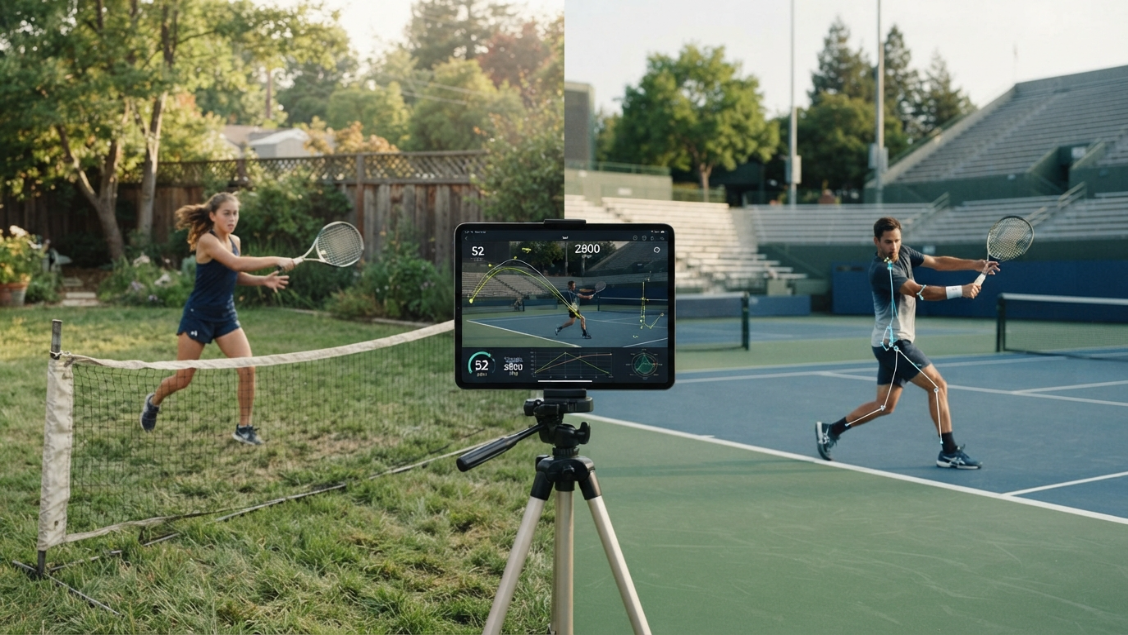
The idea of a machine that can "watch" a tennis player and respond accordingly sounds like something out of a professional training facility, but it's increasingly available as consumer-grade equipment. A vision-based tennis trainer uses cameras and sensing technology to track a player's position and movement during a session, adjusting drills based on where someone actually is on the court rather than firing on a fixed schedule.
Dual-camera systems paired with positioning sensors allow this kind of equipment to do something older ball machines simply couldn't: simulate an opponent. Instead of feeding the same shot to the same spot repeatedly, a vision-enabled machine can vary placement based on court coverage drills, forcing a player to move and recover the way they would during an actual point, rather than standing in one spot repeating a stroke over and over without any real movement demand.
Shot analysis is where this becomes genuinely useful for improvement, not just novelty. Data on shot placement, consistency, and pace over a session gives a player concrete feedback rather than a subjective sense of "that felt good." Coaches have used video review for this kind of analysis for years; built-in tracking simply makes it available during practice itself, without needing someone to review footage afterward. For a player training alone, that immediate feedback loop is often the closest substitute available for a coach standing courtside.
For anyone comparing what's realistically available in this category, the broader range at Tenniix is a useful reference point, since it shows the difference between basic feeding machines and full vision-based systems designed for adaptive, opponent-style drilling.
Full-court training is the other major shift this technology enables. Older machines were largely limited to baseline groundstroke repetition. Systems with wider tracking range and varied feed patterns can support approach shots, passing shots, and recovery drills that more closely resemble actual match situations, closing some of the gap between practice and competition that purely repetitive drilling never addressed.
Adaptive opponent simulation also opens up tactical practice that used to require a live hitting partner willing to run specific patterns repeatedly. A player working on defending against short balls followed by deep drives, for example, can now structure that exact sequence into a solo session, refining footwork and shot selection under something close to real match pressure.
None of this eliminates the value of human coaching or real match play, but it does change what's possible during unsupervised, independent practice time — turning what used to be simple repetition into something closer to a structured, responsive training session.
It's worth pointing out that this shift has happened gradually rather than overnight. Early versions of vision-assisted equipment were often bulky, expensive, and limited to professional training centers, while current consumer-grade systems have become considerably more compact and affordable without giving up much of the core tracking capability. That progression is part of why this technology has moved from a novelty to something increasingly common among serious recreational players rather than remaining a professional-only tool.
For players deciding whether to invest in a vision-based system versus a simpler feeding machine, it can help to think about training goals over the next year or two rather than just the immediate season. A player actively working toward competitive play is likely to outgrow a purely repetition-based machine faster than one focused mainly on casual, recreational hitting, which makes the added tracking and adaptive capability a more worthwhile investment from the start rather than something to add later.
FAQ
What's the main difference between a basic and vision-based machine? A basic machine feeds balls on a fixed pattern; a vision-based one tracks the player and adjusts based on position and performance.
Does vision tracking work in variable outdoor lighting? Most systems are designed for standard outdoor court conditions, though extreme lighting or weather can affect any camera-based technology.
Is this suitable for junior or developing players? Yes, difficulty and feed complexity are typically adjustable, making vision-based systems usable across skill levels.
Can vision-based training simulate specific tactical patterns? Yes, many systems allow drills to be structured around specific sequences, such as short-ball recovery followed by deep drives.

 English
 Arabic
 French
 Spanish
 Portuguese
 Deutsch
 Turkish
 Dutch
Dutch
 Italiano
 Russian
 Portuguese (Brazil)
 Greek
Greek