


AI-Based Climate Modelling Market Poised for Rapid Expansion as Governments and Enterprises Invest in Predictive Climate Intelligence
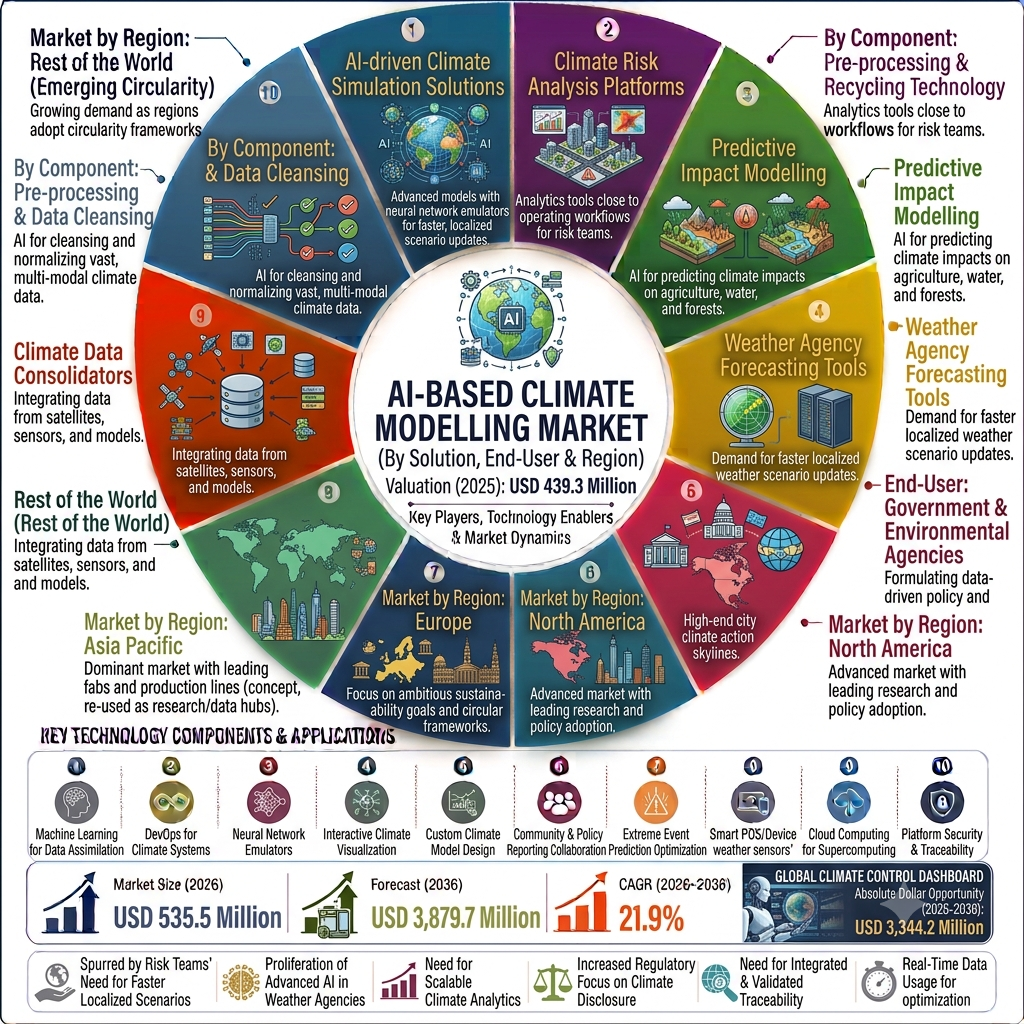
According to an extensive new market evaluation published by Fact.MR, the global AI-based climate modelling market crossed an initial industry valuation of USD 439.3 million in 2025.
Get detailed market forecasts, competitive benchmarking, and pricing trends: https://www.factmr.com/connectus/sample?flag=S&rep_id=15525
Driven by intense enterprise demand for accelerated localized scenario updates, automated risk calculations, and climate disclosure compliance, the market is estimated to reach USD 535.5 million in 2026. Looking toward the conclusion of the ten-year forecast horizon, the global industry is projected to reach an absolute market valuation of USD 3,879.7 million by 2036. This trajectory represents an explosive compound annual growth rate (CAGR) of 21.9% from 2026 to 2036, offering an absolute dollar opportunity of USD 3,344.2 million for software developers, cloud providers, and climate intelligence firms.
Key Market Highlights at a Glance
- Market Size in 2025 (Base Year): USD 439.3 million
- Estimated Market Size in 2026: USD 535.5 million
- Projected Market Size by 2036 (Forecast Year): USD 3,879.7 million
- Compound Annual Growth Rate (CAGR): 21.9% between 2026 and 2036
- Absolute Dollar Opportunity: USD 3,344.2 million over the forecast window
- Dominant End-Use Segment: BFSI commanding a 46.9% market share in 2026
- Leading Deployment Segment: Cloud infrastructure capturing a 40.5% market share in 2026
- Major Component Segment: Software representing a 29.9% market share in 2026
- Leading Application Segment: Workflow Automation holding a 33.2% market share in 2026
- Major Organization Segment: SMEs capturing a 48.0% share of demand via flexible API access
- Fastest-Growing National Markets: India expanding at a 23.7% CAGR, followed closely by China at a 23.0% CAGR
Why Is the AI-Based Climate Modelling Market Growing?
- Urgent Requirement for Localized Risk Scenarios: Traditional physics-based climate simulations operate at coarse resolutions. Enterprise risk teams need hyper-local downscaled data to evaluate how climate risks threaten specific facility grids, supply lanes, and real estate assets.
- Massive Computational and Energy Efficiency Gains: Machine learning inference algorithms process complex global atmospheric datasets up to 1,000 times faster and with significantly less energy than traditional physics equations, making recurring ensemble runs commercially viable.
- Stricter Regulatory Disclosure Mandates: Corporate disclosure frameworks and national ESG reporting protocols force large institutions to run audit-ready climate exposure models against their loan books and physical footprints.
"Climate intelligence is transitioning rapidly from long-range theoretical research into daily operational software pipelines," states a senior analyst at Fact.MR. "Large financial institutions and utility networks can no longer wait months for a localized climate simulation. They require immediate, automated scenario runs embedded directly into asset management systems to protect infrastructure from escalating weather volatility."
Which Deployment Channel Commands the Major Market Axis?
The sheer scale of processing historical meteorological observations, high-density satellite imaging, and real-time sensor streams requires hyper-elastic storage and compute infrastructure. The cloud deployment segment is projected to account for a 40.5% share of the global marketplace in 2026. This dominant layout is sustained because AI climate software experiences short periods of extreme, burst-heavy processing demand during model training and ensemble generation. Cloud architectures eliminate the need for massive on-premise hardware footprints, allowing teams to scale compute blocks on demand.
- Cloud Deployment Market Share: 40.5% of the overall marketplace in 2026
- Core Structural Focus: Managed data ingestion pipelines, scalable parallel model inference, and distributed API output delivery
- Integration Value: Provides immediate data access to multi-regional operations teams without requiring localized specialized supercomputing nodes
Which Industry Axis Commands Total Sector Application Volume?
Continuous financial protection and asset underwriting require intense exposure checking against localized weather variations. The banking, financial services, and insurance (BFSI) end-use segment is forecast to record a 46.9% share of the market in 2026. This dominant market share is driven by property insurers, agricultural lenders, and real estate investment trusts running predictive climate models to guide underwriting parameters and protect capital allocations. As physical assets face more severe weather shifts, automated risk evaluation inside the BFSI sector anchors total market volume.
- BFSI Market Share: 46.9% of global end-use demand in 2026
- Volume Catalyst: Institutional requirement to screen thousands of asset coordinates simultaneously for flood, wildfire, and windstorm probabilities
- Operational Focus: Integrating continuous risk indicators directly into portfolio management dashboards and formal audit trails
Market Dynamics
Core Market Drivers
The primary driver accelerating global industry expansion is the widespread shift from historical weather averages toward forward-looking, AI-driven predictive risk metrics. Major milestones, such as meteorological organizations running ensemble AI forecast systems at operational scale, have proven that machine learning can drastically improve track predictions for severe weather events. This validation encourages industrial, retail, and utility operators to adopt automated risk-alert workflows.
Primary Market Restraints
The primary restraint limiting immediate global adoption is the internal data friction caused by migrating legacy risk architectures over to high-speed machine learning inference grids. Furthermore, because AI models require localized training inputs to reduce data bias, enterprise teams often face high initial service calibration and validation costs before models can be comfortably integrated into core compliance workflows.
Prominent Industry Trends
The most significant trend defining the current landscape is the launch of massive, open-source foundational weather and earth-observation models by major technology conglomerates. These open frameworks allow specialized providers to build custom downscaled analytics for specific regional hazards. Additionally, there is rapid growth in automated API platforms that let mid-sized enterprises instantly embed advanced climate data fields into standard enterprise resource planning tools.
Regional Outlook: Climate Sensitivity and Infrastructure Modernization Drive High-Velocity Asian Markets
The absolute necessity to secure heavy industrial networks and protect urban population centers from weather volatility is generating high compound growth paths across emerging Asian corridors and established Western analytics centers.
- India Forecasted Growth Rate: 23.7% CAGR from 2026 to 2036
- China Forecasted Growth Rate: 23.0% CAGR from 2026 to 2036
- Australia Forecasted Growth Rate: 21.7% CAGR from 2026 to 2036
- United Kingdom Forecasted Growth Rate: 21.4% CAGR from 2026 to 2036
India is projected to expand at a 23.7% CAGR through 2036, leading the global marketplace in commercial growth velocity. This explosive development is driven by severe monsoon sensitivities, expanding agricultural protections, and rapid investments in localized climate-resilient infrastructure planning tools.
China is estimated to achieve a 23.0% CAGR during the ten-year forecast window. Growth is sustained by deep investments in nationwide environmental sensor grids, industrial weather mitigation systems, and aggressive domestic AI model implementation programs across its manufacturing and energy sectors.
Australia is anticipated to record a 21.7% CAGR over the assessment timeframe. High demand across the continent is heavily shaped by utility planners and catastrophe-risk insurance underwriters deploying predictive models to counter severe regional fire and coastal exposure patterns.
The United Kingdom is forecast to register a 21.4% CAGR over the forecast period. This expansion is strongly supported by the country's deep institutional concentration of insurance analytics talent, mature climate-service ecosystems, and progressive corporate disclosure compliance mandates.
Competitive Landscape: Strategic Focus on API Delivery and Operational Workflows
The competitive landscape within the AI-based climate modelling market is rapidly evolving, featuring a mix of enterprise technology platforms and specialized climate risk analytics providers.
- The Weather Company: Delivers deep historical data portfolios joined with scalable machine learning engines tailored for enterprise logistical routing and utility demand forecasting.
- Microsoft Corporation (Aurora Project): Focuses on large foundational atmospheric model systems designed to scale cloud infrastructure usage for meteorological agencies and corporate sustainability teams.
Competitive dynamics show that providing raw, unformatted climate outputs is no longer sufficient to secure enterprise contracts. Industry leaders are focusing intensely on workflow integration—ensuring that predictive climate data channels connect seamlessly with existing supply chain dashboards, automated real estate risk checks, and regulated carbon reporting systems. This localized product optimization helps enterprise operations leads extract clear, immediate business value from highly complex data science pipelines.
Read the Comprehensive Industry Report: https://www.factmr.com/report/ai-based-climate-modelling-market
Frequently Asked Questions
What is the projected global value of the AI-based climate modelling market by 2036?
The global AI-based climate modelling market is projected to reach an absolute market valuation of USD 3,879.7 million by the year 2036.
What is the expected compound annual growth rate of the global industry?
The market is expected to expand at an explosive compound annual growth rate (CAGR) of 21.9% from 2026 to 2036.
Which end-use segment holds the largest share within the climate modelling marketplace?
The banking, financial services, and insurance (BFSI) segment commands the market, controlling a 46.9% share of overall demand in 2026 due to continuous asset exposure screening.
What deployment type leads the AI-based climate modelling industry?
Cloud deployment leads the architecture segment, capturing a 40.5% share of the market in 2026 to support burst-heavy processing demands.
Which country is recorded as the fastest-growing market for AI climate analytics platforms?
India is recorded as the fastest-growing national market, expanding at a projected 23.7% CAGR between 2026 and 2036 due to intense monsoon and infrastructure exposures.
What key applications drive the internal division of the climate modelling software space?
The market is primarily led by Workflow Automation at a 33.2% share in 2026, followed closely by localized scenario Analytics, corporate Governance, and regulatory Compliance tracking.
To View Related Report:
AI-Based Weather Modelling Market: https://www.factmr.com/report/ai-based-weather-modelling-market
Climate Resilient Technology Market: https://www.factmr.com/report/climate-resilient-technology-market
Defense Cybersecurity Market: https://www.factmr.com/report/defense-cybersecurity-market
Chemical Industry 4.0 Market: https://www.factmr.com/report/chemical-industry-4.0-market
To View More Report:
Chip-On-Board (COB) LED Market: https://www.openpr.com/news/4577770/chip-on-board-cob-led-market-projected-to-reach-usd-854-7
High Concentration Photovoltaics (HCPV) Market: https://www.openpr.com/news/4577677/high-concentration-photovoltaics-hcpv-market-poised-to-reach

 Arabic
 French
 Spanish
 Portuguese
 Deutsch
 Turkish
 Dutch
Dutch
 Italiano
 Russian
 Romaian
 Portuguese (Brazil)
 Greek
Greek