


The Future of Image Annotation in Enterprise AI
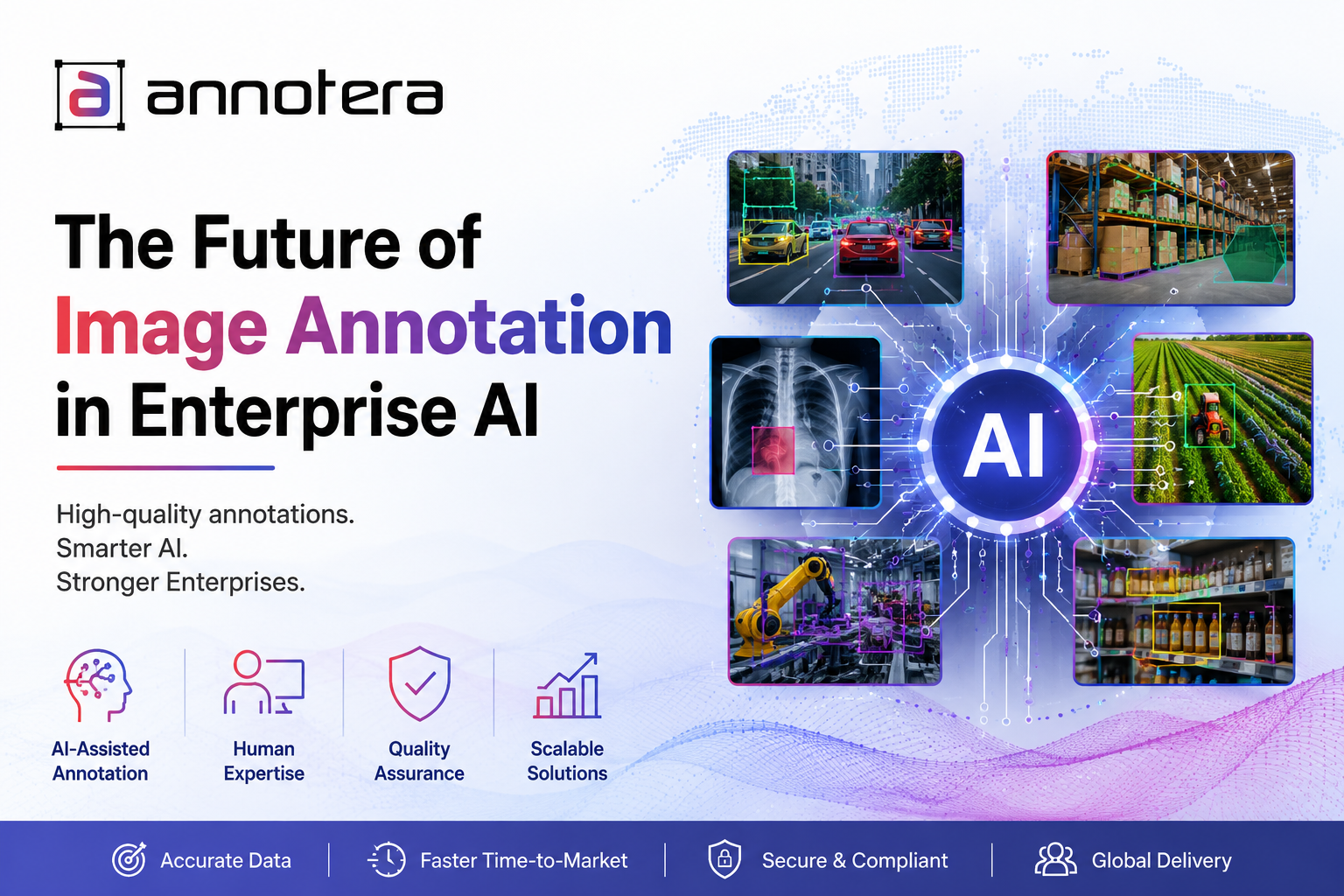
Artificial intelligence is transforming how enterprises operate, from automating quality inspections in manufacturing to enabling autonomous vehicles and powering intelligent healthcare diagnostics. However, every successful AI model shares one common requirement—high-quality training data. At the heart of this training data lies image annotation, the process of labeling visual data so machines can accurately recognize objects, scenes, patterns, and actions.
As enterprise AI becomes more sophisticated, image annotation is evolving beyond simple bounding boxes. Organizations now require scalable, precise, and domain-specific annotation workflows capable of supporting complex computer vision applications. The future of image annotation is being shaped by automation, human expertise, synthetic data, and intelligent quality assurance.
In this article, we explore how image annotation is evolving and why enterprises increasingly rely on experienced partners like Annotera to build production-ready AI datasets.
Why Image Annotation Remains Critical for Enterprise AI
Computer vision models learn by analyzing thousands—or even millions—of labeled images. Whether identifying manufacturing defects, detecting tumors in medical scans, recognizing retail products, or interpreting satellite imagery, AI performance depends directly on annotation quality.
Poor annotations introduce noise into training datasets, reducing model accuracy and increasing operational risks. Conversely, consistently labeled datasets enable models to generalize better across real-world scenarios.
As enterprise AI applications continue expanding, image annotation has become a strategic business function rather than simply a data preparation task.
Emerging Trends Shaping the Future of Image Annotation
1. AI-Assisted Annotation Is Accelerating Workflows
Machine learning-assisted annotation tools are significantly reducing manual effort by automatically generating initial labels. Human annotators then validate, correct, and refine these predictions.
This human-in-the-loop approach offers several advantages:
-
Faster project completion
-
Lower annotation costs
-
Improved consistency
-
Continuous improvement of annotation models
Rather than replacing human annotators, AI is becoming a productivity multiplier that enables annotation teams to focus on complex edge cases requiring domain expertise.
2. Human Expertise Will Continue to Drive Quality
Despite advances in automation, enterprise AI still depends on skilled human reviewers.
Complex scenarios such as:
-
Occluded objects
-
Crowded environments
-
Low-light imagery
-
Medical imaging
-
Autonomous driving scenes
-
Industrial inspections
often require contextual judgment that automated systems cannot reliably provide.
This is why every leading image annotation company combines automation with experienced quality assurance teams. Human validation ensures datasets remain accurate, unbiased, and production-ready.
3. Multi-Modal AI Requires More Sophisticated Annotation
Modern AI systems increasingly combine multiple data sources rather than relying solely on images.
Examples include:
-
Images + LiDAR
-
Images + video
-
Images + sensor fusion
-
Images + text
-
Images + GPS metadata
These multi-modal datasets require annotations that maintain consistency across different data types while preserving spatial and temporal relationships.
Future annotation workflows will increasingly support synchronized labeling across multiple modalities, enabling enterprises to build more intelligent AI systems.
4. Enterprise AI Demands Higher Annotation Precision
Simple object detection is no longer sufficient.
Today's enterprise applications frequently require:
-
Semantic segmentation
-
Instance segmentation
-
Polygon annotation
-
Keypoint annotation
-
Landmark annotation
-
3D cuboid annotation
-
Pixel-level labeling
These advanced annotation techniques provide richer contextual information, enabling AI models to perform highly specialized tasks with greater precision.
As computer vision applications mature, annotation complexity will continue to increase.
5. Synthetic Data Will Complement Real-World Images
Collecting real-world training images can be expensive, time-consuming, or even impossible in rare scenarios.
Synthetic data generated through simulations is becoming an important supplement to real-world datasets.
Organizations can create:
-
Rare traffic scenarios
-
Hazardous industrial environments
-
Extreme weather conditions
-
Medical edge cases
-
Warehouse simulations
Although synthetic data improves dataset diversity, it still requires careful validation and annotation alignment to ensure realistic model performance.
The future lies in combining synthetic data with expertly annotated real-world images.
The Growing Importance of Quality Assurance
As enterprise AI models support business-critical decisions, annotation quality can no longer rely solely on speed.
Future annotation operations emphasize:
-
Multi-stage quality reviews
-
Automated validation checks
-
Consensus-based labeling
-
Annotation guidelines
-
Inter-annotator agreement
-
Continuous quality monitoring
These quality processes significantly reduce inconsistencies while improving model reliability.
An experienced data annotation company invests heavily in standardized workflows and robust QA processes to ensure enterprise-grade datasets.
Why Enterprises Are Choosing Image Annotation Outsourcing
Building an in-house annotation team requires hiring specialists, creating workflows, managing infrastructure, and maintaining quality standards.
Many organizations now prefer image annotation outsourcing because it provides:
-
Faster project execution
-
Access to trained annotation professionals
-
Flexible workforce scaling
-
Lower operational costs
-
Consistent quality assurance
-
Faster AI deployment
Instead of investing heavily in internal operations, enterprises can focus on model development while outsourcing data preparation to specialists.
Similarly, data annotation outsourcing enables organizations to manage large-scale datasets without compromising quality or project timelines.
As AI adoption accelerates across industries, outsourcing has become a strategic advantage rather than simply a cost-saving measure.
Industry Applications Driving Future Demand
Demand for high-quality image annotation continues to grow across industries, including:
Healthcare
-
Medical image analysis
-
Disease detection
-
Radiology AI
Automotive
-
Autonomous driving
-
ADAS systems
-
Traffic sign recognition
Retail
-
Shelf monitoring
-
Product recognition
-
Customer behavior analysis
Manufacturing
-
Visual quality inspection
-
Defect detection
-
Predictive maintenance
Agriculture
-
Crop monitoring
-
Plant disease detection
-
Precision farming
Security
-
Surveillance analytics
-
Object tracking
-
Threat detection
Each application requires highly specialized annotation strategies tailored to industry-specific challenges.
Choosing the Right Image Annotation Partner
As enterprise AI projects become more sophisticated, selecting the right annotation partner becomes increasingly important.
A trusted image annotation company should provide:
-
Experienced annotation specialists
-
Human-in-the-loop validation
-
Domain expertise
-
Scalable delivery models
-
Secure data handling
-
Custom annotation workflows
-
Multi-stage quality assurance
-
Support for diverse annotation types
Organizations should look beyond pricing and evaluate long-term quality, consistency, and scalability when selecting an annotation partner.
How Annotera Supports Enterprise AI
At Annotera, we understand that successful AI begins with exceptional training data. Our experienced annotation teams combine human expertise with AI-assisted workflows to deliver accurate, scalable, and enterprise-ready image datasets.
Whether organizations require object detection, semantic segmentation, landmark annotation, polygon labeling, or custom computer vision workflows, Annotera delivers datasets designed to improve model performance while maintaining rigorous quality standards.
From startups building innovative AI products to global enterprises deploying mission-critical computer vision solutions, Annotera helps organizations accelerate AI development through reliable annotation services tailored to evolving business needs.
Final Thoughts
The future of image annotation is intelligent, scalable, and deeply integrated with enterprise AI development. As automation, synthetic data, and multimodal AI continue to advance, human expertise will remain indispensable for ensuring annotation accuracy and consistency.
Organizations that invest in high-quality annotated data today will be better positioned to build reliable AI systems tomorrow. By partnering with an experienced data annotation company offering comprehensive image annotation outsourcing services, enterprises can reduce development time, improve model performance, and confidently scale their AI initiatives.
As the demand for trustworthy AI grows, image annotation will continue to serve as the foundation upon which the next generation of enterprise intelligence is built.
Ready to build high-quality training datasets for your AI projects? Partner with Annotera for scalable, secure, and accurate image annotation solutions that help your enterprise AI models achieve superior performance. Contact our experts today to discuss your annotation requirements and accelerate your AI journey.

 English
 Arabic
 Spanish
 Portuguese
 Deutsch
 Turkish
 Dutch
Dutch
 Italiano
 Russian
 Romaian
 Portuguese (Brazil)
 Greek
Greek