


Why Your Building's Future Gets Decided Before Anyone Pours a Single Slab
Walk past any construction site and the visible work — walls going up, steel framing taking shape — looks like where the project actually happens. It isn't. The decision that determines whether that building stands solid for decades or develops problems within a few years gets made underground, before any of the visible work even starts.
That underground decision is soil preparation. Get it wrong and no amount of quality construction above ground fixes it later.
What Compaction Actually Does Beneath a Building
Loose, weak, or improperly prepared soil sits beneath structures silently for months or years before anything visible goes wrong. Then settlement starts. Cracks appear in walls that had no business cracking. Doors stop closing the way they used to. Floors develop a subtle slope nobody can quite explain.
Ground compaction services exist specifically to prevent that slow, invisible failure. Compacting soil increases density and load-bearing capacity by removing air pockets trapped within the ground — work that needs to happen before construction begins rather than after problems surface.
When Soil Needs More Than Surface-Level Fixing
Some ground simply cannot be compacted into reliability. Highly compressible clay, loose sand, sites sitting on a high water table — these conditions go beyond what standard compaction addresses, and treating them the same way as ordinary soil creates problems that surface years later, often after a building is already occupied.
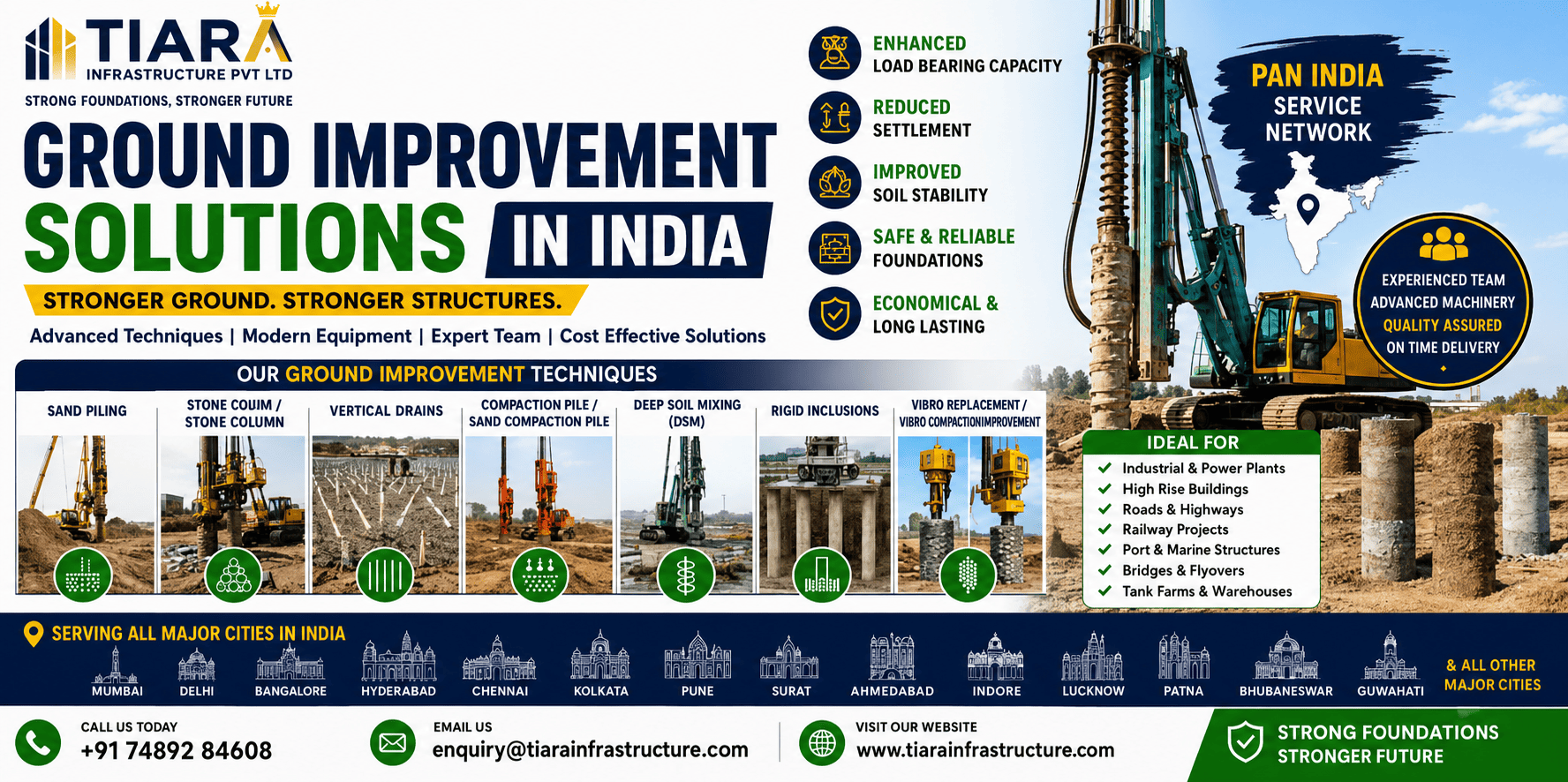
This is where ground stabilization services become necessary rather than optional. Stone columns, sand piling, vertical drains, and deep soil mixing strengthen soil at depth instead of simply working around its weaknesses on the surface.
Why the Sequence Matters More Than Either Step Alone
Experienced contractors never treat compaction and stabilization as interchangeable. They treat soil preparation as a sequence — assess first, then apply whichever combination of compaction and stabilization the ground genuinely needs. A site requiring deep stabilization that only receives surface compaction will eventually show the consequences, regardless of how well everything above ground gets built.
Getting this right at the start costs a small fraction of what remediation costs once a structure has already begun settling or showing distress.
Tiara Infrastructure provides ground improvement contracting across major Indian cities, covering sand piling, stone columns, vertical drains, and compaction work matched to actual soil conditions rather than applied as a standard template.

 Arabic
 French
 Spanish
 Portuguese
 Deutsch
 Turkish
 Dutch
Dutch
 Italiano
 Russian
 Romaian
 Portuguese (Brazil)
 Greek
Greek