


How Premium Track Lighting Enhances Product Displays And Customer Experience
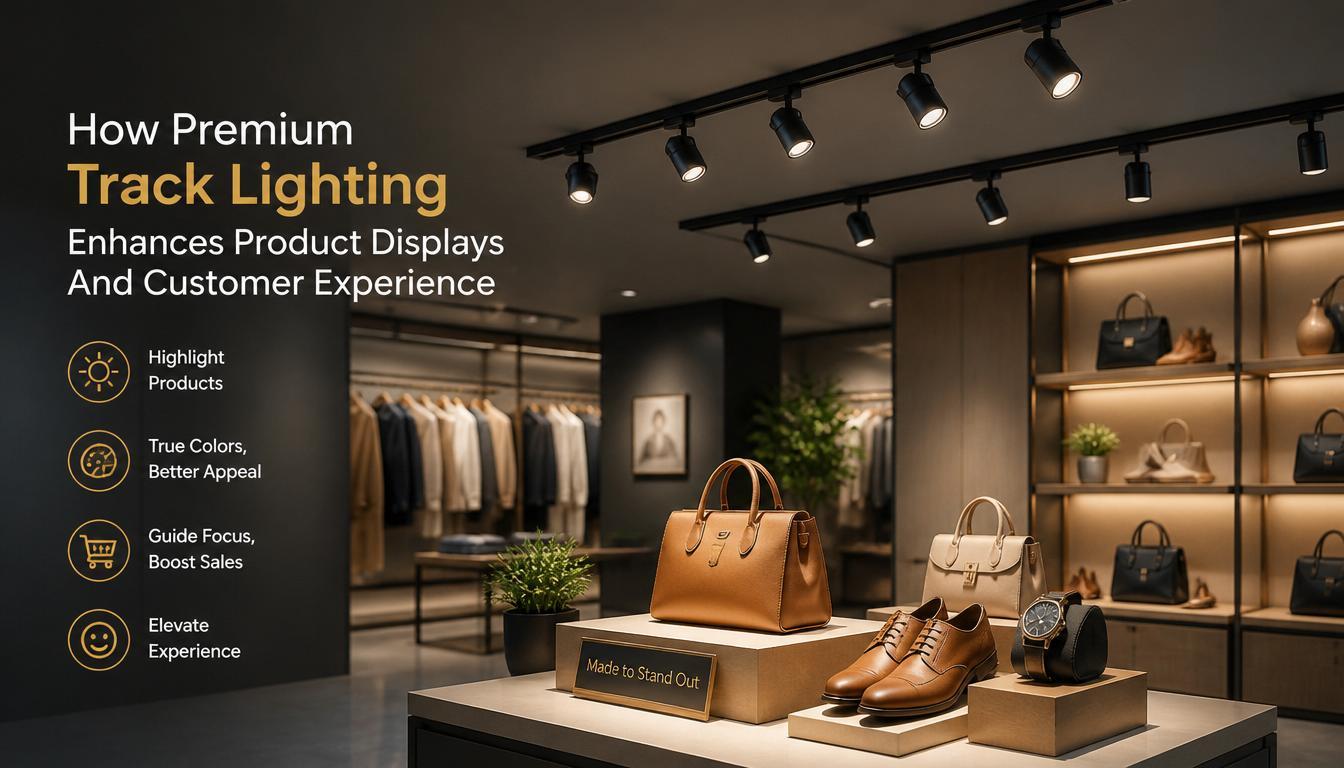
Premium Track Lighting improves both sales and customer satisfaction by providing “on-demand” lighting that can be precisely targeted to the right location without the fixed limit of recessed lighting. Adjustable heads let you redirect a track to signal a new arrival this week and a different display next week: not just leave it fixed on a single point. Thus, it acts as a tool to draw customer attention, rather than simply illuminate a room.
What Is Premium Track Lighting And How Does It Work?
Premium track lighting is a type of fixture system that involves mounting light heads onto a continuous electric track. This allows for individual manipulation of each light head by aiming, repositioning, or changing the light heads themselves. This differs from fixed recessed lighting, which locks the beam direction at installation.
How Does Track Lighting Compare To Recessed Lighting?
Recessed lighting is fixed in place once installed; if the store's layout changes, moving it requires an electrician and new ceiling cutouts. Track lighting solves this — heads slide along the track, so refreshing a display takes minutes instead of a renovation. That flexibility is a retail benefit to sellers that change inventory over time or by campaign. So the track system's higher upfront cost is often worth it.
Why Does Color Accuracy Matter For Product Display Lighting?
The true color perception that a customer will gain from a product's appearance is a matter of color accuracy. This is measured by the Color Rendering Index (CRI) and a newer standard, called TM-30. TM-30 was developed by the Illuminating Engineering Society with the support of the U.S. Department of Energy to offer a more efficient way of analyzing LED lighting compared to the traditional CRI system. TM-30 measures both color fidelity and saturation, giving a fuller picture than CRI alone. This is important for display lighting, since two lights with the same CRI can give such different light performance to colors on displayed products. One gives strong, vivid color rendition while the other gives weak, faded rendition of the same color. For retailers who are installing track lighting to merchandise, they should view CRI and TM-30 information as a minimum standard. They must review this, particularly for those merchandise categories that require color accuracy such as apparel, cosmetics, food, or other products.
What Types Of Track Lighting Fixtures Exist?
-
Fixed heads — set at a single angle, best for general coverage.
-
Adjustable lighting heads — rotate and tilt to redirect the beam as displays change.
-
Gimbal heads — recessed into the track for a lower profile with adjustability.
-
Spotlights — narrow beam angles for highlighting a single product or feature.
-
10W COB LED Track Light – Precision & High-Performance Lighting is common in adjustable heads because their concentrated light source produces a tight, high-output beam suited to focus product highlighting.
Retailers comparing fixture types in more depth can review this guide to track light fixtures before making choices.
How To Choose Track Lighting?
The fixture choice will rely on the choice of beam angle, color accuracy, and the frequency with which a display needs to change. A head that's very narrow is used with a rotating featured-product table, and a wider beam is used with a fixed shelving run. The cost of running a display-heavy floor also adds to energy efficiency – LED track lighting consumes lower energy requirements during its lifespan than older track lights and fixtures.
Conclusion
Track lighting has become famous in the retail sector by combining flexibility with precision — a single system can be re-aimed as displays rotate, without new wiring. Color accuracy, measured through CRI and the DOE-backed TM-30 standard, separates lighting that merely illuminates a product from lighting that helps sell it. CIRC Lighting offers premium track lighting systems — adjustable heads, verified color rendition, and fixtures designed to meet retail displays’ changing light requirements over time.

 Arabic
 French
 Spanish
 Portuguese
 Deutsch
 Turkish
 Dutch
Dutch
 Italiano
 Russian
 Romaian
 Portuguese (Brazil)
 Greek
Greek