


Paint Protection Film vs. Ceramic Coating: What They Each Do and Which Florida Cars Need
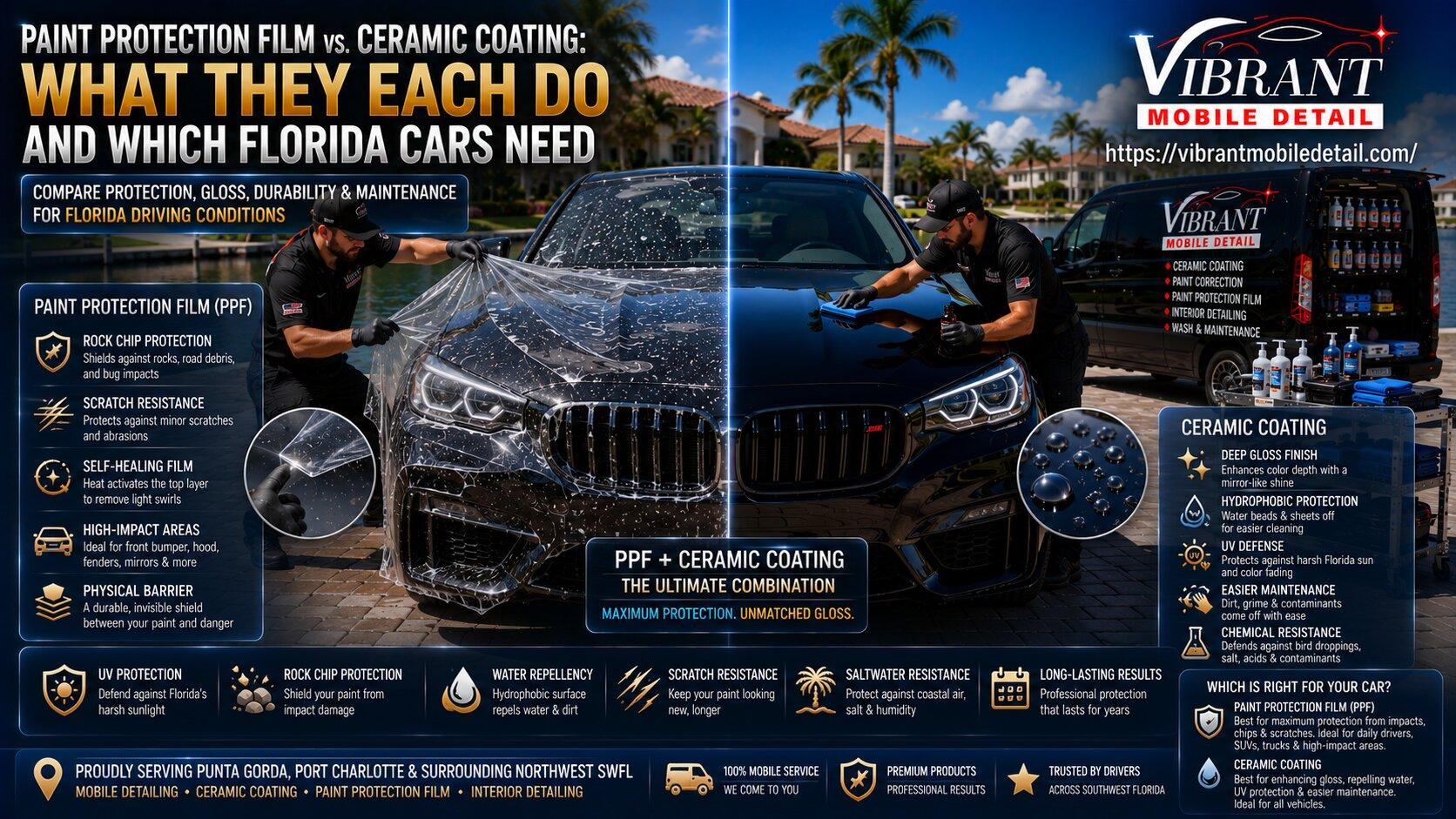
The terms paint protection film and ceramic coating appear alongside each other in nearly every high-end detailing conversation, and they are frequently misrepresented as competing alternatives when they are actually products with almost no functional overlap. Understanding the difference between them is not a matter of preference or budget; it is a matter of understanding what type of damage each product is actually capable of preventing. For drivers in Southwest Florida, where the specific combination of highway stone chip exposure on I-75 and US-41, extreme UV radiation, and twice-yearly lovebug seasons creates a layered set of threats to automotive paint, choosing between ceramic coating and paint protection film is best approached as a question about which threats matter most for a specific vehicle rather than which product is generically better.
What Paint Protection Film Actually Is
Paint protection film, abbreviated PPF in most industry discussions, is a thermoplastic urethane film applied to painted surfaces in sheets cut to fit specific panel geometry. The material is typically 6 to 10 mil thick, which is roughly 150 to 250 microns, several times thicker than the clear coat it sits over. This thickness is what produces the product's defining characteristic: the ability to absorb physical impacts from road debris without allowing that impact to reach the paint beneath.
When a gravel chip strikes a panel protected by PPF at highway speed, the thermoplastic material deforms on impact, absorbing and distributing the kinetic energy across its surface rather than transferring it to the paint. The higher-quality PPF formulations also incorporate self-healing chemistry that uses ambient heat to repair minor surface scratches by allowing the material to flow back into its original form, which means fine swirl marks and light abrasion from normal contact washing can disappear with time or gentle heat application.
The tradeoff is that PPF is a physical film applied over the paint. Like any surface film, it can yellow over time from UV exposure if it is not itself UV-stabilised, it can develop edge lifting at the boundaries of the installation if the vehicle's washing and drying routine allows moisture to work under the film at seams, and it does not provide the hydrophobic water-beading and chemical-resistant surface that ceramic coating produces. It is a physical barrier against physical damage, not a chemical barrier against chemical degradation.
What Ceramic Coating Actually Is
Ceramic coating is a liquid silicon dioxide polymer that chemically bonds to the clear coat or to whatever surface it is applied to, curing into a nano-layer that becomes a structural part of the outermost surface of the paint system. At its typical applied thickness of several microns, it provides no meaningful resistance to physical impact from road debris. A rock chip strikes a ceramic-coated panel with exactly the same force and produces exactly the same damage as on an uncoated one. This is the fundamental limit that many descriptions of ceramic coating fail to state clearly enough.
What ceramic coating does exceptionally well is resist the chemical and radiative threats that PPF does not specifically address. The inorganic silicon dioxide chemistry does not degrade under UV radiation the way organic wax and sealant compounds do, which makes it the only paint protection product that provides meaningful multi-year UV resistance without reapplication in Southwest Florida's extreme-UV climate. The coating's hydrophobic surface causes water to bead and roll off rather than sitting in contact with the paint long enough to evaporate and deposit mineral compounds, which is the mechanism responsible for the water spot resistance that coated vehicles demonstrate in Florida's hard-water and high-rainfall environment.
Why the Two Products Are Complementary, Not Competing
The distinction between physical barrier and chemical/UV barrier clarifies why high-end installations in Florida typically use both products rather than choosing one. PPF covers the areas most vulnerable to physical impact: the front bumper, hood leading edge, fenders, door edges, and mirrors. Ceramic coating covers the entire vehicle, including the PPF-protected areas, providing UV resistance and hydrophobic performance across every surface including the film itself.
A ceramic coating applied over PPF addresses two limitations of bare PPF. First, uncoated PPF can yellow over time from UV exposure in Southwest Florida's intense sun, while a UV-resistant ceramic coating on the film's surface significantly slows this yellowing. Second, bare PPF lacks the hydrophobic properties that make ceramic-coated surfaces easy to clean, which matters for maintaining the film's appearance over years of use. The combination produces a front end that resists physical impact through the film, resists UV and chemical degradation through the coating, and maintains the self-cleaning hydrophobic surface performance that makes ongoing maintenance practical.
Which Vehicles in Southwest Florida Benefit Most From Each Configuration
The choice of which protection configuration to apply is most efficiently made by thinking about the vehicle's primary use pattern rather than by trying to identify the technically superior product in the abstract.
A daily driver that regularly covers I-75 between Punta Gorda and Fort Myers, or US-41 through construction zones and agricultural areas, accumulates stone chip damage at a higher rate than a vehicle used primarily for local low-speed driving. For this driver, front-end PPF on the bumper and hood leading edge provides targeted physical protection where it is most needed, while ceramic coating covers the rest of the vehicle for UV and chemical protection. The combined installation costs more than either product alone but addresses both the physical and chemical threats that this specific use pattern generates.
A vehicle used primarily for local neighbourhood driving at lower speeds, where the risk of highway stone chip damage is lower, may find ceramic coating alone covers its primary protection needs. The UV exposure and chemical threats, including lovebug seasons, water spotting, and salt air for coastal residents, are present regardless of driving pattern, while the stone chip threat is more driving-pattern dependent.
The Realistic Cost of Each Option and What It Buys
PPF installations vary significantly in scope and cost depending on how many panels are covered. A partial front protection package, covering the bumper, hood, and mirrors with pre-cut film, represents the minimum practical scope for addressing highway stone chip damage. A full vehicle wrap covering every painted panel represents the maximum scope. The cost range between these extremes is substantial, and most Florida drivers find the partial front coverage addresses the majority of their real-world chip damage without the cost of full vehicle PPF coverage.
Ceramic coating on a standard passenger vehicle covers the full painted exterior and is priced based on the scope of paint correction work needed before the coating goes on. A vehicle in good condition requiring only light polishing before coating costs less than one requiring multi-stage correction to address accumulated swirl marks and oxidation, which is why current paint condition is the primary variable in an accurate ceramic coating quote.
The two-product combination, partial PPF on the front end plus ceramic coating on the full vehicle, sits between the cost of full PPF coverage and the standalone ceramic coating price, and it produces the most practical protection configuration for the majority of Florida daily drivers who face both the physical chip threat on highways and the chemical threat from UV, water, and lovebugs year-round.
How Florida's Specific Threats Map to Each Product
Southwest Florida generates three categories of paint threat that a useful protection strategy needs to address: physical impact from highway debris, UV radiation from a consistently extreme-UV climate, and chemical exposure from lovebug acid, salt air corrosion, and hard water mineral etching.
Physical impact is PPF's domain exclusively. No coating chemistry prevents a stone chip from transferring kinetic energy into the paint surface, and understanding this is the most important corrective to common ceramic coating marketing that implies a broader protection scope than the chemistry supports.
UV radiation is ceramic coating's strongest argument in this climate. The inorganic SiO₂ chemistry does not degrade under photodegradation, which means it provides UV protection that holds up across years rather than weeks in Southwest Florida's extreme-UV environment. PPF with UV stabilisation offers some UV resistance for the areas it covers, but it is not a substitute for ceramic coating's full-vehicle UV protection.
Chemical exposure falls primarily in ceramic coating's domain. The coating's hydrophobic surface and chemical resistance directly address lovebug acid, salt air deposition, and water spotting in a way that bare paint or PPF without a coating topcoat does not. The ceramic coating for Southwest Florida cars and trucks is specifically formulated for these conditions rather than for a generic automotive market.
Where to Start If Budget Requires Choosing
Not every driver in Southwest Florida will elect both products, and for those working with a defined budget, understanding which threat is most pressing for their specific situation helps direct the investment most effectively.
Drivers who regularly cover I-75, US-41 through active construction zones, or the stretch of Alligator Alley between Naples and Broward are exposed to stone chip risk at a rate that warrants PPF on at minimum the front bumper and hood leading edge. Drivers who do primarily local driving at lower speeds are exposed to UV, chemical, and water spot threats regardless of speed, which makes ceramic coating the more broadly applicable investment for their risk profile.
For any driver who is concerned about paint preservation but has not yet investigated the current condition of their clear coat, a starting point is understanding whether the paint needs correction work first. Paint correction for existing damage is required before any coating application regardless of which protection path is chosen, since both PPF and ceramic coating lock in the condition of the surface they are applied to. Addressing existing swirl marks and oxidation before applying protection ensures that the protection is preserving a good surface rather than sealing in existing damage.
Maintenance Considerations for Each Product
PPF requires specific care to maintain the film's edge adhesion and clarity over its service life. High-pressure washing aimed directly at film edges can work water under the boundary and lift the film over time. Regular washing with appropriate pressure keeps the film clean without compromising adhesion. For PPF with a ceramic coating applied over it, the washing approach for the whole vehicle follows the same pH-neutral, soft-contact protocol that is recommended for a standard ceramic coating.
Ceramic coating without PPF benefits from periodic top-coat maintenance at the six-month inspection that extends the coating's surface performance, as discussed across the broader ceramic coating literature for Florida vehicles. The coating's chemical barrier remains effective throughout its service life even as the hydrophobic surface properties at the outermost nano-layer gradually diminish through washing friction and UV exposure over years of use.
Frequently Asked Questions
Can paint protection film be applied to a car that already has a ceramic coating?
In most professional workflows, PPF is applied before ceramic coating rather than over an existing cured coating, because PPF adhesive bonds best to a clean, properly prepared paint surface rather than to a cured ceramic layer. A vehicle currently ceramic-coated that the owner wants to add PPF to typically requires removing the coating from the areas where film will be applied before installation.
Does paint protection film require professional installation or can it be done at home?
PPF requires precision cutting and installation skills to produce a result without bubbles, lifted edges, or visible seams, particularly on complex panel geometry. Consumer-grade self-adhesive sheets sold for DIY application are available but produce results that differ significantly from professionally cut and installed film. For vehicles where the investment is substantial enough to justify PPF at all, professional installation is the appropriate choice.
How do lovebugs specifically interact with PPF and ceramic coating differently?
On a surface protected by PPF, lovebug residue still needs to be removed promptly to avoid etching the film surface, since PPF is susceptible to acid etching from prolonged lovebug exposure under Florida's heat just as paint is. Ceramic coating on the same surface makes the removal significantly easier since the hydrophobic surface does not allow residue to bond as aggressively, reducing the urgency somewhat compared to unprotected paint.
Drivers interested in a quote for either product or a combined installation can schedule a ceramic coating or PPF consultation and note the vehicle's current paint condition and primary driving pattern for the most relevant recommendation.

 English
 Arabic
 French
 Spanish
 Portuguese
 Turkish
 Dutch
Dutch
 Italiano
 Russian
 Romaian
 Portuguese (Brazil)
 Greek
Greek