


Adson Tissue Forcep: Precision That Surgeons Rely On

The Adson tissue forcep is a lightweight, thumb-operated surgical instrument used to grasp, hold, and manipulate delicate tissue during procedures. Known for its fine serrated or toothed tips and ergonomic design, it is a staple in operating rooms across general surgery, plastic surgery, and wound care settings.
Surgical precision begins long before the first incision. It starts with the instruments a surgeon chooses—and few tools have earned their place in the operating room as consistently as the Adson tissue forcep. Compact, reliable, and engineered for control, this forcep has remained a go-to instrument for surgeons and medical professionals for decades.
Whether used during wound closure, skin grafting, or fine tissue handling, the Adson tissue forcep offers the kind of tactile sensitivity that complex procedures demand. At Azeemed Instruments, we are dedicated to providing high-quality surgical tools that meet the needs of professionals—and the Adson forcep sits at the heart of that commitment.
This blog explores what makes the Adson tissue forcep so widely trusted, how it compares to atraumatic forceps, and what to look for when selecting one for clinical use.
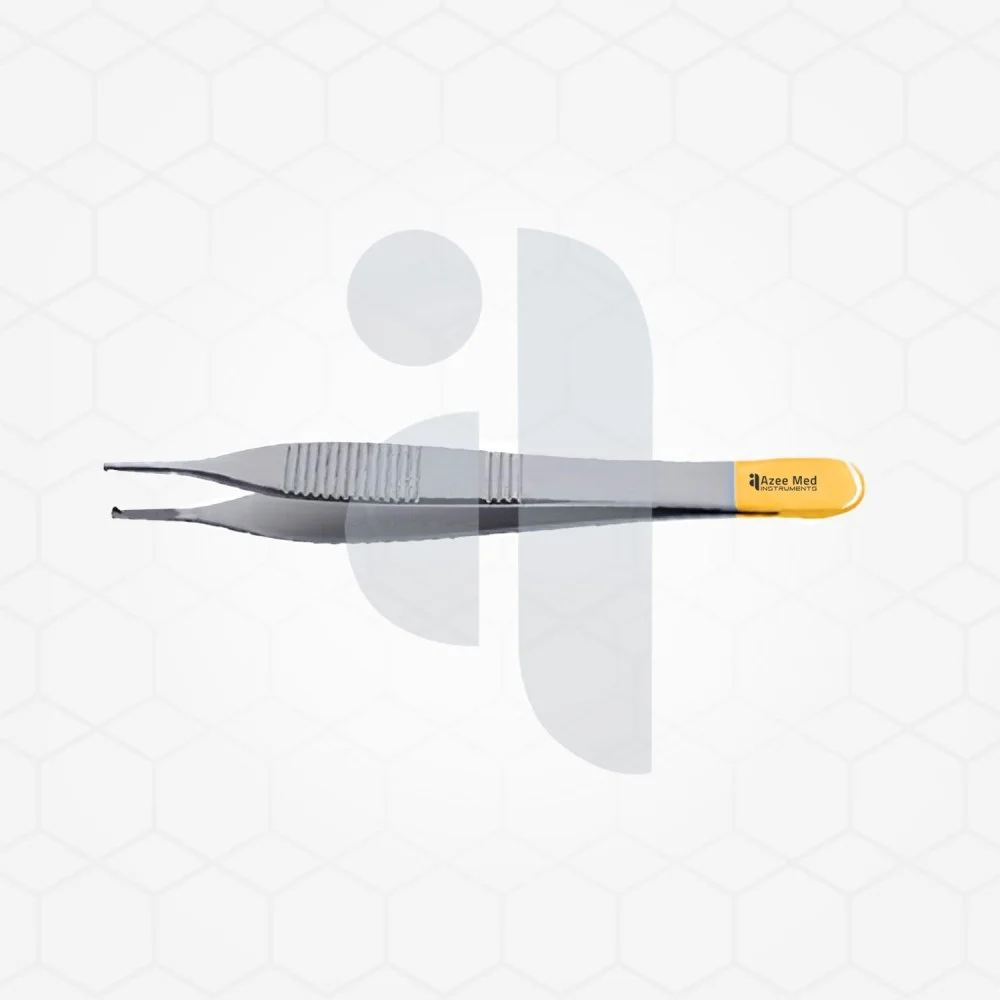
What Is an Adson Tissue Forcep and Why Do Surgeons Prefer It?
The Adson tissue forcep is a short, lightweight thumb forcep typically measuring around 12 cm in length. Its defining feature is the tip design: toothed variants carry 1×2 teeth for a firm grip on tissue, while serrated versions offer a gentler hold. The spring-loaded handle allows for one-handed operation, giving surgeons the freedom to use their other hand for suturing, cutting, or retracting.
The forcep's compact size makes it especially useful in superficial and skin-level procedures. Plastic surgeons favor it for skin flap manipulation, while general surgeons reach for it during wound debridement and closure. The narrow, tapered tip allows access to tight anatomical spaces without obstructing the surgeon's line of sight—a small detail that makes a significant difference during delicate work.
The ergonomic bow-spring handle reduces hand fatigue during extended procedures. For surgical teams performing high volumes of minor surgeries or outpatient procedures, this matters. Comfort and control are not luxuries—they are clinical requirements.
How Do Atraumatic Forceps Differ From the Adson Tissue Forcep?
Understanding the distinction between instrument types helps clinicians make better decisions at the point of care. atraumatic forceps are specifically designed to minimize mechanical damage to tissue during handling. Rather than using teeth or aggressive serrations to grip, atraumatic forceps rely on smooth or lightly textured jaws that distribute pressure more evenly across the tissue surface.
This design philosophy makes atraumatic forceps the preferred choice when working with fragile or vascularized tissue—such as bowel, blood vessels, or delicate organ walls—where even minor trauma can compromise healing or cause complications. Cardiovascular and gastrointestinal surgeons frequently rely on atraumatic variants for this reason.
The Adson tissue forcep, by contrast, prioritizes secure grip. The toothed tip bites into tissue to prevent slippage, which is ideal when working with skin or fibrous tissue that needs to be held firmly during suturing. Choosing between the two comes down to the tissue type and the degree of trauma tolerance the patient's anatomy allows. For skin and superficial tissue, the Adson tissue forcep is typically the more appropriate choice. For internal, fragile, or highly vascular structures, atraumatic forceps take precedence.
At Azeemed Instruments, our catalog includes both instrument categories, manufactured to precise tolerances to ensure consistent performance across surgical settings.
Key Design Features That Define a High-Quality Adson Tissue Forcep
Not all forceps are created equal. The quality of an Adson tissue forcep depends on several measurable factors that directly impact performance and longevity.
Material composition is the first consideration. Surgical-grade stainless steel—typically 410 or 420 series—provides the corrosion resistance and structural integrity required for repeated sterilization cycles. Instruments manufactured from substandard alloys can develop surface pitting or microfractures over time, creating sites for bacterial contamination and compromising the instrument's reliability.
Tip precision is equally critical. The teeth on a toothed Adson tissue forcep must be symmetrically aligned so that opposing jaws mesh correctly under pressure. Misaligned tips can tear tissue rather than grip it cleanly, introducing unnecessary trauma and slowing healing.
The spring tension of the handle affects control. Too stiff, and the surgeon must apply excessive force to open the jaws—causing fatigue and imprecision. Too loose, and the forcep fails to maintain grip. A well-calibrated Adson tissue forcep should open and close smoothly with minimal resistance, providing tactile feedback that helps the surgeon gauge grip pressure accurately.
Finally, surface finish matters for sterilization compatibility. A polished or satin finish reduces surface adhesion of organic material, making cleaning and autoclaving more effective and extending the instrument's functional lifespan.
How Azeemed Instruments Approaches Adson Tissue Forcep Manufacturing
Azeemed Instruments approaches surgical instrument manufacturing with a single guiding principle: the instrument must never be the variable that compromises a procedure. Every Adson tissue forcep produced under the Azeemed name undergoes strict quality control before it leaves the production facility.
Dimensional accuracy is verified against standardized specifications to ensure tip alignment, handle tension, and overall length meet clinical expectations. Instruments are inspected for surface defects, tested for corrosion resistance, and packaged to prevent contamination during shipping and storage.
Azeemed Instruments also supplies atraumatic forceps, needle holders, retractors, and a full range of general and specialty surgical instruments—all manufactured with the same commitment to precision and durability. For procurement teams, surgical centers, and individual practitioners, this breadth of catalog means fewer suppliers and more consistent quality across the instrument tray.
What to Consider When Selecting an Adson Tissue Forcep for Clinical Use
Selecting the right Adson tissue forcep starts with understanding the procedural context. For skin closure and wound management, a 1×2 toothed tip offers the most secure hold. For procedures involving more delicate dermal layers or patients with fragile skin integrity—such as elderly patients or those on long-term corticosteroid therapy—a serrated, non-toothed version may reduce the risk of skin tearing.
Length is another practical variable. Standard Adson forceps measure approximately 12 cm, which suits most superficial procedures. Longer variants are available for procedures requiring greater reach without compromising the forcep's characteristic precision.
Quantity and sterility packaging should also factor into procurement decisions. Single-use sterile forceps reduce cross-contamination risk in high-throughput settings, while reusable stainless steel instruments offer cost efficiency for facilities with robust sterilization infrastructure.
The Right Tool for the Right Tissue
The Adson tissue forcep has stood the test of time because its design aligns directly with what surgeons need: control, precision, and reliability in a compact instrument. From minor skin procedures in outpatient clinics to complex wound closures in acute care settings, the forcep earns its place on the surgical tray every time it is used.
Pairing it with the right complementary instruments—including atraumatic forceps where tissue sensitivity demands it—allows surgical teams to approach each procedure with confidence in their toolkit.
Azeemed Instruments is dedicated to providing high-quality surgical tools that meet the needs of professionals at every level of clinical practice. To explore our full range of forceps and surgical instruments, visit the Azeemed Instruments product catalog or contact our team directly for procurement inquiries.

 English
 Arabic
 French
 Spanish
 Portuguese
 Deutsch
 Turkish
 Dutch
Dutch
 Italiano
 Russian
 Romaian
 Greek
Greek