


How Operational Risk Management Boosts Workplace Safety
What is Operational Risk Management?
Speakup4Safety App in ORM is a structured process to find, assess, reduce, and monitor safety risks at work. It addresses common hazards that can cause accidents, regulatory violations, or operational disruptions.
ORM helps teams stay ahead of daily risks, whether on job sites, in warehouses, during routine tasks, or out in the field. It’s a practical approach to identifying hazards early, taking action quickly, and keeping people safe during daily operations.
The main goals of ORM:
Prevent workplace accidents and injuries
Improve safety performance
Meet regulatory and audit requirements
Reduce downtime and safety-related costs
By managing risks early and often, companies can avoid surprises and stay ahead of safety problems.
A Step-by-Step Guide to ORM: 4 Key Phases
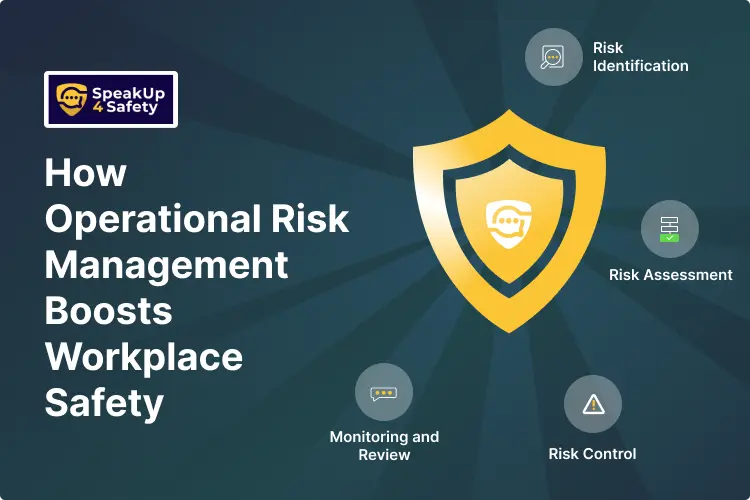
A strong ORM system follows a clear, four-step process that helps teams identify risks early, take action quickly, and prevent workplace accidents.
Step 1: Risk Identification
Start by examining your workplace for any condition, activity, or system that could potentially cause harm or disrupt operations
Examples of common risks:
Frayed electrical wires near machinery
Workers not using PPE (personal protective equipment)
Incomplete safety protocols for new hires
Tip: Do walk‑throughs, ask frontline workers, and review past incidents.
Step 2: Risk Assessment
After identifying a risk, assess how likely it is to occur and how severe the impact would be if it did.
Key considerations:
Chance: How likely is it?
Impact: What harm could it cause?
Step 3: Risk Control
Once prioritized, apply appropriate controls to eliminate or minimize each risk.
Examples of controls:
Add guards or ventilation
Update procedures
Train staff
Post warning signs
Best Practice: Always remove the hazard if you can, rather than relying only on PPE.
Step 4: Monitoring and Review
After implementing controls, monitor their effectiveness over time. ORM is not a set-and-forget approach.
How to do this:
Schedule regular safety audits
Analyze incident and near-miss data for patterns
Get feedback from employees on what’s working
Update controls as conditions or equipment change
Safety checks and records are key to meeting D.Lgs 81/2008 and ISO standards. Digital ORM tools help automate these tasks and keep everything audit-ready.
Together, these four steps form the foundation of a proactive safety culture, but their success depends heavily on one key practice: accurate and timely incident reporting.
Why Incident Reporting Is Essential in Operational Risk Management?
Incident reports give teams the facts they need to make safety decisions. A single unreported trip can lead to a second, serious injury. Missing a forklift near‑miss may hide a layout problem.
For example:
A worker trips on a poorly secured cable but doesn’t report it. Two weeks later, another employee suffers a serious injury in the same spot.
A near miss involving a forklift goes unreported. Management remains unaware of a blind spot in the warehouse layout that later contributes to a collision.
Every report: injury, near miss, or hazard, adds to risk visibility. With clear data, teams spot patterns and stop issues before they grow. Digital tools make incident reporting instant, trigger alerts, and store audit‑ready records.
Even though it’s important, many companies still find it hard to build a strong reporting culture, which makes ORM harder to implement.
Common Challenges in Operational Risk Management and How to Overcome Them
Implementing ORM can feel overwhelming. Here’s how to make it easier:
Challenge: Our team resists change.
Solution: Involve team members early in the implementation process. Demonstrate how digital tools improve efficiency and enhance workplace safety.
Challenge: An overload of data makes it difficult to identify and prioritize key safety concerns.
Solution: Leverage real-time Safety Management Dashboards to pinpoint and monitor your highest-priority risks. Begin by addressing the most critical safety risks with the highest potential impact.
Challenge: We already follow safety rules. Why should organizations consider updating their current safety practices?
Solution: ORM provides a proactive approach that extends well beyond basic compliance. It helps prevent issues before they become serious problems, and proves that your safety program is working.
Many Italian companies, especially small and mid-sized ones, are switching from paper checklists to digital ORM tools. A Cineas survey in 2024 showed that over 60% of them are now investing more in structured risk management.
How SpeakUp4Safety Simplifies Operational Risk Management
SpeakUp4Safety is more than just a reporting tool; it’s a full ORM platform that guides you from spotting risks to tracking corrective actions.
Here’s how operational risk management works within the platform:
Risk Identification: Employees can instantly report hazards, near misses, or unsafe conditions through mobile or desktop interfaces. The platform automatically logs and groups reports, allowing users to include details, images, and documents for better tracking.
Risk Assessment: The platform evaluates each report using built-in criteria to assign severity and likelihood scores. This enables teams to quickly prioritize and allocate resources to the most critical risks.
Risk Control: With the platform, safety managers assign tasks, outline solutions, and set deadlines. Teams can also monitor progress in real time within a centralized platform. Users can upload images or notes to confirm that they’ve resolved each issue.
Monitoring & Review: Tracks every action taken, sends automatic reminders, and maintains real-time dashboards. Audit-ready records and status logs ensure full tracked and compliance visibility.
Key ORM-Driven Features Include:
Interactive dashboards that display open risks and status updates in real time.
Digital checklists to ensure consistent inspections and follow-ups.
Custom workflows to standardize how different risk types are handled.
Real-time alerts that flag urgent or recurring issues immediately.
Audit-ready logs and records for compliance and accountability.
Learn more : https://speakup4safetyapp.com/blog/how-operational-risk-management-boosts-workplace-safety/

 English
 Arabic
 French
 Spanish
 Deutsch
 Turkish
 Dutch
Dutch
 Italiano
 Russian
 Romaian
 Portuguese (Brazil)
 Greek
Greek