


Why More Listeners Are Switching to Spatial and 3D Audio
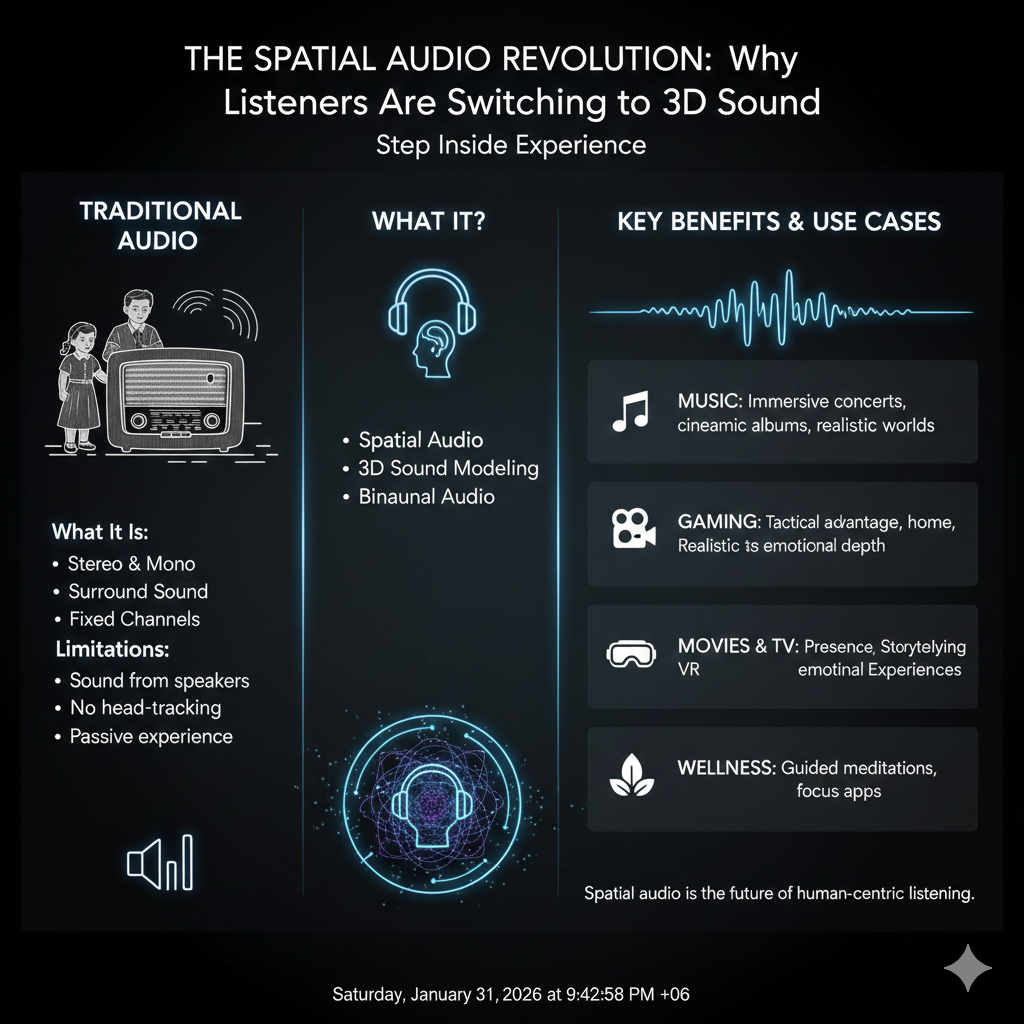
The way we experience sound is changing—and quickly. For decades, stereo and surround sound dominated music, movies, and gaming. But today, a growing number of listeners are switching to spatial and 3D audio, and the reasons are compelling. Unlike traditional audio, spatial sound doesn’t just play music or effects—it creates a fully immersive environment where sound moves naturally around you.
But why is this shift happening now? Let’s explore the factors driving the rise of spatial and 3D audio.
What Is Spatial and 3D Audio?
Spatial and 3D audio is an advanced technology that simulates how we naturally hear in real life. Instead of sound coming from fixed left and right channels, it places audio in a 3D soundscape around the listener.
Key features include:
-
Directionality: Sounds can come from above, behind, or any angle
-
Distance perception: Objects can feel near or far
-
Dynamic movement: Audio reacts to your head movements or environment
-
Realism: Uses binaural audio and HRTFs (Head-Related Transfer Functions) to mimic natural hearing
This technology creates a listening experience that is far more immersive than traditional stereo or even basic surround sound.
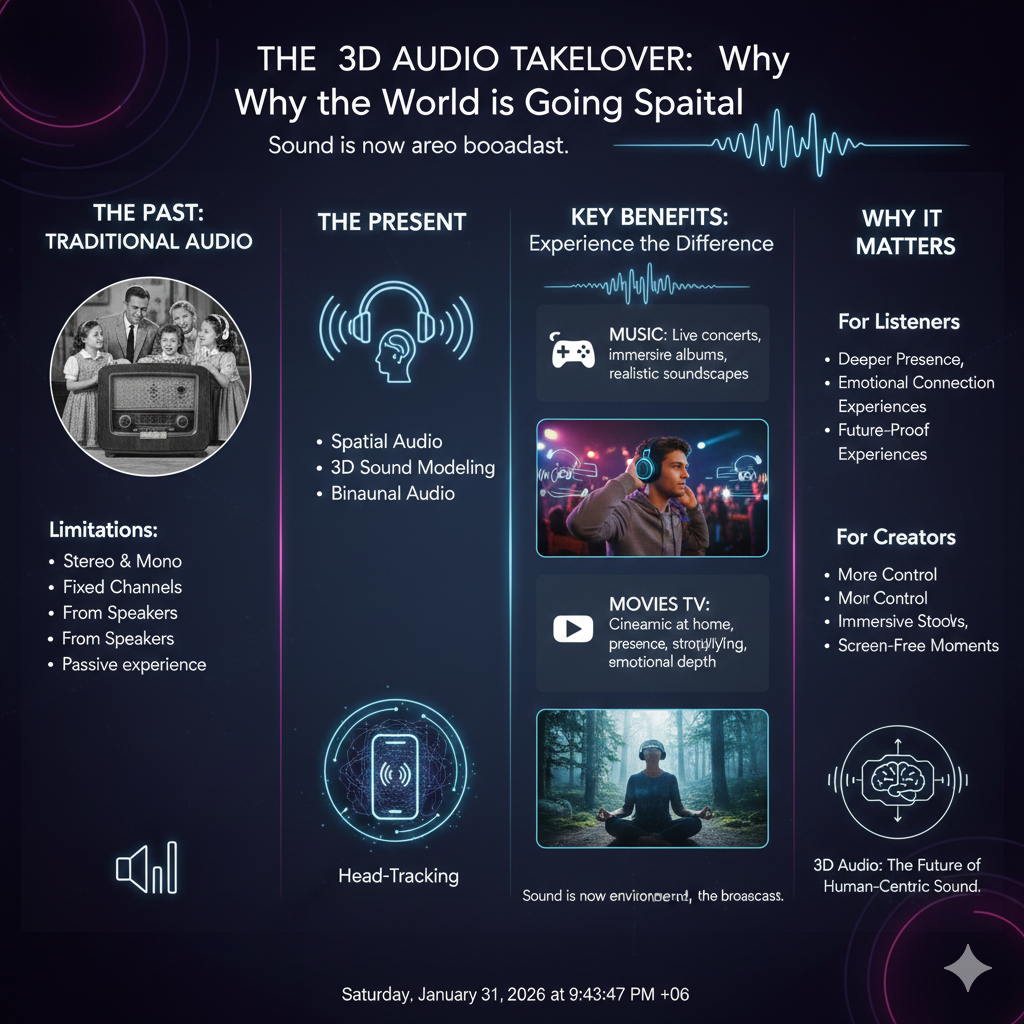
Reasons Listeners Are Making the Switch
1. A More Immersive Music Experience
With spatial audio, listeners feel like they are inside the song rather than simply hearing it. Instruments, vocals, and sound effects occupy distinct positions in a 3D soundstage. This depth makes concerts, live recordings, and studio mixes feel more lifelike—almost like standing on stage with the artist.
2. Gaming Gets Real
Gamers are among the biggest adopters of spatial and 3D audio. Accurately locating footsteps, gunfire, or environmental cues can make a huge difference in both immersion and performance. Beyond gameplay advantages, 3D audio transforms virtual worlds into realistic, believable spaces.
3. Movies and TV Feel Cinematic at Home
Spatial audio brings cinematic sound into living rooms. Explosions, ambient sounds, and dialogue can come from all directions, recreating a theater-like experience without leaving home. Viewers report deeper emotional engagement and a more natural connection to the story.
4. VR and AR Applications
As virtual and augmented reality grow, 3D audio becomes essential. Realistic sound enhances presence, making digital environments feel tangible. Voices, objects, and environmental sounds can now interact with users in real time, increasing immersion in gaming, virtual meetings, and educational simulations.
5. Accessible Technology
Unlike traditional immersive audio, which often required expensive speaker setups, spatial audio is increasingly available on smartphones, wireless earbuds, headphones, and smart speakers. Platforms like Apple Music, Spotify, and YouTube are offering spatial audio tracks, making it easier than ever for everyday listeners to adopt.
6. A Desire for More Engaging Content
Listeners are moving away from passive audio experiences. Podcasts, music, and virtual events now compete for attention in a crowded digital space. Spatial audio provides an active, engaging, and memorable listening experience that traditional formats can’t match.
The Future of Listening Is 3D
As hardware, software, and content continue to evolve, spatial and 3D audio will become standard rather than a luxury. Key trends include:
-
Personalized spatial audio: Algorithms adapting sound to individual ears and room acoustics
-
Interactive audio content: Music, podcasts, and games that react to listener behavior
-
Integration with smart devices: Immersive audio across phones, TVs, AR/VR headsets, and home systems
In short, the shift toward spatial and 3D audio represents a new era where listening is no longer passive—it’s immersive, interactive, and deeply engaging.
Final Thoughts
More listeners are switching to spatial and 3D audio because it transforms sound from something we hear into something we experience. From music and gaming to movies and VR, the 3D audio revolution is making listening more realistic, emotional, and memorable.
The question isn’t whether spatial audio will take over—it’s how soon it will become the standard for every listener who wants to feel truly surrounded by sound.

 English
 Arabic
 French
 Portuguese
 Deutsch
 Turkish
 Dutch
Dutch
 Italiano
 Russian
 Romaian
 Portuguese (Brazil)
 Greek
Greek