


Peanut Oil Price Trend Analysis with Industry Insights
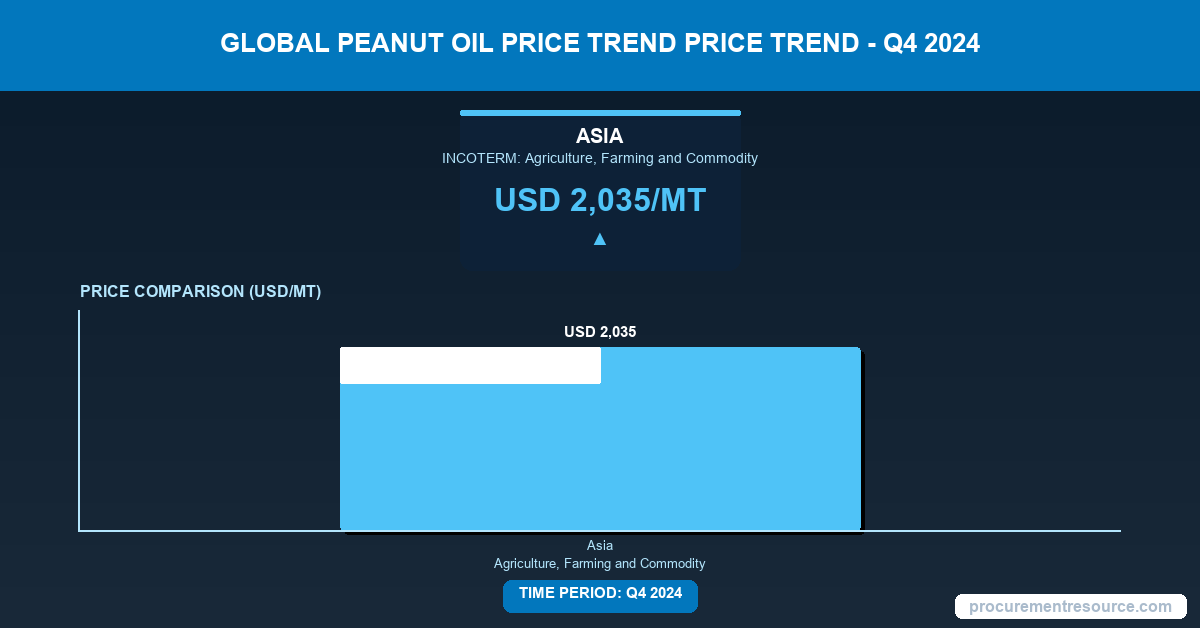
The Peanut Oil Price Trend has shown dynamic movement across global markets, with Asia recording prices at 2035 USD/MT in December 2023. This pricing reflects a balance between supply availability and fluctuating demand from food processing industries. Market participants closely track to evaluate procurement strategies, especially as feedstock costs and trade policies continue to influence pricing structures. Groundnut production levels, weather conditions, and export competition remain key determinants shaping price trajectories.
The market snapshot reveals that peanut oil pricing is influenced by both domestic agricultural output and international trade flows. In Asia, particularly India, increased groundnut production has historically led to price softening, while export competition from countries such as Nigeria and Ghana has further pressured regional suppliers. Demand from the food industry remains consistent, but price sensitivity among buyers continues to impact procurement decisions. Seasonal harvest cycles and government interventions also contribute to periodic fluctuations in the market.
Supply chain dynamics play a critical role in determining the Peanut Oil Price Trend. The availability of groundnuts, which serve as the primary feedstock, directly impacts production costs and supply levels. In recent years, bumper harvests in regions like Gujarat have increased supply, leading to downward pressure on prices. However, logistical challenges, currency fluctuations, and rising transportation costs have offset some of these declines. Additionally, global trade disruptions and shifting import-export regulations have altered supply routes, further influencing price stability.
Market Snapshot
| Parameter | Detail |
|---|---|
| Market Direction | Mixed |
| Primary Demand Sector | Food Processing Industry |
| Key Feedstock | Groundnut |
| Major Supply Region | Asia |
| Short-Term Outlook | Stable to Slightly Volatile |
Latest Price Data
| Region | Incoterm | Price (USD/MT) | Period |
|---|---|---|---|
| Asia | Ex-Works | 2035 | December 2023 |
Key Drivers Affecting Peanut Oil Price Trend Prices
- Groundnut Supply Levels: Variations in groundnut harvest output directly impact raw material availability and pricing.
- Global Trade Dynamics: Export competition from African and Latin American countries affects market pricing in Asia.
- Government Policies: Auctions, subsidies, and trade regulations influence supply and pricing stability.
- Currency Fluctuations: Exchange rate volatility affects import costs and export competitiveness.
- Weather Conditions: Climate variability impacts crop quality and yields, influencing supply chains.
Regional Market Analysis
North America
The North American peanut oil market is shaped by stable domestic demand and moderate import dependence. The United States plays a key role in influencing regional trade policies, which can impact global price trends. Tariff uncertainties and shifting trade agreements have created fluctuations in import pricing, while domestic production remains relatively steady. Demand from food manufacturers continues to support market stability, although price sensitivity among buyers has increased.
Asia Pacific
Asia Pacific remains the largest and most influential region in the Peanut Oil Price Trend analysis. India dominates both production and consumption, with states like Gujarat contributing significantly to supply. Increased groundnut output has historically led to price softening, particularly during harvest seasons. However, strong domestic demand from the food processing sector helps stabilize prices. Export competition and government interventions further shape market dynamics in the region.
Europe
In Europe, peanut oil prices are largely influenced by import dependencies. The region relies heavily on supplies from Asia and Africa, making it vulnerable to global price fluctuations. Competition among exporters and changing trade routes have impacted pricing trends. Additionally, consumer preference for alternative edible oils has limited demand growth, contributing to a relatively subdued market environment.
Middle East & Africa
The Middle East and Africa region plays a dual role as both a supplier and consumer in the peanut oil market. African countries such as Nigeria and Ghana have emerged as competitive exporters, offering lower-priced products that challenge Asian suppliers. In the Middle East, demand is driven by food processing and hospitality sectors. Trade flows between these regions significantly influence global pricing patterns.
Market Outlook
The short-term outlook for the Peanut Oil Price Trend suggests a stable to slightly volatile market environment. Supply levels are expected to remain adequate due to ongoing agricultural production, while demand from food processors continues to provide support. However, external factors such as weather disruptions and currency fluctuations may introduce temporary price volatility.
In the medium term, the market is likely to be influenced by evolving trade dynamics and shifts in global edible oil consumption patterns. Increased focus on domestic sourcing in key markets may stabilize prices, while technological advancements in agriculture could improve yield efficiency. Overall, the Peanut Oil Price Trend is expected to remain balanced, with periodic fluctuations driven by supply-demand dynamics.
Frequently Asked Questions
1. What drives Peanut Oil Price Trend prices globally?
Global peanut oil prices are primarily driven by groundnut supply, weather conditions, trade policies, and demand from the food processing industry.
2. Why did Peanut Oil Price Trend prices change recently?
Recent price changes have been influenced by bumper harvests, increased export competition, and fluctuations in global trade dynamics.
3. Which industries consume Peanut Oil Price Trend the most?
The food processing industry is the largest consumer, followed by restaurants, snack manufacturers, and household cooking applications.
4. What is the short-term price outlook for Peanut Oil Price Trend?
The short-term outlook indicates stable to slightly volatile prices, supported by steady demand and adequate supply levels.
5. How do regional supply-demand dynamics affect Peanut Oil Price Trend pricing?
Regional supply-demand imbalances, influenced by production levels and trade flows, play a crucial role in determining global pricing trends.
"
About Us
Procurement Resource ensures that our clients remain at the vanguard of their industries by providing actionable procurement intelligence with the help of our expert analysts, researchers, and domain experts. Our team of highly seasoned analysts undertake extensive research to provide our customers with the latest and up-to-date market reports, cost-models, price analysis, benchmarking, and category insights, which aid in simplifying the procurement process for our clientele. We work with a diverse range of procurement teams across industries to get real-time data and insights that can be effectively implemented by our customers. We also track the prices and production costs of an extensive range of goods and commodities, thus, providing you with the updated and reliable data. We, at Procurement Resource, with the help of the latest and cutting-edge techniques in the industry, help our clients understand the supply chain, procurement, and industry climate, so that they can form strategies which ensure their optimum growth.
Media Contact:
Procurement Resource
Address: 30 North Gould Street, Sheridan, WY 82801, USA
Email: sales@procurementresource.com
UK: +44-753-717-1117 | USA: +1-307-363-1045

 English
 Arabic
 French
 Spanish
 Portuguese
 Deutsch
 Turkish
 Dutch
Dutch
 Italiano
 Romaian
 Portuguese (Brazil)
 Greek
Greek