


Bio-based Acrylonitrile Market: Unlocking Growth Opportunities Through Green Chemistry and Sustainable Industrial Transformation
The global shift toward sustainability is redefining the foundations of industrial manufacturing, particularly within the chemical sector. As environmental concerns intensify and regulatory frameworks become more stringent, industries are increasingly turning toward renewable and eco-friendly alternatives. Among these, bio-based acrylonitrile has emerged as a critical innovation, offering a sustainable pathway for producing high-performance polymers and materials. The bio-based acrylonitrile market is gaining momentum as companies, governments, and consumers align their priorities with environmental responsibility and long-term resource efficiency.
Bio-based acrylonitrile is a renewable alternative to conventional acrylonitrile, which is traditionally derived from petroleum-based feedstocks. Produced using organic raw materials such as biomass, agricultural residues, and sugars, bio-based acrylonitrile significantly reduces greenhouse gas emissions and dependency on fossil fuels. This environmentally friendly profile positions it as a vital component in the transition toward a circular and low-carbon economy.
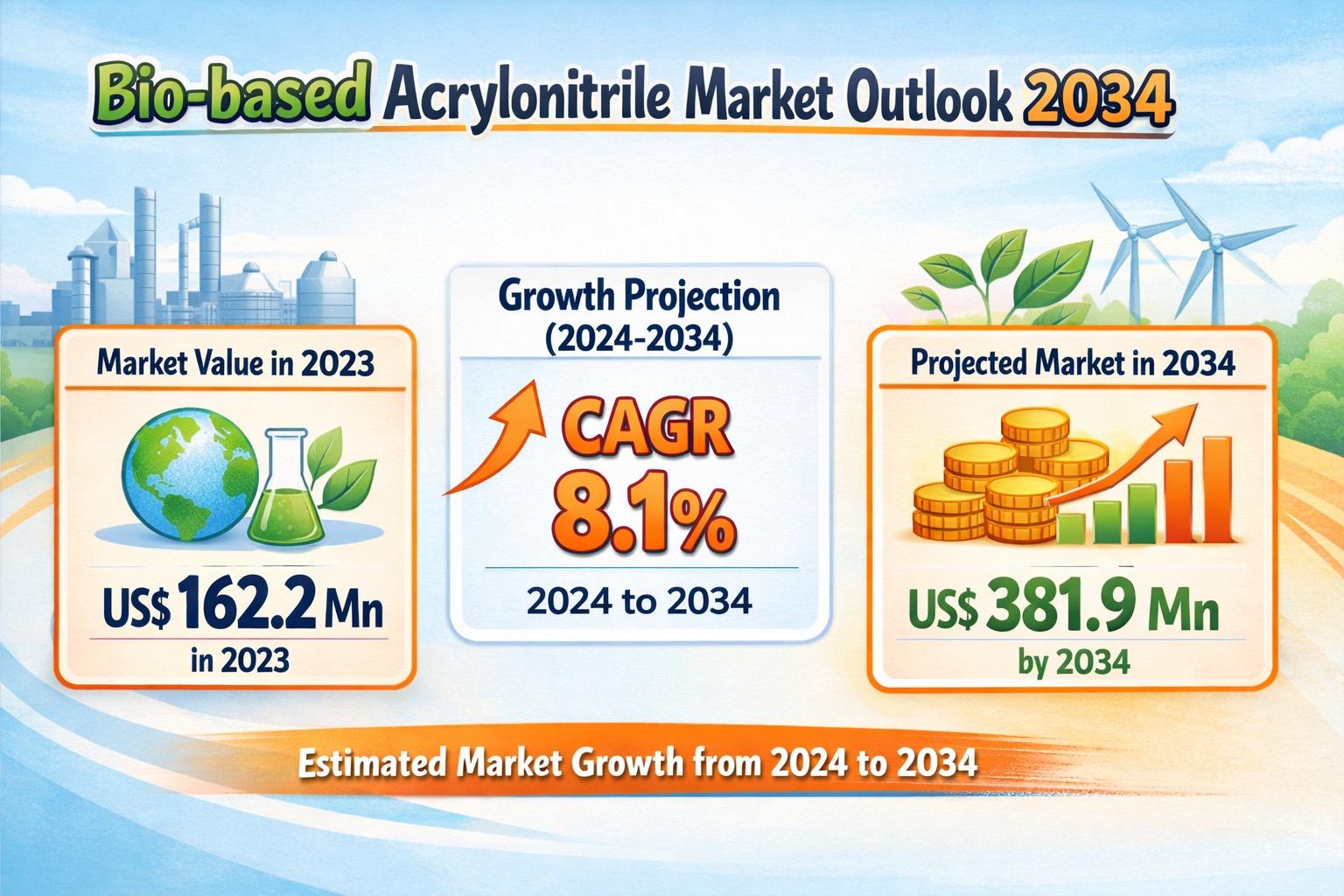
The market for bio-based acrylonitrile has demonstrated promising growth potential. Valued at over US$ 160 million in 2023, it is projected to grow steadily at a compound annual growth rate (CAGR) of 8.1% through 2034. By the end of the forecast period, the market is expected to surpass US$ 380 million, reflecting increasing adoption across multiple industries and regions. This growth is driven by a convergence of technological innovation, favorable policy support, and rising demand for sustainable materials.
One of the primary catalysts for this market expansion is the increasing demand for environmentally sustainable alternatives. Industries are under mounting pressure to reduce their carbon footprints and adopt greener practices. Bio-based acrylonitrile enables manufacturers to produce essential materials such as acrylic fibers, resins, and plastics with significantly lower environmental impact. These materials are widely used in sectors including automotive, packaging, electronics, and construction, making the transition to bio-based inputs highly impactful.
In the automotive industry, for example, lightweight and durable materials derived from acrylonitrile play a crucial role in improving fuel efficiency and reducing emissions. The use of bio-based acrylonitrile further enhances these benefits by minimizing the environmental footprint of production processes. Similarly, in the packaging sector, companies are increasingly adopting bio-based polymers to meet sustainability goals and respond to consumer demand for eco-friendly products.
Another major driver of the bio-based acrylonitrile market is the rapid advancement in bio-manufacturing technologies. Bio-manufacturing leverages biological systems such as enzymes, bacteria, and fermentation processes to produce chemicals and materials. Continuous research and development efforts have led to significant improvements in yield, efficiency, and scalability. These advancements are making it increasingly feasible to produce bio-based acrylonitrile at a commercial scale.
Two primary production methods dominate the market: fermentation-based and direct synthesis-based processes. Fermentation-based production involves converting sugars into intermediate compounds using microorganisms, which are then processed into acrylonitrile. This method is gaining popularity due to its renewable nature and potential for reduced emissions. Direct synthesis-based methods, on the other hand, focus on chemical pathways that are being optimized for better efficiency and cost-effectiveness.
Despite these advancements, challenges remain in achieving cost competitiveness with traditional petrochemical processes. The production of bio-based acrylonitrile can be more expensive due to factors such as feedstock variability, complex processing requirements, and the need for specialized infrastructure. However, ongoing innovation and economies of scale are expected to gradually bridge this gap, making bio-based alternatives more accessible and economically viable.
Government policies and initiatives are playing a crucial role in supporting the growth of the bio-based acrylonitrile market. Many countries are investing in bioeconomy development and implementing regulations that encourage the use of renewable materials. Financial incentives, research funding, and public-private partnerships are helping accelerate the commercialization of bio-based technologies. These efforts are particularly evident in regions such as Europe and North America, where sustainability is a key policy priority.
Europe has established itself as a leader in the bio-based acrylonitrile market, driven by strong regulatory support, advanced technological capabilities, and a well-developed industrial base. The region’s commitment to reducing carbon emissions and promoting circular economy principles has created a favorable environment for the adoption of bio-based materials. Additionally, the presence of leading chemical manufacturers and research institutions further strengthens the market.
North America is also experiencing significant growth, supported by robust research and development activities and government backing for sustainable innovation. The region’s advanced infrastructure and strong focus on technological advancement are contributing to the rapid expansion of bio-based acrylonitrile production and application.
The Asia Pacific region is expected to emerge as a major growth hub in the coming years. Rapid industrialization, increasing environmental awareness, and supportive government policies are driving the adoption of bio-based materials. Countries such as China, Japan, and India are investing in bio-manufacturing and renewable technologies, creating new opportunities for market players.
In terms of applications, bio-based acrylonitrile is widely used in the production of fibers, resins, adhesives, and water treatment chemicals. Acrylic fibers are particularly important in the textile industry due to their strength, durability, and resistance to environmental factors. Bio-based resins are used in manufacturing high-performance materials for automotive and electronic applications, while adhesives and coatings benefit from improved sustainability profiles.
The growing emphasis on circular economy principles is also shaping the market landscape. Companies are increasingly focusing on recycling and reusing materials to minimize waste and maximize resource efficiency. Bio-based acrylonitrile aligns with these principles by enabling the production of recyclable and biodegradable products, further enhancing its appeal.
The competitive landscape of the bio-based acrylonitrile market is characterized by strategic collaborations, technological innovation, and expansion initiatives. Leading companies are investing heavily in research and development to improve production processes and develop advanced products. Partnerships between chemical manufacturers, biotechnology firms, and research institutions are driving innovation and accelerating market growth.
Companies such as AnQore, Solvay, Asahi Kasei Corporation, and Trinseo are actively engaged in expanding their bio-based product portfolios and strengthening their market presence. These organizations are focusing on enhancing production efficiency, reducing costs, and meeting the evolving needs of customers.
A notable innovation in the market is the development of bio-based acrylonitrile products with significantly lower carbon footprints compared to conventional alternatives. Such advancements highlight the potential of green chemistry to transform traditional industrial processes and contribute to global sustainability goals.
Looking forward, the bio-based acrylonitrile market is expected to witness continued growth and evolution. Emerging technologies, increasing investments, and growing awareness about environmental sustainability will drive further adoption. As production processes become more efficient and cost-effective, bio-based acrylonitrile is likely to become a mainstream material across various industries.
The integration of digital technologies, such as artificial intelligence and data analytics, into bio-manufacturing processes is another promising trend. These technologies can optimize production, reduce waste, and enhance overall efficiency, further supporting market growth. Additionally, advancements in feedstock sourcing and supply chain management will play a crucial role in ensuring consistent and sustainable production.
Collaboration will remain a key factor in overcoming challenges and unlocking new opportunities. By fostering partnerships and sharing knowledge, stakeholders can accelerate innovation and drive the transition toward a more sustainable chemical industry. The combined efforts of governments, industries, and consumers will be essential in shaping the future of the bio-based acrylonitrile market.

 English
 Arabic
 French
 Spanish
 Deutsch
 Turkish
 Dutch
Dutch
 Italiano
 Russian
 Romaian
 Portuguese (Brazil)
 Greek
Greek