


U.S. Dermal Fillers Market Competitive Landscape, Innovation Trends, and Strategic Opportunities: 2024–2034 Deep Dive
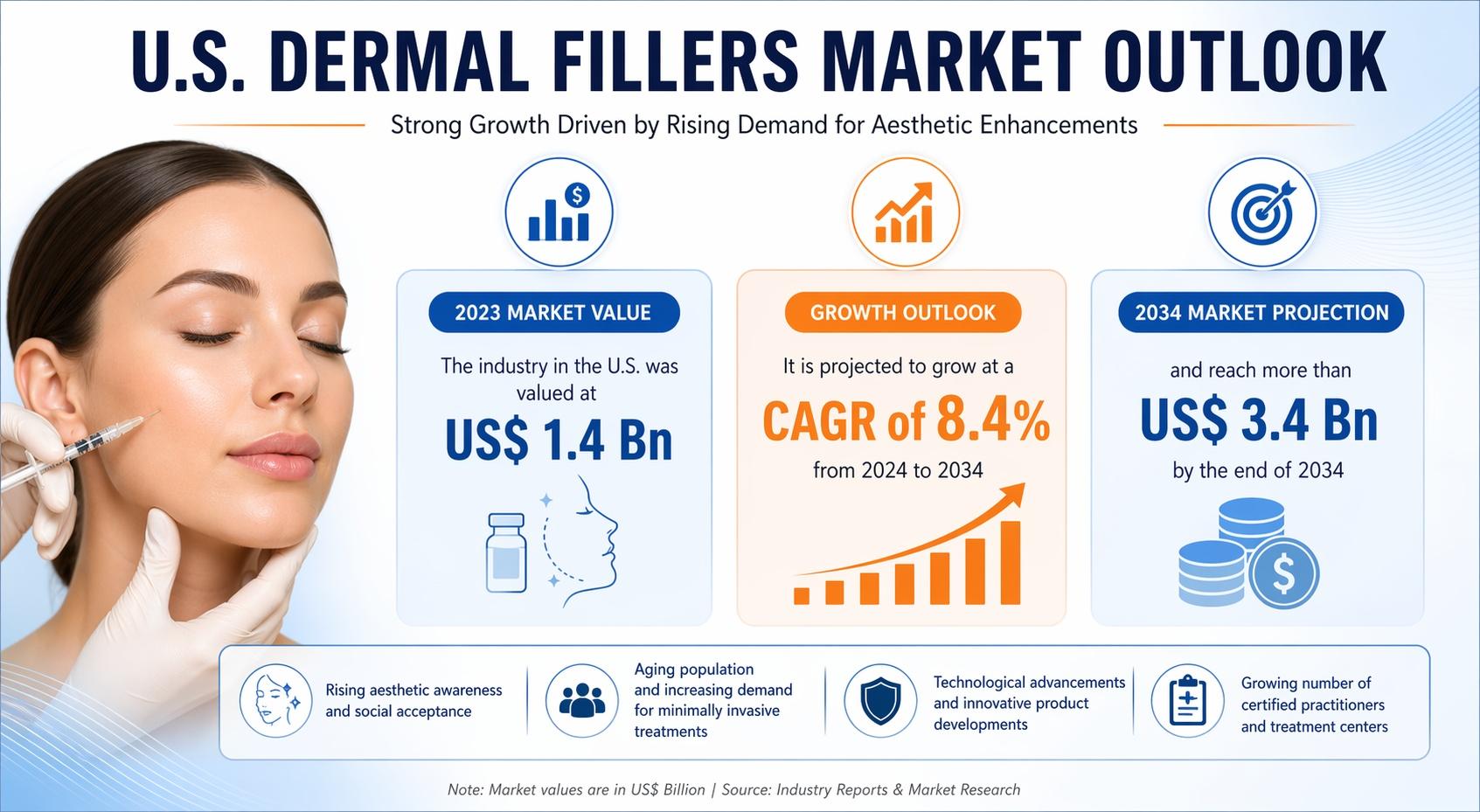
The U.S. dermal fillers market is undergoing a period of structural transformation driven by rapid technological innovation, evolving consumer expectations, and intensifying competition among leading aesthetic pharmaceutical companies. While the market is already valued at US$ 1.4 billion in 2023 and projected to exceed US$ 3.4 billion by 2034 at a CAGR of 8.4%, the real story lies in how competitive strategies, product innovation pipelines, and shifting consumer behavior are reshaping the industry’s foundation.
Unlike traditional pharmaceutical markets that rely heavily on therapeutic necessity, the dermal fillers sector is strongly influenced by lifestyle choices, aesthetic aspirations, and social perception of beauty. This makes it both highly lucrative and highly dynamic, with companies continuously innovating to stay ahead in a rapidly evolving consumer-driven environment.
Evolution of the U.S. Dermal Fillers Industry
Over the past decade, dermal fillers have transitioned from niche cosmetic enhancements to mainstream aesthetic procedures. Initially limited to elite clientele and specialized dermatology clinics, these injectable treatments are now widely available across dermatology clinics, hospitals, and particularly MedSpas.
This transformation has been fueled by:
- Improved safety profiles of modern fillers
- Greater social acceptance of cosmetic enhancements
- Expansion of minimally invasive treatment options
- Strong influence of digital media and beauty culture
- Increased affordability and financing options
The U.S. market is now characterized by frequent repeat procedures, diversified product offerings, and a strong focus on personalization. Unlike earlier generations of fillers that focused primarily on wrinkle reduction, modern fillers now address facial contouring, volume restoration, skin quality improvement, and collagen stimulation.
Competitive Structure: A Fragmented but Innovation-Driven Market
The U.S. dermal fillers industry is highly fragmented, with both global pharmaceutical giants and emerging biotechnology companies competing for market share. Despite fragmentation, a few dominant players control a significant portion of revenues due to strong brand recognition, FDA approvals, and extensive distribution networks.
Key players include:
- AbbVie (Allergan Aesthetics division)
- Galderma
- Merz Pharma
- Revance Therapeutics
- Teoxane
- Suneva Medical
- Prollenium Medical Technologies
These companies compete across multiple dimensions:
- Product efficacy and longevity
- Safety and regulatory approvals
- Aesthetic outcome quality
- Pricing strategies
- Distribution through clinics and MedSpas
- Physician training and brand loyalty programs
In this market, physician preference plays a critical role. Many dermatologists and cosmetic surgeons develop strong loyalty to specific filler brands based on ease of injection, patient satisfaction, and consistency of results.
Product Innovation as the Core Growth Engine
Innovation is the most critical driver of competitiveness in the dermal fillers market. Unlike traditional drug development, innovation in aesthetic injectables focuses on formulation refinement, patient comfort, longevity, and natural appearance.
1. Hyaluronic Acid (HA) Evolution
Hyaluronic acid remains the dominant material in the U.S. dermal fillers market due to its biocompatibility, reversibility, and safety profile. However, the innovation within this segment has been substantial.
Modern HA fillers now offer:
- Improved cross-linking technology for durability
- Enhanced elasticity for natural facial movement
- Reduced swelling and downtime
- Targeted formulations for specific facial regions
The HA segment has also benefited from its reversibility using hyaluronidase, making it the preferred choice for both physicians and patients seeking safety and flexibility.
2. Collagen-Stimulating Fillers
A major innovation trend is the rise of biostimulatory fillers, such as Poly-L-lactic acid (PLLA) and Calcium Hydroxylapatite-based products. These fillers not only provide immediate volume but also stimulate the body’s natural collagen production over time.
This dual-action mechanism offers:
- Longer-lasting aesthetic improvements
- Improved skin texture over time
- Gradual and natural-looking enhancement
Such products are particularly appealing to aging populations seeking long-term rejuvenation rather than temporary correction.
3. Next-Generation Multi-Functional Fillers
Recent product development is moving toward multi-functional dermal fillers that combine:
- Volume restoration
- Skin hydration improvement
- Collagen stimulation
- Wrinkle reduction
These advanced formulations aim to simplify treatment plans by reducing the need for multiple products or procedures. The goal is to deliver comprehensive facial rejuvenation in a single treatment session.
Strategic Role of FDA Approvals
Regulatory approvals by the U.S. Food and Drug Administration (FDA) play a crucial role in shaping market competition. FDA approval not only validates product safety and efficacy but also provides a significant marketing advantage.
Recent approvals have expanded the scope of dermal filler applications to new facial regions such as:
- Temple hollows
- Under-eye areas
- Chin and jawline contouring zones
These approvals have opened new revenue streams for manufacturers and expanded the overall addressable market.
For companies, gaining FDA approval often results in:
- Increased physician adoption
- Stronger brand credibility
- Higher pricing power
- Expanded clinical usage
Role of MedSpas in Market Expansion
One of the most important structural changes in the U.S. dermal fillers market is the rapid rise of MedSpas as a dominant distribution channel.
MedSpas combine medical oversight with spa-like environments, offering aesthetic treatments in a comfortable, non-clinical setting. They are staffed by trained nurses, aestheticians, and supervised medical professionals.
Key advantages of MedSpas include:
- Lower cost compared to hospitals
- Enhanced customer experience
- Convenience and accessibility
- Personalized treatment packages
- Aggressive marketing and social media presence
MedSpas are particularly popular among millennials and Gen Z consumers, who value convenience, aesthetics, and personalized care experiences.
As a result, MedSpas are now one of the fastest-growing end-user segments in the dermal fillers ecosystem.
Consumer Behavior and Demand Shifts
Consumer behavior in the U.S. dermal fillers market is evolving rapidly, influenced by social media, celebrity culture, and increasing awareness of cosmetic procedures.
Key behavioral trends include:
1. Early Adoption of Aesthetic Treatments
Younger consumers are increasingly opting for preventive treatments in their 20s and 30s to delay visible signs of aging.
2. Normalization of Cosmetic Procedures
Dermal fillers are no longer considered taboo but rather a routine part of self-care and wellness.
3. Preference for Natural Results
Consumers increasingly demand subtle, natural-looking enhancements rather than dramatic transformations.
4. Rise of Male Aesthetic Treatments
Male participation in dermal filler procedures is steadily increasing, especially for jawline enhancement and under-eye correction.
Regional Competitive Dynamics
South Region Leadership
The South region leads the U.S. dermal fillers market due to:
- High number of MedSpas
- Strong beauty culture
- Increasing disposable income
- High procedure volumes
States like Florida and Texas are particularly significant contributors.
West Region Innovation Hub
The West region, especially California, is a major innovation and trend-setting hub. It is characterized by:
- High concentration of aesthetic professionals
- Celebrity-driven beauty trends
- Early adoption of advanced cosmetic procedures
Northeast Premium Market
The Northeast region represents a high-income, premium market where consumers are willing to pay for advanced aesthetic treatments. States like New York and Massachusetts drive strong demand for premium filler brands.
Pricing Dynamics and Accessibility
Dermal filler pricing varies widely based on:
- Product type (HA vs biostimulatory fillers)
- Clinic or MedSpa location
- Practitioner expertise
- Treatment area complexity
On average, hyaluronic acid fillers range between US$ 500 and US$ 1,000 per syringe, while premium or specialty fillers may cost significantly more.
The introduction of financing plans and subscription-based aesthetic services is improving affordability and expanding the customer base.
Key Challenges Facing the Market
Despite strong growth, several challenges persist:
1. Safety Concerns
Improper injection techniques can lead to complications such as asymmetry or vascular issues.
2. Regulatory Oversight
Strict FDA regulations increase development timelines and compliance costs.
3. Market Saturation in Urban Areas
Highly competitive urban markets can limit pricing flexibility.
4. Short Product Lifecycles
Biodegradable fillers require repeat treatments, increasing long-term cost burden for patients.
Future Strategic Opportunities
The next decade presents several high-value opportunities for market participants:
1. Expansion of Personalized Aesthetic Medicine
AI-driven facial mapping and personalized filler recommendations are expected to grow significantly.
2. Growth in Combination Therapies
Combining dermal fillers with skin boosters, lasers, and neuromodulators will become standard practice.
3. Development of Longer-Lasting Fillers
Research is focused on extending product longevity to reduce repeat procedures.
4. Digital Transformation in Aesthetic Clinics
Online consultations, virtual assessments, and digital treatment planning are reshaping patient journeys.
5. Expansion into Preventive Aesthetics
Younger demographics will continue to drive demand for early intervention treatments.
Conclusion
The U.S. dermal fillers market is evolving from a product-driven industry into a highly competitive, innovation-led ecosystem shaped by consumer preferences, technological advancements, and strategic corporate positioning. Companies that succeed in this space will be those that combine clinical excellence with consumer-centric innovation and strong brand trust.

 English
 Arabic
 French
 Spanish
 Portuguese
 Turkish
 Dutch
Dutch
 Italiano
 Russian
 Romaian
 Portuguese (Brazil)
 Greek
Greek