


Contractors All Risk Insurance Policy: Complete Protection for Your Construction Projects
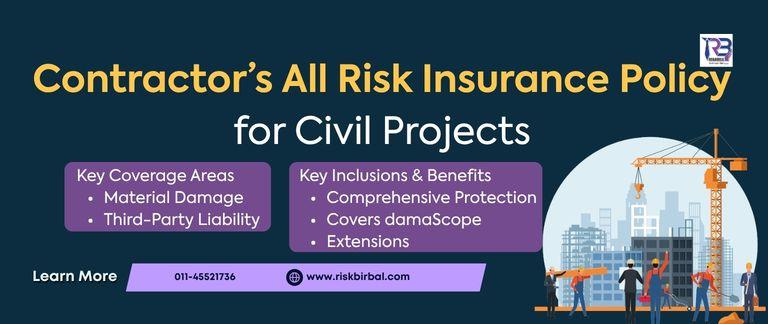
Construction sites are full of moving parts, heavy machinery, and unpredictable weather. One small accident can lead to huge financial losses. That is why every builder needs a Contractors All Risk Insurance Policy. It protects your project from start to finish. Similarly, if your work involves assembling large machinery or steel structures, the Best Erection All Risk Insurance Policy is another smart option to explore. But for general construction, a Contractors All Risk policy is your best friend.
What Exactly is a Contractors All Risk Insurance Policy?
A Best Contractors All Risk Insurance Policy (often called CAR insurance) is a special type of insurance designed for construction projects. It covers both the materials and the liability arising from the work. In easy words, if something unexpected damages your site or hurts someone, this policy pays for it.
Unlike standard business insurance, a Contractors All Risk policy covers the project itself—not just your office or equipment. It is commonly used for buildings, bridges, roads, dams, and housing complexes.
Other Names You Might Hear
While shopping, you may come across similar terms. These include construction all risk cover, builders risk insurance, project insurance, and contractor’s plant and machinery insurance. All these point to the same core idea: complete protection for your construction site.
Key Features of Contractors All Risk Insurance
A good Contractors All Risk Insurance Policy comes with several useful features:
- All-risk cover – It covers all sudden and unforeseen physical loss or damage, unless specifically excluded.
- Material damage – Protects construction materials, temporary structures, and site equipment.
- Third-party liability – Covers legal costs if someone gets injured or their property is damaged because of your work.
- Flexible tenure – You can buy it for a few months to several years, depending on project length.
- Add-on covers – Options like terrorism cover, earthquake cover, or flood cover can be added.
What Does a Contractors All Risk Policy Cover?
Let me break it down with easy examples.
1. Damage to Permanent Works
Imagine you are building a 10-floor apartment. A sudden storm blows away the scaffolding and damages the concrete slabs on the 5th floor. Your Contractors All Risk Insurance Policy will pay for repairing that damage.
2. Damage to Construction Materials
Suppose a fire breaks out in your material storage shed, burning cement bags and steel rods. The policy covers the cost of replacing those materials.
3. Construction Plant & Machinery
If a crane or excavator on site gets damaged due to an operator’s honest mistake, the policy pays for repairs.
4. Temporary Structures
Office cabins, worker sheds, and site fences are also covered. If a vehicle rams into your site office, insurance takes care of it.
5. Third-Party Liability
A pedestrian walks near your site. A brick falls from the 3rd floor and hits his shoulder. Your policy covers his hospital bills and any legal expenses.
Practical Example to Help You Understand Better
Let’s take a real-life situation.
Scenario: Rohan Constructions is building a shopping mall. One night, heavy rain causes flooding at the site. The excavated pit fills with water, and the foundation work is ruined. Also, the electric pump and wiring get damaged.
Because Rohan had a Contractors All Risk Insurance Policy, his claim was accepted. The insurer paid for:
- Removing water from the pit
- Re-doing the foundation work
- Repairing the pump and wiring
Without this policy, Rohan would have lost lakhs of rupees.
What is NOT Covered (Exclusions)
Every insurance has limits. Here are common exclusions in a Contractors All Risk policy:
- Normal wear and tear – Aging or rusting of materials is not covered.
- Willful negligence – If you ignore safety rules on purpose, no claim.
- Faulty design or workmanship – If a structural engineer makes a bad design, insurance won’t pay to fix it. However, resulting damage to other parts may be covered.
- War, nuclear risks, or radioactive contamination
- Consequential losses – Loss of profit, delay penalties, or rent loss due to project delay are not covered. (You need a separate delay insurance for that.)
- Theft from an unattended vehicle or unexplained disappearance.
Note: For projects involving assembly of heavy machinery, you may need an Erection All Risk Insurance Policy. That is a different product focused on mechanical and electrical erection works. We have covered it in detail in another blog (click here to read).
Why is Contractors All Risk Insurance So Important?
Many small builders avoid insurance to save money. That can be a costly mistake. Here is why you should never skip it:
- Unpredictable nature of construction – Fire, flood, lightning, collision, theft – anything can happen overnight.
- Large financial exposure – Even a small fire can destroy months of work. Rebuilding costs could break your business.
- Contractual requirement – Most big project owners and government tenders make CAR insurance mandatory.
- Peace of mind – You can focus on quality and speed, knowing that accidental damage won’t ruin you.
Tips for Choosing the Right Contractors All Risk Insurance Policy
Picking the right policy is not difficult if you follow these easy steps:
1. Assess Your Project Correctly
Calculate the total completed value of the project, including materials, labor, and contractor’s profit. That should be your sum insured.
2. Read the Exclusions Carefully
Some policies exclude earthquake or flood in certain zones. If your site is in a high-risk area, buy add-ons to cover those perils.
3. Check the Deductible
This is the amount you pay before insurance kicks in. A lower deductible means higher premium, but less out-of-pocket expense during a claim.
4. Compare Multiple Insurers
Dont just buy from the first agent. Get quotes from 3–4 companies. Look at claim settlement ratios and customer reviews.
5. Add Necessary Riders
Common riders include:
- Terrorism cover (very relevant today)
- Earthquake and flood cover (if not already included)
- Maintenance visit cover (for a set period after completion)
6. Know the Claim Process
Ask the insurer: Whom to call in an emergency? What documents are needed? A quick claim settlement saves your project timeline.
Conclusion
A Contractors All Risk Insurance Policy is not an expense—it is an investment in the safety of your project. From a small house extension to a massive flyover, every construction site faces risks. Fire, storm, theft, or accidental damage can happen to anyone. With the right Contractors All Risk cover, you shift that financial burden to the insurer. You also comply with legal and contract requirements. So before you pour the first bag of cement or lay the first brick, talk to an insurance advisor and get a policy that fits your project. Your future self will thank you.
Frequently Asked Questions (FAQs)
1. Who should buy a Contractors All Risk Insurance Policy?
Any individual or company involved in construction—builders, contractors, project owners, developers, and even sub-contractors—should buy this policy. It is also mandatory for many government and private tenders.
2. Does a Contractors All Risk policy cover worker injuries?
No. Worker injuries are covered under a separate Workmen’s Compensation Policy or an Employer’s Liability Insurance. CAR insurance only covers third-party injury, not your own employees.
3. Can I get a policy for a small home renovation?
Yes. Many insurers offer CAR policies for small projects like a house extension, terrace renovation, or interior works. The premium is very affordable for low-risk projects.
4. What happens if my project gets delayed? Will CAR insurance pay for penalty?
No. Delay penalties or loss of rent due to late completion are not covered under a standard Contractors All Risk policy. You would need a specific Delay in Start-Up (DSU) insurance.
5. Is architect’s fee covered in case of damage?
Yes. If the damage is serious and requires re-design or re-approval from an architect, reasonable architect’s fees are covered as part of the repair cost.
6. How is the premium calculated?
Premium depends on:
- Project value (sum insured)
- Type of construction (residential, commercial, industrial)
- Location (earthquake/flood zone)
- Duration of the project
- Past claim history of the contractor
7. Can I cancel the policy mid-way and get a refund?
Yes, most insurers allow cancellation. You will get a refund of the unexpired premium after deducting a short-period premium (usually 15-25%). Check your policy wording.

 Arabic
 French
 Spanish
 Portuguese
 Deutsch
 Turkish
 Dutch
Dutch
 Italiano
 Russian
 Romaian
 Portuguese (Brazil)
 Greek
Greek