


Master These 10 AI Skills to Thrive in the Modern Workforce
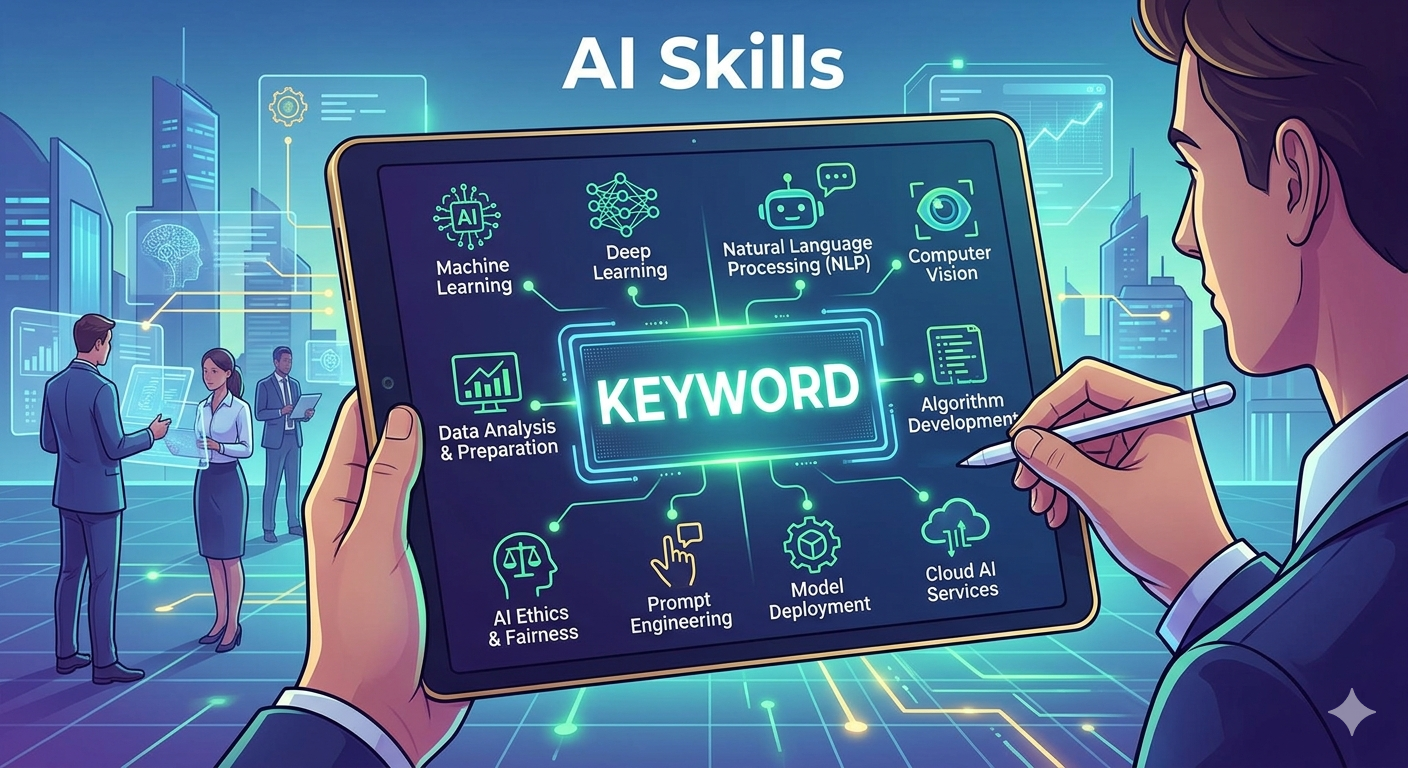
Artificial intelligence is no longer a niche specialty it is the defining professional currency of our era. Whether you work in marketing, finance, law, healthcare, or engineering, AI is reshaping every role, every workflow, and every expectation. The professionals who thrive in the next decade will not simply be those who understand AI they will be those who can harness it with precision and creativity.
Here are ten AI skills that are quickly becoming essential for every forward-thinking professional regardless of industry.
1. Prompt Engineering
Communicating with AI systems is a skill in itself. Prompt engineering is the art of crafting precise, context-rich instructions that guide large language models toward accurate, useful outputs. Professionals who learn to write effective prompts structuring roles, constraints, examples, and output formats consistently get far more value from AI tools than those who rely on vague, one-line inputs. It is the new version of knowing how to formulate a good search query, except the stakes and the rewards are dramatically higher.
2. AI-Augmented Writing and Editing
Generative AI tools have transformed writing from a bottleneck into a superpower. The skill is not in getting AI to write for you wholesale it is in using AI as an intelligent collaborator: brainstorming structures, drafting first versions, stress-testing arguments, and refining tone. Professionals in communications, legal, marketing, and strategy who master AI-assisted writing produce higher-quality content in a fraction of the time.
3. Data Analysis and Interpretation with AI
AI tools can now parse enormous datasets, identify patterns, generate visualizations, and surface insights that would take a human analyst days to uncover. Professionals who combine domain knowledge with AI-driven data tools hold a formidable edge. You do not need to be a data scientist but you do need to know how to ask the right questions of AI-powered analytics platforms and critically evaluate the outputs they produce.
4. AI Workflow Automation
From inbox management to CRM updates, AI can automate repetitive tasks that consume hours of professional time each week. Understanding how to design and deploy AI-driven workflows using tools like Zapier, Make, or custom API integrations is increasingly expected in operations, project management, and administrative roles. Professionals with this skill reclaim time for higher-value strategic work.
5. Understanding AI Ethics and Bias
As organizations integrate AI into hiring, lending, healthcare, and customer service decisions, the ability to critically evaluate AI systems for ethical integrity and bias has become a vital professional responsibility. Knowing how training data shapes model behavior, how to spot discriminatory outputs, and how to advocate for fairness frameworks is no longer just for ethicists it is essential for any professional involved in deploying or governing AI systems.
6. AI-Powered Research and Synthesis
The ability to rapidly synthesize vast bodies of knowledge research papers, industry reports, legal precedents, competitive intelligence is supercharged by AI. Professionals who learn to use AI research tools effectively can absorb and apply information at a speed that was previously impossible. This skill is invaluable in consulting, law, medicine, policy, and academia, where staying current and comprehensive directly drives outcomes.
7. No-Code and Low-Code AI Development
AI has democratized software creation. No-code platforms powered by AI now allow professionals without engineering backgrounds to build custom applications, dashboards, and automation tools. Understanding how to translate a business problem into a functional AI-assisted solution even without writing a single line of code is a genuinely transformative skill that elevates professionals across every function.
8. AI Literacy and Vendor Evaluation
The AI tools market is evolving at a dizzying pace. Professionals who can evaluate AI vendor claims critically, understand the difference between machine learning, generative AI, and rules-based automation, and assess fit for specific use cases are invaluable to their organizations. This strategic AI literacy helps companies avoid costly mistakes, choose the right platforms, and build coherent AI strategies rather than accumulating a chaotic stack of disconnected tools.
9. AI-Enhanced Presentation and Visual Storytelling
The ability to communicate complex ideas clearly and compellingly is perennial and AI has radically accelerated it. Tools that generate slides, infographics, diagrams, and data visualizations from text prompts are transforming how professionals tell stories with data. Mastering AI-driven visual communication elevates proposals, board presentations, client pitches, and internal reports in ways that capture attention and drive decisions.
10. Continuous AI Learning and Adaptation
Perhaps the most important skill of all is the meta-skill of staying current. The AI landscape is changing faster than any single certification or course can capture. Professionals who build habits of continuous learning following research developments, experimenting with new tools, and participating in professional AI communities maintain a durable competitive advantage. Adaptability, curiosity, and a willingness to unlearn outdated assumptions are as important as any technical competency.
Summary
The integration of AI into professional life is not a future possibility it is a present reality. The ten skills outlined above represent a practical roadmap for any professional who wants to remain relevant, productive, and competitive in an AI-augmented world. From prompt engineering and data analysis to ethical awareness and continuous learning, these capabilities collectively define what modern professional excellence looks like.
For those serious about structured, high-quality AI skills development, platforms like Unichrone offer industry-recognized training and certification programs that equip professionals with the knowledge and credentials to confidently navigate the AI era. Investing in these skills today is not optional it is the strategic imperative of a generation.

 Arabic
 French
 Spanish
 Portuguese
 Deutsch
 Turkish
 Dutch
Dutch
 Italiano
 Russian
 Romaian
 Portuguese (Brazil)
 Greek
Greek