


How Smart Contract Automation Enhances STO Development Platforms
The financial technology landscape is changing rapidly, and Security Token Offering (STO) development platforms are becoming an important part of modern digital fundraising. Businesses are increasingly exploring tokenized assets and blockchain-based investment systems because they offer better transparency, improved efficiency, and stronger compliance capabilities compared to traditional fundraising methods.
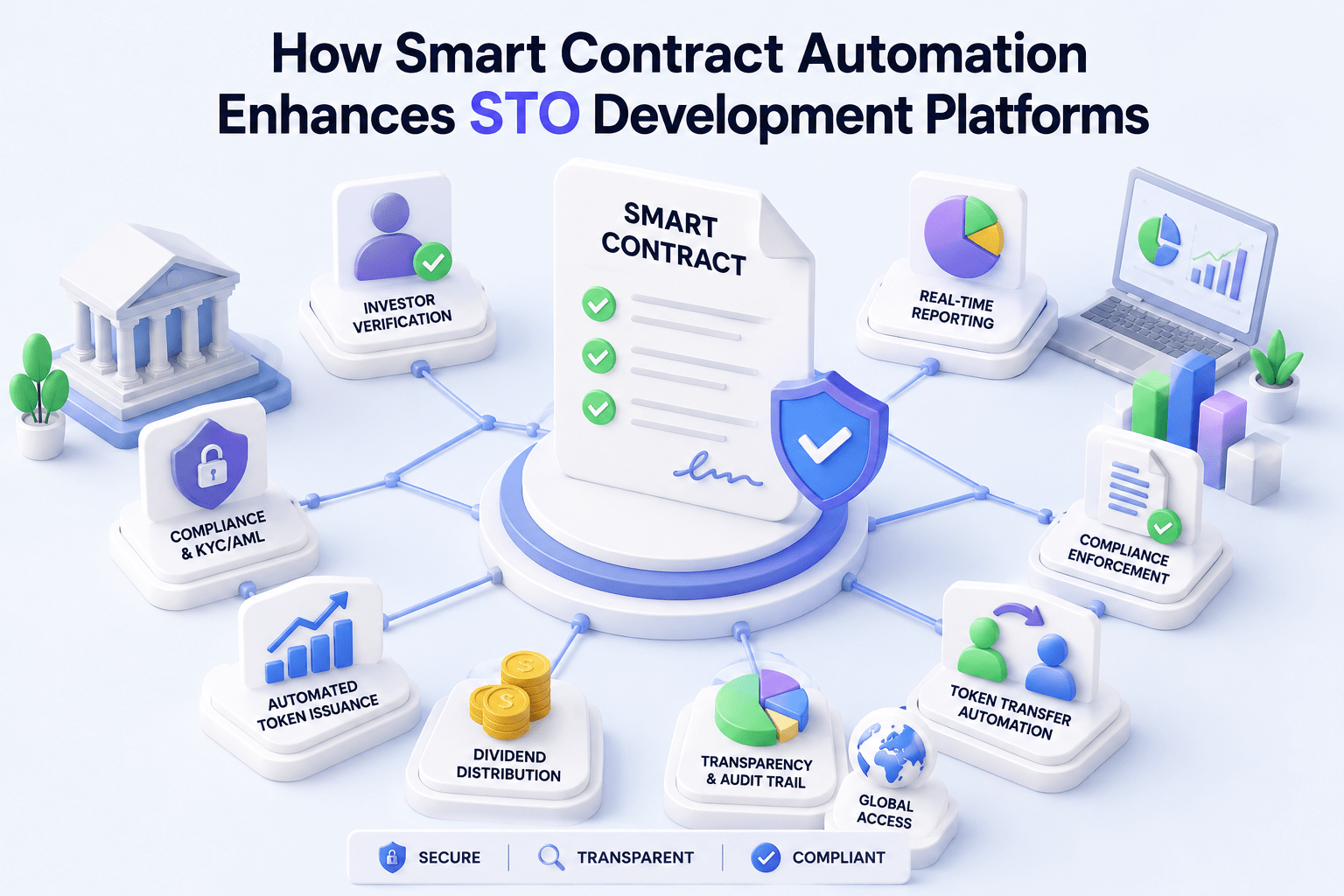
At the center of this transformation is smart contract automation. Smart contracts help STO platforms automate complex processes such as investor verification, token issuance, compliance management, dividend distribution, and asset transfers. Instead of depending heavily on manual operations, businesses can create streamlined and secure digital investment ecosystems powered by blockchain technology.
As the demand for security token development, asset tokenization, and regulated blockchain platforms continues to grow, smart contract automation is becoming one of the most valuable technologies within STO infrastructure.
Understanding Smart Contracts in STO Platforms
A smart contract is a blockchain-based program designed to execute actions automatically when predefined conditions are met. In STO development, these contracts function as digital agreements that help manage token-related activities without requiring constant manual supervision.
For example, smart contracts can automatically:
-
Issue security tokens to verified investors
-
Restrict unauthorized token transfers
-
Distribute dividends based on ownership percentages
-
Record transactions on an immutable blockchain ledger
-
Enforce compliance and investor eligibility rules
Because these processes are automated, STO platforms can operate with greater consistency and reduced operational friction.
Why Automation Matters in STO Development
Traditional fundraising systems often involve paperwork, intermediaries, approval delays, and repetitive administrative tasks. These limitations can slow down investment processes and increase operational costs.
Smart contract automation helps solve these challenges by creating a more efficient workflow. Instead of handling tasks manually, STO platforms can rely on programmable blockchain logic to execute operations in real time.
This automation improves:
-
Transaction efficiency
-
Accuracy of token management
-
Investor onboarding speed
-
Operational scalability
-
Compliance monitoring
-
Overall platform reliability
As STO ecosystems grow larger and more complex, automation becomes essential for maintaining performance and security.
Automated Token Issuance and Allocation
One of the most important applications of smart contracts in STO development is automated token issuance. Once investors complete identity verification and meet compliance requirements, smart contracts can instantly allocate tokens according to predefined investment conditions.
This process removes unnecessary delays and reduces the risk of human error during fundraising campaigns.
Automated token allocation also creates a transparent investment environment because every transaction is recorded on the blockchain. Investors can independently verify token ownership and transaction history without relying solely on centralized systems.
Simplifying Compliance Management
Regulatory compliance plays a major role in STO development. Security token platforms often need to follow strict regulations related to investor eligibility, KYC verification, AML procedures, and regional investment restrictions.
Managing these requirements manually can become difficult, especially for platforms handling international investors.
Smart contract automation simplifies compliance by embedding rules directly into the blockchain system. This allows STO platforms to automatically enforce regulatory requirements during transactions.
For example, automated contracts can:
-
Verify accredited investor status
-
Prevent restricted token transfers
-
Enforce lock-in periods
-
Block transactions from unsupported regions
-
Maintain transparent audit trails
This approach helps businesses create more compliant and regulation-ready fundraising ecosystems.
Improving Investor Onboarding
Investor onboarding is often one of the most time-consuming stages in digital fundraising. Traditional onboarding processes involve document collection, identity checks, approval workflows, and compliance verification.
Smart contract automation helps streamline this experience.
When integrated with KYC and AML systems, STO platforms can automatically verify user information and grant access to eligible investors faster. This reduces waiting times while maintaining regulatory standards.
A smoother onboarding experience can improve investor confidence and make blockchain investment platforms more accessible to a broader audience.
Enhancing Transparency Across the Platform
Transparency is one of the defining advantages of blockchain-based systems. Smart contracts strengthen this transparency by ensuring that platform rules and transactions are executed exactly as programmed.
Every token transfer, ownership update, and investment action is permanently recorded on the blockchain ledger. Since these records cannot be altered easily, investors gain better visibility into platform operations.
This level of transparency helps reduce disputes, improve accountability, and build trust between issuers and investors.
Automating Dividend Distribution
Managing dividend payments manually can become complicated for STO platforms with large investor communities. Smart contract automation simplifies this process by distributing rewards automatically based on token ownership data.
Instead of processing payouts manually, the platform can execute dividend distributions through blockchain transactions.
Automated dividend systems help improve:
-
Payment accuracy
-
Transaction speed
-
Operational efficiency
-
Investor satisfaction
-
Financial transparency
For businesses managing tokenized investment products, this automation reduces administrative overhead while creating a smoother investor experience.
Supporting Secondary Market Transactions
Many modern STO platforms support secondary market trading, allowing investors to trade security tokens after the initial offering phase.
Smart contracts play an important role in securing these transactions. Before approving token transfers, automated systems can verify whether buyers meet compliance and eligibility requirements.
This helps create a safer digital trading environment while maintaining regulatory controls.
Secondary market support also improves liquidity, which is often considered an important factor in the growth of tokenized asset ecosystems.
Strengthening STO Platform Security
Security remains a major priority in blockchain fundraising platforms. Smart contract automation reduces the risks associated with manual transaction handling and centralized processing systems.
Modern STO development platforms often combine smart contracts with additional security technologies such as:
-
Multi-signature authentication
-
Encrypted wallet systems
-
Role-based access controls
-
Automated monitoring tools
-
Immutable transaction records
These security layers help protect investor assets and reduce vulnerabilities within the platform infrastructure.
Enabling Fractional Asset Ownership
Fractional ownership is becoming increasingly common in industries such as real estate, venture capital, and private equity. STO platforms make this model more accessible by tokenizing assets into smaller digital units.
Smart contracts automate the management of these ownership structures by handling token allocation, transfer permissions, dividend calculations, and investor records.
This allows more investors to participate in high-value investment opportunities without requiring large amounts of capital.
As tokenization continues to expand across industries, fractional ownership models are expected to play a larger role in digital finance ecosystems.
Scalability and Long-Term Efficiency
As STO platforms grow, manual operations become harder to manage. Smart contract automation helps businesses scale their fundraising infrastructure without significantly increasing operational complexity.
Automated systems can handle:
-
Large transaction volumes
-
Multiple investor accounts
-
Real-time compliance checks
-
Token lifecycle management
-
Cross-border investment operations
This scalability makes STO development platforms more adaptable for enterprises planning long-term blockchain fundraising strategies.
The Future of Smart Contract Automation in STO Development
The future of STO development will likely involve deeper integration with emerging technologies such as artificial intelligence, decentralized identity systems, and cross-chain interoperability solutions.
Future smart contract systems may support:
-
AI-assisted compliance analysis
-
Automated governance mechanisms
-
Cross-chain security token transfers
-
Advanced investor analytics
-
Real-time risk monitoring
As blockchain technology matures, automation will continue to improve the efficiency and reliability of tokenized investment platforms.
Conclusion
Smart contract automation is playing an increasingly important role in the evolution of STO development platforms. By automating token issuance, compliance workflows, investor onboarding, dividend distribution, and transaction management, smart contracts help create more efficient and transparent digital fundraising ecosystems.
For businesses exploring security token development, asset tokenization, and blockchain-based investment infrastructure, automation provides a practical way to improve scalability, strengthen security, and simplify operational processes.
As the digital asset industry continues to evolve, smart contract automation is expected to remain a foundational technology behind secure, compliant, and investor-friendly STO platforms.

 English
 Arabic
 French
 Spanish
 Portuguese
 Turkish
 Dutch
Dutch
 Italiano
 Russian
 Romaian
 Portuguese (Brazil)
 Greek
Greek