


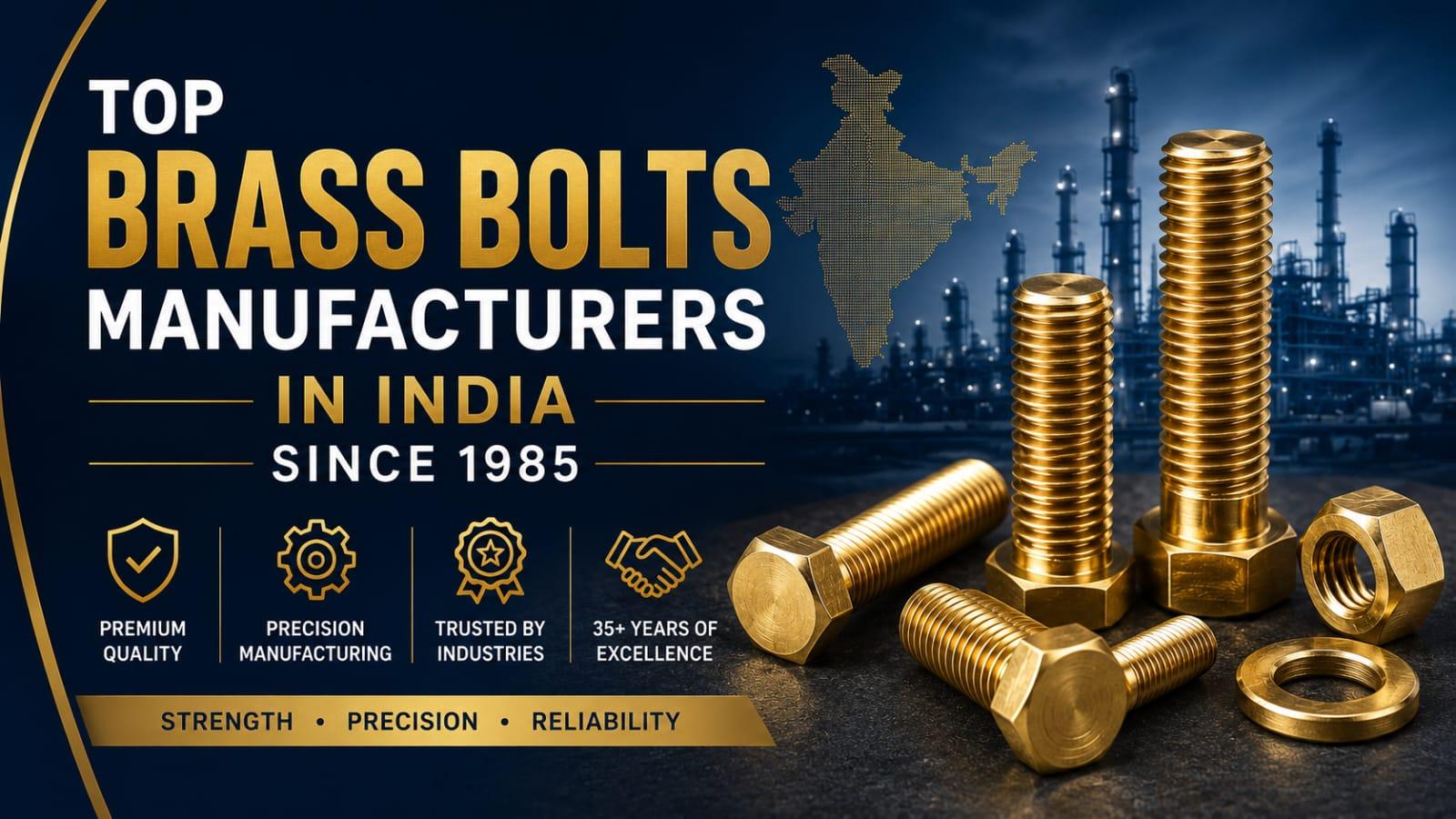
Top Brass Bolts Manufacturers in India Since 1985
A delayed shipment usually starts with something small. A mismatched thread pitch. Poor plating thickness. A supplier who quietly swaps raw material grades after the first order. That's how procurement teams end up rejecting entire lots of Brass Bolts three days before dispatch.
Most buyers only discover the problem after installation starts.
Across electrical panels, switchgear assemblies, transformers, telecom hardware, and marine fittings, fastening failure is rarely dramatic. It is expensive instead. Loose conductivity, corrosion marks around joints, stripped threads during torque application — these are the issues procurement managers spend weeks cleaning up after the invoice is already paid.
India exported more than $17 billion worth of engineering goods in recent years, and industrial fasteners remain a major contributor to that manufacturing supply chain. Buyers now expect tighter tolerances, traceable material sourcing, and consistent production capacity from suppliers handling Brass Bolts, Copper Bolt products, and Hex Nut assemblies.
And yet, many sourcing decisions are still made on price alone.
The Specification Detail That Separates Reliable Fasteners From Scrap Inventory
Brass Bolts for Electrical and Industrial Applications
Brass Bolts are widely used where conductivity and corrosion resistance matter at the same time. Common industries include:
-
Electrical switchgear manufacturing
-
Transformer assembly
-
Automotive electrical systems
-
Renewable energy infrastructure
-
Telecom equipment manufacturing
-
Marine hardware production
Typical specifications include:
-
Material Grades: IS 319 Brass Free Cutting, CW614N, CZ121
-
Thread Standards: Metric, BSW, UNC, UNF
-
Sizes: M2 to M24
-
Finish Options: Natural brass, nickel plated, tin plated
-
Tensile Strength: Usually between 350–550 MPa depending on alloy composition
Here's what buyers often overlook: plating adhesion consistency.
A bolt can pass dimensional inspection and still fail in humid operating environments because the coating thickness varies across batches. That problem usually appears six months later, long after the supplier stops answering calls.
Copper Bolt Requirements Buyers Rarely Document Properly
Copper Bolt products are heavily used in earthing systems, power distribution setups, railways, and electrical transmission projects because conductivity is non-negotiable there.
Common specifications include:
-
ETP Copper and Electrolytic Copper grades
-
High conductivity standards above 99.9% purity
-
Tin-coated options for oxidation resistance
-
Custom threading for busbar assemblies
-
Heat resistance for heavy electrical loads
Which means material purity certificates matter more than glossy catalogs.
Some suppliers mix secondary copper to reduce cost. Buyers rarely detect it during incoming inspection because the dimensional accuracy still looks correct. The conductivity drop only appears during load conditions.
That's not a manufacturing shortcut. That's a liability transfer.
Why Hex Nut Precision Changes Assembly Speed
Hex Nut tolerances directly affect installation efficiency on production floors. A slightly inconsistent thread fit can slow assembly teams by hours across large projects.
Standard configurations include:
-
DIN 934 Hex Nut standards
-
Metric and imperial threading
-
Brass, copper, stainless steel, and mild steel variants
-
Lock nut and heavy hex options
-
RoHS-compliant finishing for export markets
Nobody tells you how difficult thread consistency becomes during large-volume production runs above 200,000 pieces.
Tool wear changes thread accuracy gradually. Suppliers without calibrated inspection intervals usually discover defects after dispatch, not before packing.
Five Supplier Checks Procurement Teams Should Stop Ignoring
1. Ask for Batch Traceability, Not Just ISO Certificates
An ISO certificate alone proves almost nothing unless the supplier maintains batch-level inspection records.
Bad answer:
“We check quality internally.”
That statement means there is no documented accountability.
Reliable Brass Bolts Manufacturers maintain hardness reports, plating reports, and raw material traceability linked to production lots.
2. Verify Actual Manufacturing Capacity
Many traders present themselves as manufacturers.
A factory producing 40,000 Copper Bolt units monthly cannot realistically deliver 600,000 units in 18 days unless subcontracting is involved. Buyers need clarity before placing annual contracts.
3. Check Thread Inspection Methods
Go beyond visual inspection claims.
Bad answer:
“We inspect randomly.”
Random inspection without calibrated gauges is exactly how mixed-thread shipments happen.
Suppliers handling Hex Nut production seriously use GO/NO-GO gauges and maintain calibration records.
4. Audit Packaging Standards
Loose-packed industrial fasteners create transit damage, thread deformation, and plating scratches.
Export buyers especially need:
-
Moisture-resistant packaging
-
Batch labeling
-
Carton weight consistency
-
Pallet stability for container loading
One damaged shipment can erase margin from an entire order cycle.
5. Evaluate Communication During Technical Discussions
Most procurement problems begin before production starts.
A supplier who avoids tolerance discussions or material substitution questions will become harder to manage after advance payment is released.
And yes, that happens more often than buyers admit publicly.
Why Reliable Brass Bolts Protect Margins Better Than Cheap Alternatives
Reduced Installation Failure
Consistent threading lowers rejection rates during assembly. That directly cuts labor waste on factory floors where downtime costs accumulate hourly.
Better Corrosion Resistance in Humid Environments
Industrial-grade Brass Bolts and Copper Bolt products resist oxidation far better than low-grade mixed-alloy fasteners, especially in coastal installations and outdoor electrical systems.
India's western coastal regions regularly see humidity above 70% during monsoon months. Poor plating gets exposed fast there.
Lower Warranty Claims
A failed Hex Nut connection inside electrical equipment can trigger overheating, vibration loosening, or conductivity loss. Buyers absorb replacement costs long before suppliers do.
Faster Vendor Approval for Export Markets
European and Middle Eastern buyers increasingly request RoHS compliance and material certification for industrial fasteners. Suppliers prepared with documentation move faster through procurement approval cycles.
Stable Long-Term Pricing
Established Brass Bolts Manufacturers generally maintain stronger raw material procurement networks. That reduces sudden pricing shocks during copper and brass market volatility.
Fewer Production Interruptions
Consistency matters more than one-time pricing advantages.
A late shipment during infrastructure or OEM production schedules costs significantly more than a 2% savings on fastener pricing.
Why Brass Bolts Manufacturers in India Continue Gaining Global Demand
Specialized labor, proficient engineering, and an efficient exporting network make India one of the leading supply locations for industrial fasteners.
Thousands of engineering and machining workshops are located in Rajkot, Gujarat, and are connected to casting, threading, plating, and precision finishing. Because of that, lead times are shortened since subcontracting systems are in the vicinity.
This means that working with established Indian Brass Bolts Manufacturers usually shortens the time needed to coordinate production compared to sourcing overseas.
Buyers looking for Copper Bolt and Hex Nut Manufacturers in India, are now factoring in the accessibility of Gujarat ports for faster exports to the Middle East and Africa over the Inland producing areas.
There is something else that buyers also tend to assume, and that is power.
There are still many small workshops in some industrial zones where the supply of power is inconsistent and disruptive to manufacturing. Suppliers in built-up engineering clusters are generally better able to bear this risk due to investing in infrastructure and production planning.
We designed our production capabilities around the need to fulfill repeat orders, not one-time requests.
Fasteners in India are manufactured, since ‘85, in our manufacturing unit located in Rajkot, Gujarat.
At Kiran Industries, we've built our production around repeat orders, not one-time quotes. We cater to wholesalers, Procurement Managers, and OEM Suppliers. Our export buyers need consistency across recurring orders, not just competitive pricing.
Our production covers Brass Bolts, Copper Bolt products, Hex Nut assemblies, and custom industrial fasteners for electrical and engineering applications. We're ISO-certified, and we maintain inspection processes tied directly to batch production records.
We also learned something the hard way years ago. Around 2018, repeated export feedback showed moisture exposure issues during monsoon container movement for one packaging format we used on plated fasteners. We changed the internal packaging method after three separate buyer complaints from Gulf shipments. That adjustment reduced transit-related surface damage noticeably.
Send the Drawings, Thread Specs, and Annual Volume — We'll Quote Precisely
We typically respond to technical inquiries within 24 business hours.
For accurate quotations, send:
-
Fastener drawings or dimensions
-
Material grade requirements
-
Thread specifications
-
Surface finish requirements
-
Estimated annual quantity
-
Delivery location
Our MOQ depends on size and customization level, though standard production orders generally begin from 5,000 pieces onward.
And if a specification cannot be manufactured economically, we'll say that upfront instead of discovering it halfway through production.
Conclusion
Industrial buyers sourcing Brass Bolts are under more pressure now than they were even five years ago. Tighter tolerances, export compliance demands, and unpredictable raw material pricing have changed what reliable sourcing actually means. Suppliers who understand conductivity, plating integrity, thread precision, and shipment discipline will continue separating themselves from low-cost traders. The next phase of industrial procurement will favor manufacturers who can prove consistency batch after batch — not just promise it during negotiations.
Here is the another blog you might be interested in:
Top Bolt Manufacturers in India | Allen & Flange Bolts
FAQs
Which Industries Source Brass Bolts from Manufacturers in India?
Manufacturers in India producing Brass Bolts are used in the manufacturing of electrical and electronic equipment, telecom systems, renewable energy systems, automotive electrical systems, and marine engineering because of their resistance to corrosion and good conductivity.
How Do the Copper Bolt Manufacturers in India Ensure the Conductivity Standards?
Almost all of the established Copper Bolt Manufacturers in India offer test certificates for the raw materials as well as the reports for the verification of the conductivity. It is highly recommended that the buyers demand a test of a third-party laboratory for the important projects rather than relying on the supplier alone.
What Thread Standards Do Hex Nut Manufacturers Offer?
Manufacturers of Hex Nuts offer metric, UNC, UNF, BSW threads, and many more depending on the destination to which the product is exported and the requirements of the assembly.
What is the Typical Lead Time for the Orders of Brass Bolts?
Lead times for standard orders fall in the range of 2 to 5 weeks depending on the range of sizes, quantity of the order, and requirements for plating. The lead times may be extended due to custom toolings.
Are Plating Options for Copper Bolt Products Available?
Yes, they are. The most common are tin plating, nickel plating, and a natural finish. For some of the heavy-current applications, the extra coatings are avoided since the performance of conductivity is more critical than the appearance.
Why Do Some Hex Nut Shipments Experience a Failure at the Time of Installation?
The primary reason is inconsistency in threads. Gauge inspection that is not performed adequately, tooling that is worn, and production of mixed batches is some of the reasons for fitment issues which only come apparent during assembly.
How Should Buyers Evaluate Brass Bolt Manufacturers Before Choosing Their Suppliers?
To make an evaluation, the buyers need to consider production capability, inspection systems, batch traceability, export experience as well as packaging standards. In the long run, a supplier that offers the lowest rate while avoiding the discussion of technical aspects will be the most expensive.

 English
 Arabic
 French
 Spanish
 Portuguese
 Turkish
 Dutch
Dutch
 Italiano
 Russian
 Romaian
 Portuguese (Brazil)
 Greek
Greek