


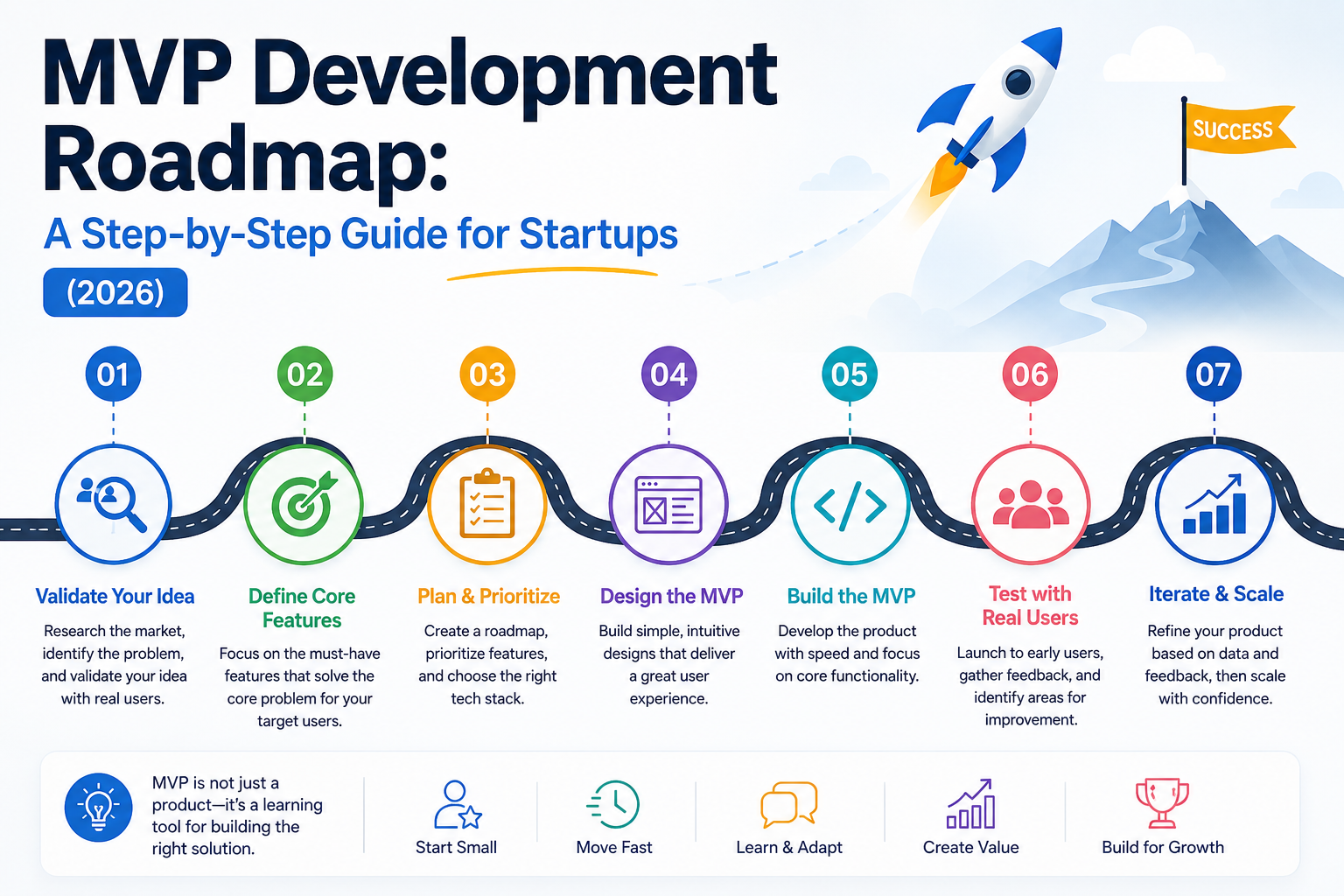
MVP Development Roadmap: A Step-by-Step Guide for Startups (2026)
90% of startups fail, and one of the biggest reasons is building products no one actually needs.
An MVP development roadmap helps founders avoid this mistake by validating ideas early, reducing costs, and accelerating time-to-market.
Markets are more competitive than ever, customer expectations are higher, and investors expect faster traction with lower burn rates. CB Insights has repeatedly identified a lack of market demand as one of the leading reasons startups fail. Yet many founders still spend months building products before validating whether users actually need them.
This guide explains how startups can validate ideas, prioritize features, reduce development waste, and launch lean products faster.
What Is an MVP Development Roadmap?
An MVP development roadmap is a structured framework that outlines how a startup moves from an initial idea to a launch-ready product. It defines product validation stages, feature priorities, technical planning, development timelines, and launch objectives required to build a scalable minimum viable product efficiently.
Unlike traditional software planning, an MVP roadmap focuses on validation rather than building every possible feature. The objective is to launch quickly, solve a clear user problem, and learn from real market feedback.
Startups use MVP roadmaps to:
-
Reduce unnecessary development expenses
-
Launch products faster with lean execution
-
Validate business ideas before large-scale investment
-
Improve investor confidence through early traction
-
Create scalable product foundations for future growth
A well-planned MVP roadmap also helps teams avoid feature overload and maintain clarity during development.
Key Insight: A good MVP solves one problem extremely well but not multiple problems poorly.
Why Startups Need an MVP Roadmap in 2026
The startup ecosystem has become increasingly competitive. New AI-powered tools, low-code platforms, and global digital products have accelerated competition across almost every industry.
Without a clear roadmap, startups often face:
-
delayed launches,
-
unclear product priorities,
-
and poor user adoption
A structured product planning approach helps founders focus on building only what users truly need.
|
Without MVP Roadmap |
With MVP Roadmap |
|
Random feature additions |
Clear feature prioritization |
|
Slow product launch |
Faster go-to-market |
|
Budget overruns |
Controlled development costs |
|
Weak validation |
Data-driven decisions |
|
Technical confusion |
Structured scalability planning |
Step 1: Validate the Startup Idea
The first stage of any successful startup MVP roadmap is validation.
Many startups fail because founders assume demand instead of validating it.
This step confirms whether the problem is real, urgent, and worth solving.
Before writing code, founders should understand:
-
who the target audience is,
-
What pain points exist,
-
how users currently solve the problem,
-
and whether users are willing to pay for a better solution.
One of the most effective ways to validate an idea is through direct customer conversations. Speaking with potential users often reveals insights that market research alone cannot uncover.
Startups should analyze competitors strategically. Instead of copying existing products, the goal should be to identify gaps, frustrations, or underserved audiences.
A simple landing page can also help measure demand. Many successful startups validate interest through waitlists, email signups, or demo requests before building the actual product.
The founders of Dropbox are a well-known example. Before developing the full product, they released a simple explainer video demonstrating how the platform would work. The overwhelming response confirmed market demand and helped validate the business idea early.
One major mistake founders make during validation is ignoring negative feedback. Constructive criticism is often more valuable than praise because it highlights gaps that need improvement before launch.
Summary: Validate demand before writing code. Assumptions are the biggest startup risk.
Step 2: Define the MVP Scope
Once the idea is validated, the next step is defining what the MVP should include.
This stage is critical because many startups fail by trying to build too much too early. An MVP is not a smaller version of a complete product. It is the simplest version capable of solving one core problem effectively.
Studies show that startups using MVP approaches can reduce initial development costs by up to 30–40% by avoiding unnecessary features.
A focused MVP generally serves:
-
one target audience,
-
one primary pain point,
-
and one essential workflow.
For example, a food delivery startup does not need loyalty programs, AI recommendations, or advanced analytics in its first version. Core ordering functionality is usually enough for initial validation.
The MoSCoW prioritization framework is commonly used during the MVP planning process.
|
Priority |
Purpose |
|
Must-Have |
Essential functionality |
|
Should-Have |
Important but non-critical |
|
Could-Have |
Optional improvements |
|
Won’t-Have |
Features reserved for future versions |
According to lean product development best practices, reducing initial feature scope often shortens MVP launch timelines and helps teams focus on core user value.
A common founder mistake at this stage is prioritizing investor impressiveness over user value. Users care more about solving problems efficiently than seeing dozens of features.
Summary: Focus on solving one core problem, not building a full product.
Step 3: Create User Flows and Wireframes
After defining the MVP scope, startups move into wireframing and user flow planning.
Wireframes help visualize how users will interact with the product before development begins. This stage helps identify usability issues early and reduces expensive redesigns later.
Teams should focus on creating simple, intuitive user journeys. Confusing onboarding flows are one of the most common reasons early-stage products lose users.
Popular design tools used by startups include:
-
Figma,
-
Balsamiq,
-
and Adobe XD.
At the MVP stage, functionality matters more than visual perfection. Many successful startups intentionally launch with minimal design polish so they can focus on testing product usability faster.
Experienced founders often recommend starting with low-fidelity wireframes because they encourage faster iteration and prevent unnecessary design debates.
Summary: Design simple, intuitive user journeys to reduce friction and improve early adoption.
Step 4: Build the Technical Architecture
This stage determines how scalable and maintainable the product will become in the future.
Although MVPs should remain lean, startups still need a stable technical foundation. Poor architectural decisions can create expensive rebuilding costs once user growth begins.
During this stage, startups typically decide:
-
frontend technologies,
-
backend frameworks,
-
database systems,
-
hosting infrastructure,
-
and integration capabilities.
Some founders choose no-code or low-code platforms for faster validation. Others invest directly in custom development if scalability is critical from the beginning.
|
Development Approach |
Best Use Case |
|
No-Code MVP |
Fast validation |
|
Low-Code MVP |
Limited technical resources |
|
Custom Development |
Long-term scalability |
|
Hybrid Development |
Budget-conscious startups |
One major founder mistake is over-engineering too early. Building enterprise-level infrastructure before validating demand often wastes valuable time and funding.
For example, many startups use a stack like React or Next.js for frontend, Node.js or Django for backend, PostgreSQL for databases, and AWS or Google Cloud for hosting. This combination balances speed, flexibility, and scalability.
Summary: Choose a scalable but lean tech foundation, avoid over-engineering early.
Step 5: Start MVP Development
Once planning is complete, the actual development process begins.
Most startups today follow agile sprint-based development because it allows faster iteration and continuous improvement.
A typical MVP development cycle includes:
-
backend setup,
-
database configuration,
-
authentication systems,
-
core feature implementation,
-
API integrations,
-
testing,
-
and deployment preparation.
Development speed is important, but speed without clarity creates technical debt. Successful startups maintain a balance between rapid execution and sustainable product quality.
Clear communication between founders, developers, and designers also becomes extremely important during this phase. Many startup delays happen because requirements keep changing mid-development.
Summary: Build fast with clarity- speed matters, but uncontrolled development creates technical debt.
MVP Development Timeline for Startups
The timeline for an MVP depends on complexity, feature scope, integrations, and team size.
Most startups in 2026 complete MVP development within 8 -16 weeks.
|
MVP Stage |
Estimated Timeline |
|
Idea Validation |
1-3 weeks |
|
Product Planning |
1 week |
|
Wireframing & UX |
1-2 weeks |
|
MVP Development |
6 -12 weeks |
|
Testing & QA |
1-3 weeks |
|
Launch Preparation |
1 week |
Complex SaaS products or marketplace platforms may require longer timelines due to backend architecture and third-party integrations.
Step 6: Conduct MVP Testing
Testing is one of the most underestimated phases in the MVP product roadmap.
Even strong ideas fail when users encounter bugs, crashes, or confusing workflows. A poor first experience can damage user trust immediately.
Startups should test:
-
functionality,
-
performance,
-
usability,
-
security,
-
and onboarding experience.
Beta testing is especially valuable because real users often behave differently than internal teams expect.
Many successful startups launch first to a small audience before expanding publicly. This controlled rollout helps identify friction points and prioritize improvements without exposing major issues to a larger market.
An important founder insight is that early users should be treated as collaborators rather than customers. Their feedback often shapes the final product direction more than internal assumptions.
Summary: Test with real users early- small issues can break trust and impact adoption.
Step 7: Launch the MVP Strategically
Launching an MVP is not the end goal. It is the beginning of continuous product learning.
Many startups mistakenly assume launch day determines success. In reality, post-launch iteration matters far more.
Startups typically choose between a soft launch for testing or a full public launch for growth.
|
Soft Launch |
Full Launch |
|
Limited audience |
Public availability |
|
Lower risk |
Higher visibility |
|
Easier issue management |
Greater support demand |
|
Feedback-focused |
Growth-focused |
After launch, startups should monitor:
-
user retention,
-
churn rate,
-
activation rate,
-
engagement metrics,
-
and customer acquisition costs.
Without analytics, founders cannot accurately measure whether the product is achieving product-market fit.
Real Startup MVP Examples
The early version of Airbnb was extremely simple. The founders initially offered apartment rentals through a basic website with manual coordination. Instead of building a large platform immediately, they focused on validating whether people were willing to book short-term stays online.
Uber also started with a narrow MVP strategy. The company launched in limited markets to validate rider demand and operational feasibility before scaling globally.
Similarly, Instagram focused primarily on photo sharing and filters during its initial launch. The simplified product experience helped accelerate adoption quickly.
These examples show that successful MVPs prioritize clarity and user value over feature quantity.
Summary: Launch is just the beginning- measure, learn, and iterate continuously.
Common Founder Mistakes During MVP Development
One of the biggest mistakes founders make is trying to build a “perfect” product before launch. Perfection delays learning.
Another common issue is ignoring user feedback because it conflicts with the founder’s original vision. Startups that adapt quickly generally perform better than those that resist change.
Poor development partner selection also creates major risks. Teams without startup experience often prioritize unnecessary complexity, which increases timelines and costs.
Some founders also skip analytics implementation entirely. Without measurable data, product decisions become guesswork rather than strategy.
Best Practices for a Successful MVP Planning Process
The most effective MVP strategies focus on learning speed rather than feature volume.
Startups should prioritize fast validation cycles, simple user journeys, and continuous feedback collection. Products evolve more successfully when founders stay close to real user behavior instead of relying only on assumptions.
Scalability should be planned gradually rather than forced prematurely. Many startups waste resources building infrastructure designed for millions of users before validating demand from the first hundred.
A sustainable MVP planning process balances:
-
execution speed,
-
budget efficiency,
-
user feedback,
-
and long-term technical scalability
Actionable MVP Development Checklist
Validation Phase
Validate market demand through interviews, competitor analysis, and audience research before beginning development.
Planning Phase
Define core MVP features, prioritize essential workflows, and establish measurable product success metrics.
Design Phase
Create user flows and wireframes that simplify onboarding and improve usability.
Development Phase
Build core functionality first, maintain sprint clarity, and implement analytics from the beginning.
Testing Phase
Conduct usability testing, identify friction points, and improve stability before public launch.
Launch Phase
Release strategically, monitor user behavior carefully, and continue improving the product based on real feedback.
In a nutshell, MVP Roadmap Framework is :
Validate → Define → Design → Build → Test → Launch → Iterate
Conclusion
A successful MVP strategy is not about building the largest or most advanced product immediately. It is about solving the right problem with the simplest possible solution and learning from users quickly.
Startups that follow structured MVP frameworks often reduce wasted development effort, launch faster, and improve their chances of reaching product-market fit. A successful MVP is less about building more features and more about validating the right solution quickly.
Startups that focus on validation, iteration, and user-centric execution often gain a stronger competitive advantage.
If you're planning a startup, don’t start with code, start with validation. Define your MVP roadmap this week and test your idea before investing months into development.
Frequently Asked Questions
1. What is an MVP development roadmap?
An MVP development roadmap is a structured plan that helps startups move from idea validation to product launch while focusing only on core features needed for market testing.
2. How long does MVP development take for startups?
Most startup MVPs take between 8 and 16 weeks, depending on feature complexity, integrations, development resources, and testing requirements.
3. What should a startup MVP roadmap include?
A startup MVP roadmap should include market validation, feature prioritization, wireframing, technical planning, development stages, testing strategy, launch preparation, and post-launch iteration planning.
4. What is the biggest mistake founders make during MVP development?
The biggest mistake is building too many features before validating whether users actually need the product.
5. Why is validation important in the MVP planning process?
Validation helps startups confirm market demand before investing heavily in development. It reduces risk, improves product direction, and increases the chances of achieving product-market fit.
6. Should startups choose no-code or custom MVP development?
No-code platforms work well for rapid validation and early-stage testing, while custom development is often better for products requiring scalability, complex workflows, or long-term flexibility.

 English
 Arabic
 French
 Spanish
 Portuguese
 Turkish
 Dutch
Dutch
 Italiano
 Russian
 Romaian
 Portuguese (Brazil)
 Greek
Greek