


Benefits of Digital Marketing: What Kotler Didn’t Fully Predict
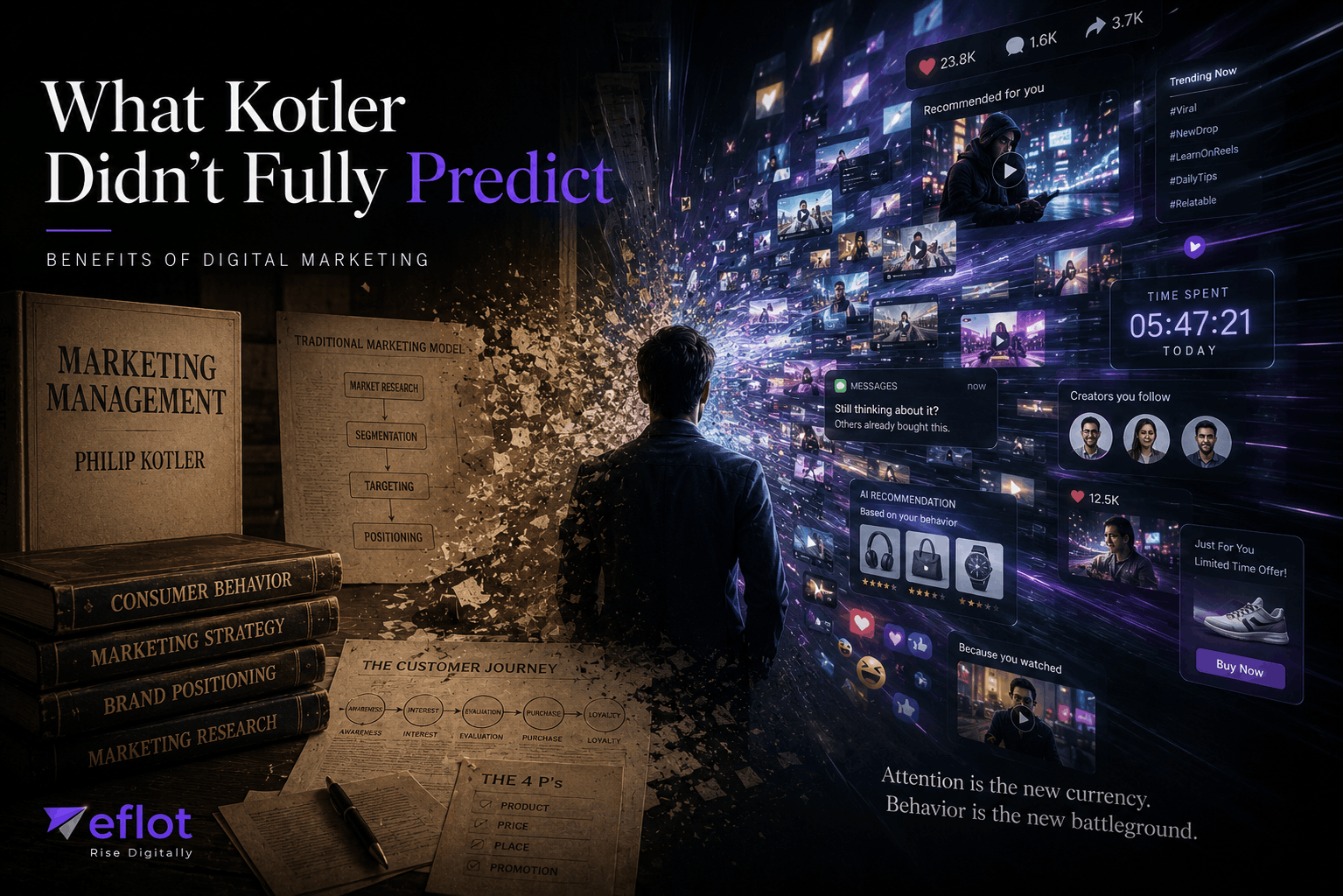
For decades, marketing was largely understood through structured theories.
Businesses learned:
-
segmentation
-
targeting
-
positioning
-
brand communication
-
consumer behavior
-
distribution strategy
through frameworks popularized by Philip Kotler and other classical marketing thinkers.
And to be clear — many of those principles still remain foundational today.
But something changed when marketing moved into algorithm-driven digital environments.
The internet did not simply digitize traditional marketing.
It changed:
-
how attention works
-
how trust forms
-
how audiences behave
-
how brands compete
-
how visibility is distributed
As a result, many of the real benefits of digital marketing today come from systems that classical marketing theory could not fully anticipate at internet scale.
Not because the theories were wrong.
But because the environment evolved faster than the models built around it.
When marketing moved from mass communication to algorithmic distribution
Traditional marketing operated in relatively stable media systems.
Television, newspapers, radio, and outdoor advertising worked through:
-
broad reach
-
repeated exposure
-
controlled communication cycles
Brands communicated.
Consumers received.
The process was slower and more predictable.
Modern digital marketing works differently.
Today:
-
algorithms decide visibility
-
platforms mediate attention
-
audiences fragment rapidly
-
trends emerge and disappear quickly
-
content competes in real time
This changed one of marketing’s biggest assumptions:
Visibility is no longer controlled only by budget.
Now, relevance, engagement behavior, retention signals, and platform algorithms influence discoverability heavily.
This is one reason businesses increasingly invest in structured digital marketing services rather than relying only on traditional advertising systems.
The biggest shift: attention became measurable
One of the biggest benefits of digital marketing is measurement precision.
Earlier marketing systems struggled to measure:
-
exact audience behavior
-
conversion journeys
-
attention retention
-
interaction quality
Businesses often estimated performance indirectly.
Modern digital systems changed this completely.
Today businesses can track:
-
click behavior
-
audience drop-off
-
conversion pathways
-
search intent
-
engagement duration
-
remarketing interactions
This transformed marketing from:
assumption-driven communication
into:
behavior-driven optimization.
This is one of the biggest departures from older marketing environments.
Why consumer behavior changed faster than marketing theory
Classical marketing theory assumed consumers moved through relatively structured decision journeys.
But digital environments disrupted that pattern.
Modern consumers:
-
compare multiple brands instantly
-
verify reviews before purchase
-
search repeatedly before converting
-
consume short-form and long-form content simultaneously
-
interact across multiple platforms before deciding
Trust formation itself changed.
Earlier:
-
trust came from repetition and familiarity
Now:
-
trust comes from validation, reviews, expertise signals, and discoverability
This is why content marketing became strategically important in digital ecosystems.
Because consumers increasingly evaluate expertise before engagement.
Why segmentation became far more aggressive online
Kotler’s STP model — Segmentation, Targeting, and Positioning — remains highly relevant.
But digital marketing intensified it dramatically.
Earlier segmentation relied on:
-
demographics
-
geography
-
broad behavioral assumptions
Today platforms segment users through:
-
behavioral data
-
search intent
-
engagement patterns
-
browsing history
-
interaction velocity
-
predictive modeling
This means digital marketing can now target:
-
highly specific buyer behaviors
-
micro-intent audiences
-
niche commercial interests
at a scale traditional systems never achieved.
This is one reason modern performance marketing became so commercially powerful.
Why digital marketing changed competition itself
Traditional competition was often geographically constrained.
Now businesses compete inside attention ecosystems.
A local business is no longer compared only against nearby competitors.
It may compete against:
-
national brands
-
niche creators
-
direct-to-consumer startups
-
influencer-driven businesses
-
AI-scaled content systems
This changed how businesses approach visibility.
Earlier:
-
distribution advantage mattered heavily
Today:
-
discoverability advantage matters more.
This is where systems like:
-
SEO service
-
local SEO
-
PPC service
-
conversion optimization
-
search visibility strategy
became essential business infrastructure rather than optional marketing activities.
What classical marketing did not fully predict
Many traditional theories assumed:
-
media scarcity
-
slower communication
-
limited distribution channels
-
centralized authority systems
But digital systems introduced:
-
infinite content creation
-
decentralized influence
-
creator economies
-
algorithmic amplification
-
rapid reputation shifts
For example:
A small business today can:
-
outperform larger brands through content
-
rank higher through SEO
-
build authority through niche positioning
-
acquire customers through viral discovery
without owning traditional media power.
This is one of the most disruptive benefits digital marketing introduced.
Why trust became more unstable online
Traditional branding often relied on controlled image-building over long periods.
Digital environments behave differently.
Today:
-
a single negative review can spread rapidly
-
reputation shifts happen faster
-
audiences verify claims independently
-
social proof influences perception immediately
This means branding became less controlled and more participatory.
Consumers now shape brand perception publicly.
That was difficult to fully predict during earlier marketing eras.
Why speed became a competitive advantage
One major difference between traditional and digital marketing is response speed.
Earlier campaigns required:
-
production cycles
-
printing
-
distribution delays
-
slower feedback systems
Now businesses can:
-
test campaigns instantly
-
adjust messaging rapidly
-
optimize funnels in real time
-
launch audience experiments immediately
This created a new competitive dynamic:
faster learning systems outperform slower planning systems.
In many industries today, adaptability matters as much as creativity.
Why digital marketing became more psychological
Modern digital systems increasingly optimize around:
-
retention
-
engagement
-
emotional triggers
-
behavioral loops
-
attention duration
Platforms reward content that keeps users active longer.
As a result, marketing today is heavily influenced by:
-
consumer psychology
-
behavioral economics
-
dopamine-driven interaction systems
-
algorithmic recommendation patterns
This goes far beyond classical advertising frameworks.
Why SEO became more important than many expected
Search engines quietly became one of the most powerful trust systems online.
When consumers search:
-
products
-
services
-
businesses
-
solutions
They often interpret visibility itself as credibility.
This changed how businesses approach growth.
Today, strong search visibility can influence:
-
authority perception
-
lead quality
-
conversion likelihood
-
long-term discoverability
This is why structured SEO service systems became central to sustainable digital acquisition.
Why digital marketing still follows some classical principles
Despite all these changes, many foundational principles from Kotler still remain true.
Businesses still need:
-
positioning clarity
-
audience understanding
-
value communication
-
trust-building
-
differentiation
The difference is:
the environment became faster, noisier, and algorithmically mediated.
So modern marketing is not a rejection of classical theory.
It is an evolution of it.
How Eflot approaches modern digital marketing systems
Eflot approaches digital marketing by combining foundational marketing principles with modern search and attention systems.
Instead of focusing only on visibility metrics, the emphasis is placed on:
-
search-driven discoverability
-
conversion-focused strategy
-
content positioning
-
behavioral audience understanding
-
integrated SEO and performance systems
The objective is not simply generating impressions.
It is building sustainable digital attention systems that convert visibility into business outcomes.
FAQ
Did Philip Kotler’s theories become outdated?
No. Many foundational concepts still remain highly relevant, but digital environments changed how they operate in practice.
What is the biggest benefit of digital marketing today?
Measurement precision and audience targeting are among the biggest advantages.
Why does digital marketing feel different from traditional marketing?
Because algorithms, platforms, and real-time behavior tracking changed how attention works.
Why is SEO so important now?
Search visibility increasingly influences trust, discoverability, and buying decisions.
Did digital marketing change consumer behavior?
Yes. Consumers now research, compare, and validate brands much more actively before converting.
Key Takeaways
-
Digital marketing changed how visibility and trust operate
-
Algorithms now influence attention distribution heavily
-
Consumer behavior evolved faster than traditional marketing systems expected
-
Measurement precision became a major advantage of digital marketing
-
SEO and discoverability now influence credibility directly
-
Modern marketing is an evolution of classical marketing principles, not a replacement

 English
 Arabic
 Spanish
 Portuguese
 Deutsch
 Turkish
 Dutch
Dutch
 Italiano
 Russian
 Romaian
 Portuguese (Brazil)
 Greek
Greek