


The Skill That Makes School Maths Feel Effortless
For many children, school maths can feel like a subject full of rules, steps and pressure. One week they are learning addition, the next they are solving multiplication problems, and soon they are expected to understand fractions, word problems and mental calculations. When the foundation is weak, maths can quickly become stressful.
But there is one skill that can make school maths feel much easier: strong mental number sense. When children understand how numbers work, how they connect and how to calculate confidently, they stop seeing maths as something scary. They begin to see it as something they can solve.
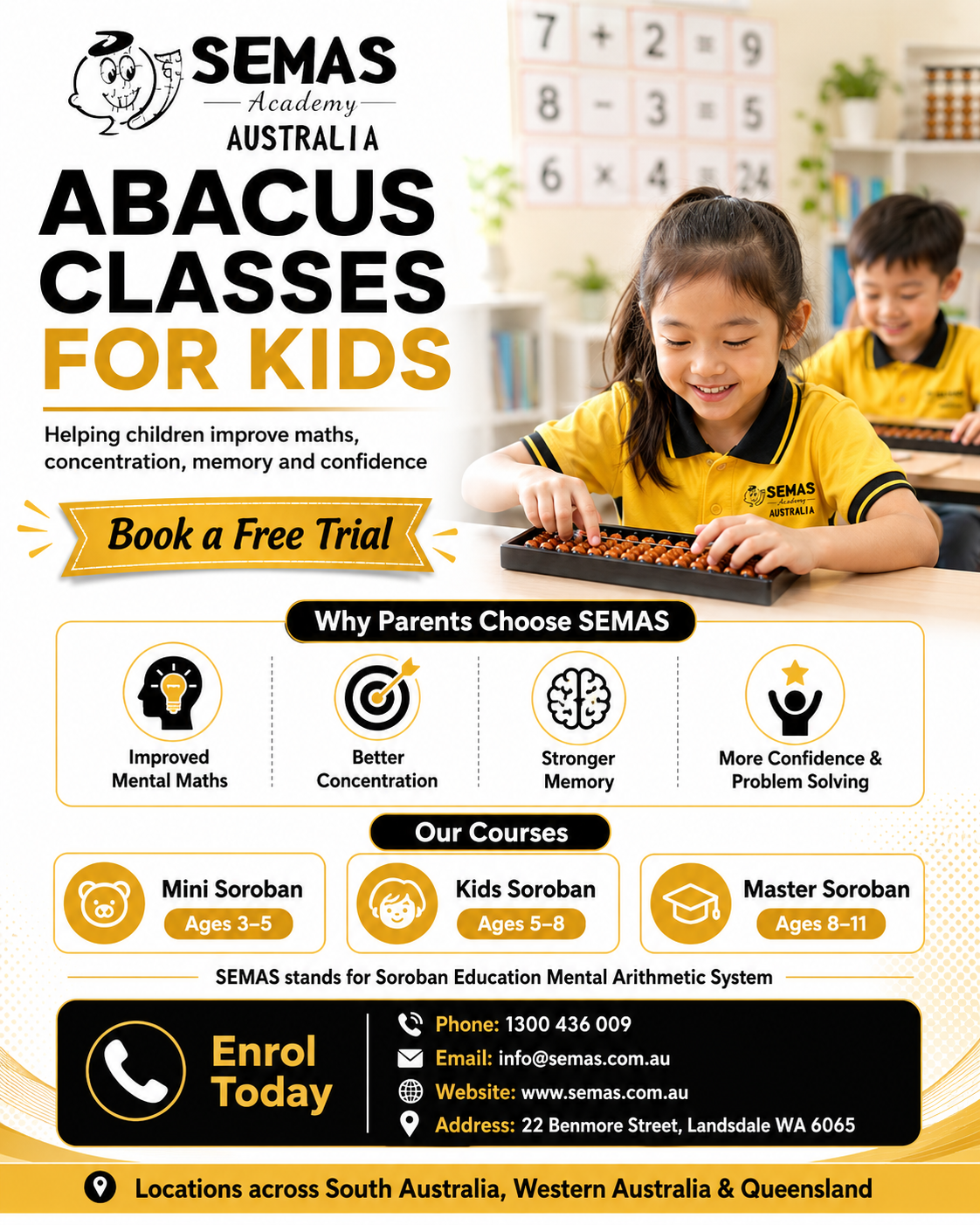
This is where abacus learning becomes valuable. Through structured bead-based practice, children learn to visualise numbers, calculate mentally and build confidence step by step. For parents searching for effective abacus classes or practical abacus maths support, SEMAS offers a Soroban-based program designed to help children strengthen maths ability, focus, memory and problem-solving skills.
Why School Maths Feels Difficult for Many Children
Maths is a cumulative subject. This means each new topic depends on earlier understanding. If a child does not fully understand number value, addition or subtraction, they may struggle later with multiplication, division, fractions and algebra.
Many children fall behind not because they are not intelligent, but because they lack confidence and a strong foundation. They may memorise methods without understanding them. They may count on fingers for too long. They may feel nervous when asked to solve problems quickly.
Common reasons children struggle with maths include:
-
Weak number sense
-
Poor understanding of place value
-
Slow mental calculation
-
Fear of making mistakes
-
Lack of regular practice
-
Difficulty remembering steps
-
Low confidence in class
Abacus maths helps address these issues by making numbers visual and practical. Children do not just copy methods; they learn how numbers move, combine and change.
What Is the Skill Behind Effortless Maths?
The skill that makes maths feel easier is not just speed. It is number fluency. Number fluency means a child can work with numbers accurately, flexibly and confidently.
A fluent child does not panic when seeing a calculation. They can break numbers apart, estimate answers, recognise patterns and choose a method that makes sense. This reduces stress and improves performance.
For example, when solving 48 + 27, a child with strong number fluency may think, “48 is close to 50, and 27 makes 75 if I adjust by 2.” This kind of thinking is much more powerful than slow counting.
Abacus learning develops this fluency through repeated visual practice. Children first move beads physically, then begin to picture the abacus in their minds. Over time, they calculate with greater speed and accuracy.
How Abacus Learning Builds Number Fluency
The abacus turns numbers into something children can see and touch. This is important because young learners often struggle with abstract ideas. A written number like 356 may look like three digits, but on an abacus, children can understand it as hundreds, tens and ones.
This improves place value understanding, which is essential for almost every maths topic.
|
Maths Skill |
How Abacus Learning Helps |
|
Place value |
Children see ones, tens, hundreds and thousands clearly |
|
Addition |
Beads show how numbers combine |
|
Subtraction |
Children see how numbers are taken away |
|
Mental maths |
Visualisation helps children calculate without writing every step |
|
Speed |
Regular practice improves fluency |
|
Accuracy |
Step-by-step bead movement reduces careless mistakes |
With regular abacus maths practice, children start building the mental habits that make school maths smoother.
From Physical Beads to Mental Maths
At the beginning, children use a real abacus. They move beads to represent numbers and solve sums. This physical stage is important because it builds understanding.
As they practise more, children begin to remember bead positions. They can picture numbers in their mind. Eventually, they learn to perform calculations mentally by visualising the abacus.
This process is known as mental abacus. It is one of the reasons abacus learning is so effective. Children are not simply memorising answers. They are training the brain to process numbers visually.
The learning journey usually follows four stages:
-
Recognising numbers on the abacus
-
Moving beads to solve basic calculations
-
Practising speed and accuracy
-
Visualising the abacus for mental arithmetic
This gradual approach helps children feel successful at every stage.
Why Abacus Classes Improve Confidence
Confidence plays a huge role in school performance. A child who believes they are “bad at maths” may stop trying, even when they are capable of improving. On the other hand, a confident child is more likely to attempt problems, ask questions and keep practising.
Abacus classes build confidence through visible progress. Children can see themselves improving from simple bead work to faster calculations. They experience success in small steps, and these small wins build self-belief.
When a child solves a calculation independently, they feel proud. When they improve their speed, they feel motivated. When they understand a maths concept that once felt difficult, they begin to believe, “I can do this.”
SEMAS focuses on helping children develop confidence along with mental arithmetic skills, making maths feel less intimidating and more achievable.
How Abacus Maths Supports Classroom Learning
Abacus maths does not replace school maths. It strengthens the foundation that school maths depends on. When children are more fluent with numbers, they can follow classroom lessons more easily.
For example, multiplication becomes easier when children understand repeated addition. Division becomes easier when they understand grouping. Fractions become easier when they understand parts and wholes. All of this depends on strong number sense.
Abacus learning can help children with:
-
Faster mental addition
-
More accurate subtraction
-
Better multiplication readiness
-
Stronger place value understanding
-
Improved concentration during lessons
-
Greater confidence in tests
-
Better problem-solving habits
These skills can make school maths feel less like a struggle and more like a natural extension of what the child already understands.
The Role of Focus and Memory in Maths Success
Maths is not only about numbers. Children also need focus and memory. They must remember instructions, follow steps, check answers and stay calm during problem-solving.
Abacus learning trains these skills naturally. A child must concentrate while moving beads. They must remember bead values and calculation steps. Later, when using mental abacus, they must hold visual patterns in memory.
|
Learning Skill |
Why It Matters in School Maths |
How Abacus Supports It |
|
Focus |
Helps children follow lessons and avoid mistakes |
Bead practice requires careful attention |
|
Memory |
Helps children remember methods and number facts |
Visual patterns strengthen recall |
|
Accuracy |
Reduces careless errors |
Step-by-step practice builds discipline |
|
Confidence |
Encourages participation |
Children gain pride through progress |
|
Problem-solving |
Helps with word problems and advanced topics |
Abacus builds logical thinking |
This is why many parents choose abacus classes not only for maths marks but for overall learning development.
SEMAS Abacus Learning Pathway
SEMAS offers structured Soroban-based abacus programs for children at different age levels. This helps children start at the right stage and progress gradually.
|
SEMAS Course |
Age Group |
Learning Focus |
|
Mini Soroban |
3 to 5 years |
Early number awareness, counting and bead familiarity |
|
Kids Soroban |
5 to 8 years |
Core arithmetic, confidence, focus and number fluency |
|
Master Soroban |
8 to 11 years |
Advanced mental arithmetic, speed and problem-solving |
This course structure makes SEMAS suitable for early learners, primary school students and older children who want to sharpen their mental maths skills.
SEMAS also offers learning support through abacus education and English classes, giving families access to a broader academic development pathway.
Why Choose SEMAS for Abacus Classes?
Parents want a program that is more than just another tuition class. They want a place where children are encouraged, guided and supported. SEMAS provides a Soroban-based learning system focused on whole-brain development, maths confidence and mental arithmetic.
SEMAS is a strong choice for parents because it offers:
-
Abacus classes for children aged 3 to 11 years
-
Soroban-based mental arithmetic training
-
Experienced and qualified instructors
-
Interactive learning methods
-
Personalised attention
-
Flexible class timing options
-
Safe and supportive learning environment
-
Free trial class option
-
Multiple learning locations across Australia
-
Support for memory, focus, confidence and problem-solving
For families looking for abacus learning that supports school success, SEMAS offers a clear and structured program that helps children grow step by step.
Why Abacus Maths Is Useful Even for Children Who Are Already Good at Maths
Some parents think abacus classes are only for children who struggle with maths. That is not true. Abacus learning can benefit children at all levels.
For children who find maths difficult, it builds understanding and confidence. For children who already enjoy maths, it improves speed, accuracy and mental sharpness. It can also give advanced learners an extra challenge beyond regular schoolwork.
Strong students often benefit from abacus maths because it trains them to calculate faster and think more flexibly. This can be useful in school tests, competitions and everyday problem-solving.
How Parents Can Support the Learning Process
Children make the best progress when parents support the process at home. This does not mean parents need to teach the abacus themselves. Encouragement, routine and patience are often enough.
Parents can support abacus learning by:
-
Encouraging short, regular practice
-
Praising effort and improvement
-
Avoiding pressure for instant results
-
Asking children what they learned in class
-
Keeping attendance consistent
-
Celebrating small milestones
Like music or sport, abacus learning improves with practice. The more consistent the child is, the stronger their skills become.
The Long-Term Value of Abacus Learning
The benefits of abacus classes can continue long after the child leaves the learning centre. Mental calculation, focus, memory and confidence are useful in many areas of life.
A child who learns to think clearly with numbers may feel more prepared for higher-level maths. A child who develops patience through practice may handle challenges better. A child who gains confidence in learning may become more willing to try new subjects.
This long-term value is what makes abacus learning more than a short-term academic activity. It builds habits that support lifelong learning.
Conclusion
The skill that makes school maths feel effortless is strong number fluency. When children understand numbers, visualise calculations and trust their own thinking, maths becomes less stressful and more enjoyable.
Abacus maths helps children build this skill through a structured, visual and hands-on method. They begin with beads, move toward mental calculation and gradually develop focus, memory, accuracy and confidence.
For parents searching for effective abacus classes, SEMAS offers a Soroban-based program designed to support children at different ages and ability levels. With experienced instructors, interactive lessons, age-based courses and a focus on whole-brain development, SEMAS helps children build the skills that make school maths feel easier.
In the end, effortless maths is not magic. It is the result of strong foundations, regular practice and the right learning method. Abacus learning gives children that foundation, helping them become confident thinkers both inside and outside the classroom.

 English
 Arabic
 French
 Spanish
 Portuguese
 Deutsch
 Turkish
 Italiano
 Russian
 Romaian
 Portuguese (Brazil)
 Greek
Greek