


Why Most Businesses Fail to Generate Leads Despite Getting Website Traffic
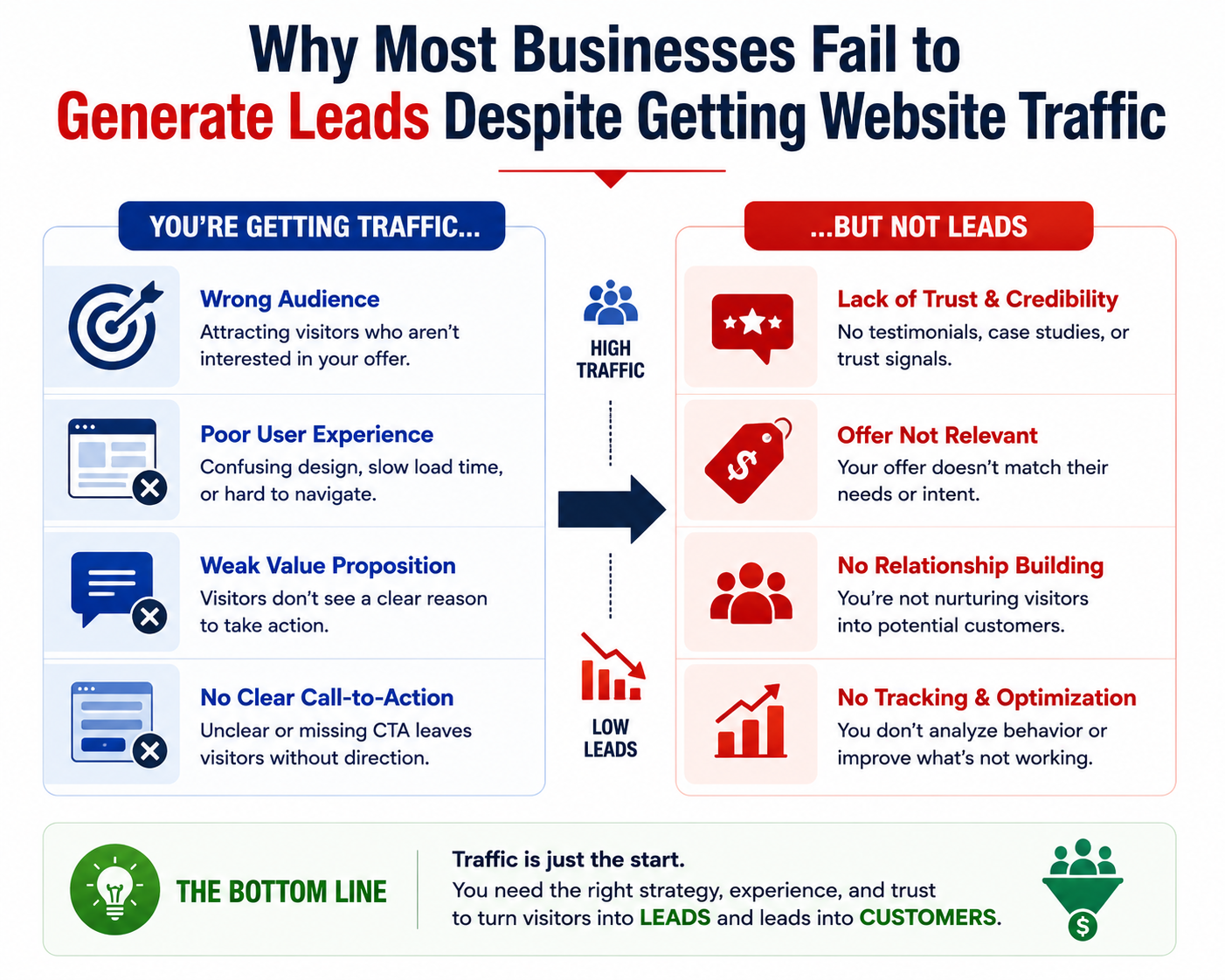
In 2026, generating website traffic has become easier than ever through social media, paid advertising, and search engine visibility. However, many businesses still struggle to convert that traffic into actual customer enquiries or sales.
Most users discover businesses through Google, social platforms, or online advertisements. While traffic numbers may look impressive, traffic alone does not guarantee business growth.
The real challenge is turning website visitors into qualified leads and paying customers.
Many businesses focus heavily on increasing clicks and visitors but ignore the factors that influence conversions. As a result, they spend money on marketing but fail to generate meaningful business outcomes.
Traffic Without Strategy Does Not Create Leads
Website traffic is only valuable when visitors take action. If users leave the website without calling, filling out forms, booking services, or making purchases, the traffic provides little business value.
Businesses often chase traffic numbers instead of focusing on conversion quality.
A website may receive:
- Thousands of visitors
- Social media clicks
- Ad traffic
- Search impressions
but still fail to generate leads if the user journey is poorly optimized.
Poor Website Design Reduces Conversions
One of the biggest reasons businesses fail to generate leads is weak website design and poor user experience.
Modern users expect:
- Fast loading speeds
- Mobile-friendly layouts
- Easy navigation
- Clear information
- Professional design
If a website feels outdated or confusing, users leave quickly and search for competitors instead.
👉 Check Your SEO Score: https://www.fly-social.com/tools/gmb-audit
Lack of Clear Call-to-Action
Many websites fail because they do not guide visitors toward taking action.
A call-to-action (CTA) tells users what to do next, such as:
- Contact us
- Book an appointment
- Request a quote
- Get a free audit
- Call now
Without strong CTAs, users may leave the website without engaging further.
Wrong Traffic Sources Bring Low-Quality Visitors
Not all website traffic is valuable. Businesses often attract users who are not interested in their services because they target broad or irrelevant audiences.
For example:
- Viral social traffic may not convert
- Untargeted ads may bring random clicks
- Poor keyword targeting may attract irrelevant visitors
Lead generation improves when traffic matches customer intent.
Weak SEO Strategy Affects Conversion Quality
SEO is not only about ranking higher; it is about attracting the right audience.
Businesses that target irrelevant keywords often receive traffic that does not convert into leads.
Strong SEO focuses on:
- Search intent
- Local optimization
- Service-focused keywords
- User needs
This improves traffic quality and conversion potential.
Mobile Optimization Is Often Ignored
Most searches in 2026 happen on mobile devices. Businesses with poor mobile experiences lose large numbers of potential customers.
Mobile issues include:
- Slow loading
- Difficult navigation
- Broken layouts
- Hard-to-click buttons
A poor mobile experience directly reduces lead generation opportunities.
Slow Website Speed Increases Bounce Rates
Website speed strongly affects user behavior. Visitors expect pages to load quickly, especially when searching for services or local businesses.
Slow websites increase:
- Bounce rates
- Customer frustration
- Lost conversions
Even small delays can reduce lead generation significantly.
Lack of Trust Signals Prevents Conversions
Visitors rarely become leads unless they trust the business.
Trust signals include:
- Customer reviews
- Testimonials
- Case studies
- Certifications
- Secure websites
- Professional branding
Businesses without trust indicators struggle to convert traffic effectively.
Poor Landing Page Optimization
Many businesses send traffic to generic pages instead of focused landing pages designed for conversions.
High-converting landing pages should include:
- Clear value propositions
- Strong headlines
- Simple forms
- Customer benefits
- Trust-building elements
Weak landing pages reduce conversion opportunities.
Businesses Ignore User Intent
One major reason businesses fail to generate leads is misunderstanding what users actually want.
Visitors may search for:
- Information
- Pricing
- Local services
- Comparisons
- Solutions to problems
Websites that fail to satisfy search intent lose customer interest quickly.
Lack of Local SEO Optimization
Local businesses especially struggle when they ignore local SEO.
Without local optimization, businesses may miss nearby high-intent customers searching for immediate solutions.
Local SEO improves:
- Google Maps visibility
- Nearby search rankings
- Customer calls
- Walk-in traffic
No Lead Capture System
Many websites fail because they do not collect visitor information properly.
Lead capture systems include:
- Contact forms
- Chat support
- Email signup forms
- Booking systems
- Consultation requests
Without these systems, businesses lose potential customer opportunities.
Weak Content Fails to Build Engagement
Content plays a major role in conversions. Generic or low-quality content does not build authority or customer confidence.
Helpful content improves:
- User trust
- Website engagement
- Conversion potential
Businesses should focus on solving customer problems through informative content.
Poor Online Reputation Affects Lead Generation
Customers often research reviews before contacting businesses. Negative reviews or weak online presence reduce trust and conversions.
Positive reviews improve:
- Brand credibility
- Customer confidence
- Conversion rates
Businesses Focus Too Much on Traffic Numbers
Many businesses treat traffic as the final goal instead of focusing on revenue and leads.
High traffic with low conversions often indicates:
- Poor targeting
- Weak user experience
- Low trust
- Ineffective sales funnels
Successful businesses prioritize conversion optimization over vanity metrics.
Importance of Conversion Rate Optimization
Conversion Rate Optimization (CRO) helps businesses improve the percentage of visitors who take action.
CRO focuses on:
- Better design
- Faster performance
- Strong CTAs
- User behavior analysis
- Simplified navigation
This improves overall marketing performance without necessarily increasing traffic.
How Businesses Can Improve Lead Generation
To convert traffic into leads effectively, businesses should:
- Improve website speed
- Optimize mobile experience
- Use clear CTAs
- Focus on targeted SEO
- Build trust signals
- Create high-converting landing pages
- Improve local SEO visibility
Small improvements in these areas can significantly increase lead generation.
Future of Lead Generation in 2026
AI and smarter search algorithms are changing how users interact with websites. Businesses now need:
- Personalized experiences
- Faster websites
- Helpful content
- Strong credibility
- Mobile-first optimization
Websites that prioritize user experience and trust will generate better leads consistently.
Conclusion
Many businesses fail to generate leads despite getting website traffic because they focus only on visibility instead of conversions. Traffic alone does not guarantee business growth unless visitors are guided toward meaningful actions.
Poor user experience, weak SEO targeting, lack of trust signals, slow websites, and ineffective landing pages are some of the biggest reasons businesses lose potential customers.
Businesses that focus on conversion optimization, targeted SEO, and customer experience can successfully turn website traffic into high-quality leads and long-term business growth.

 English
 French
 Spanish
 Portuguese
 Deutsch
 Turkish
 Dutch
Dutch
 Italiano
 Russian
 Romaian
 Portuguese (Brazil)
 Greek
Greek