Mental health providers across the USA are facing a growing challenge: balancing quality patient care with increasingly complex billing requirements. From claim denials and delayed reimbursements to insurance verification issues and compliance risks, managing finances has become one of the biggest operational burdens for behavioral health clinics.
This is where specialized medical billing for mental health becomes essential. Unlike general healthcare billing, behavioral health billing requires deeper knowledge of therapy codes, telehealth regulations, payer-specific rules, documentation standards, and evolving insurance policies. Whether it’s a solo therapist, psychiatric practice, rehabilitation center, or counseling clinic, having the right billing process directly impacts revenue and patient satisfaction.
As mental healthcare demand rises nationwide, many providers are turning to dedicated billing partners for better financial stability and operational efficiency.
The Growing Complexity of Mental Health Billing
Mental health billing is no longer limited to submitting claims and waiting for reimbursement. Insurance companies now demand accurate coding, complete documentation, prior authorization management, and strict compliance with state-specific regulations.
Behavioral health providers often deal with:
- Frequent claim denials
- Session authorization issues
- Telehealth billing changes
- Time-based CPT coding complexities
- Coordination of benefits
- Delayed insurance reimbursements
- Patient eligibility verification challenges
Even small errors in coding or documentation can lead to rejected claims and revenue loss. This is why many clinics now depend on specialized medical billing services designed specifically for behavioral healthcare.
Why Specialized Mental Health Billing Matters
A general billing approach may not work effectively for psychiatric and therapy practices. Mental health claims involve unique coding structures, psychotherapy modifiers, and payer guidelines that differ from other medical specialties.
Specialized billing teams understand:
Behavioral Health CPT Codes
Mental health billing commonly uses codes related to:
- Individual psychotherapy
- Group therapy
- Family counseling
- Psychiatric evaluations
- Medication management
- Telepsychiatry services
Accurate coding is essential because incorrect CPT usage can trigger audits or denials.
Time-Based Documentation
Therapy sessions often depend on session duration. Billing teams must ensure documentation matches the billed time accurately.
Insurance Authorization Tracking
Many insurance companies require prior authorization for ongoing behavioral health treatment. Missing authorization deadlines can cause significant reimbursement issues.
Telehealth Compliance
Virtual mental health visits continue to grow across the USA. Billing teams must stay updated with payer-specific telehealth policies and modifiers.
How Mental Health Practices Improve Revenue Through Better Billing
Mental health providers frequently lose revenue because of inefficient administrative workflows. A strong billing strategy improves collections while reducing staff stress.
Here’s how optimized billing systems help:
Faster Claims Submission
Timely claim submission reduces aging accounts receivable and accelerates cash flow.
Lower Denial Rates
Professional billing teams identify coding issues before claim submission, preventing unnecessary rejections.
Improved Patient Billing Experience
Clear patient statements and accurate copay calculations reduce confusion and improve patient trust.
Better Insurance Follow-Up
Consistent follow-up with insurance companies helps recover unpaid claims faster.
Detailed Financial Reporting
Providers gain visibility into collections, denials, payer performance, and revenue trends.
State-Specific Demand for Mental Health Billing Services
Mental health practices across different states often face unique insurance regulations and payer requirements. This has increased demand for localized expertise in behavioral health billing.
For example, providers searching for a mental health billing agency Delaware often need support with regional payer compliance and Medicaid requirements. Similarly, clinics seeking a mental health billing company Georgia may require assistance handling high patient volumes and multi-provider credentialing.
Behavioral health providers are also increasingly searching for:
- mental health billing services Arizona
- mental health billing services Cary
- mental health billing services company Delaware
- mental health billing services company Georgia
- mental health billing services Connecticut
- mental health billing services Illinois
- mental health billing services North Carolina
- mental health billing services Ohio
- mental health billing services Rhode Island
- mental health billing services Tennessee
- mental health billing services Texas
- mental health billing services Virginia
- mental health billing Toledo Ohio
These growing searches reflect a nationwide need for billing support tailored specifically to mental healthcare operations.
Common Billing Challenges Mental Health Providers Face
Insurance Eligibility Errors
One of the most common problems occurs when patient eligibility is not verified correctly before appointments. This can result in denied claims or unpaid balances.
Documentation Gaps
Incomplete therapy notes or missing treatment plans often create reimbursement delays.
Coding Mistakes
Behavioral health coding requires precision. Incorrect modifiers or mismatched diagnosis codes can trigger denials.
Credentialing Delays
Many providers experience revenue interruptions because insurance credentialing was not completed properly or renewed on time.
Underpaid Claims
Insurance companies occasionally reimburse lower amounts than expected. Without active follow-up, practices lose substantial revenue over time.
The Role of Medical Coding Services in Mental Health
Accurate coding forms the foundation of successful behavioral health billing. Professional medical coding services help ensure that every therapy session, psychiatric evaluation, and treatment plan is documented correctly.
Experienced coders understand:
- ICD-10 mental health diagnosis coding
- Behavioral health CPT guidelines
- Telehealth modifiers
- Insurance-specific billing edits
- Compliance standards
Strong coding accuracy reduces audit risks while improving reimbursement consistency.
Why Revenue Cycle Management Matters for Behavioral Health Practices
Behavioral health clinics often focus heavily on patient care, leaving financial processes unmanaged. Comprehensive revenue cycle management services help practices maintain stable cash flow while reducing administrative pressure.
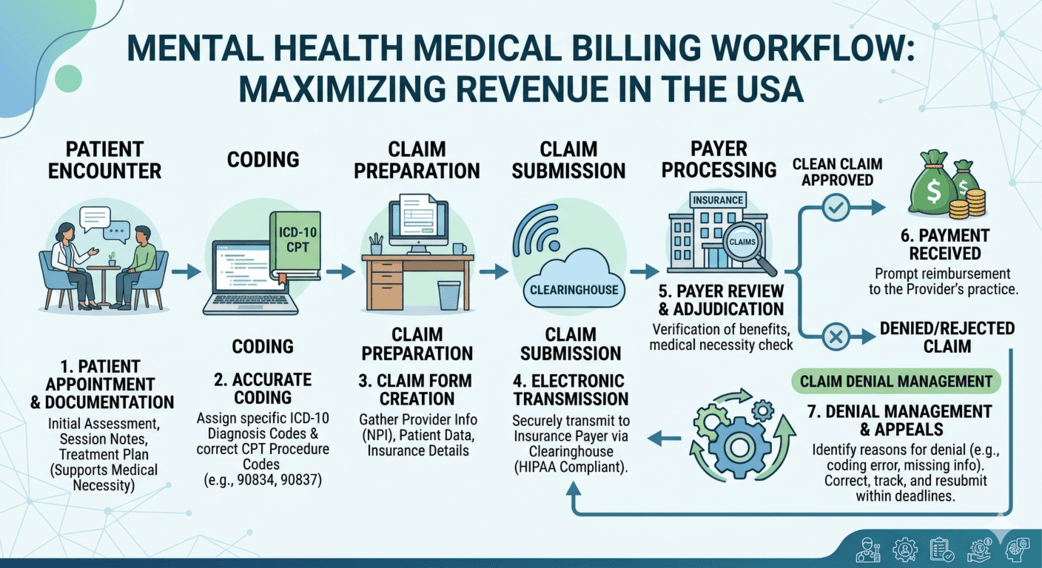
Revenue cycle management typically includes:
- Insurance verification
- Patient scheduling coordination
- Claim creation
- Coding review
- Claim submission
- Denial management
- Payment posting
- Accounts receivable follow-up
- Financial reporting
A streamlined revenue cycle allows providers to focus more on therapy and patient outcomes instead of paperwork.
Credentialing Services Help Practices Avoid Revenue Delays
Insurance credentialing is one of the most overlooked parts of mental health operations. Without proper credentialing, providers cannot bill insurance companies successfully.
Reliable credentialing services help with:
- Provider enrollment
- CAQH profile management
- Insurance application submission
- Revalidation tracking
- Group credentialing
- Medicare and Medicaid enrollment
Timely credentialing prevents claim rejections and ensures uninterrupted reimbursement.
Real-World Example: How Billing Support Increased Collections
A multi-provider counseling clinic in Texas struggled with delayed reimbursements and rising claim denials. Their internal administrative team was overwhelmed by insurance follow-ups and authorization tracking.
After transitioning to a specialized behavioral health billing workflow, the clinic achieved:
- Faster claims turnaround
- Reduced denial rates
- Improved patient billing transparency
- Better insurance collections
- Increased monthly revenue consistency
The clinic also reduced staff burnout because administrative pressure was significantly lower.
This scenario reflects what many behavioral health practices experience across the country.
The Importance of Compliance in Mental Health Billing
Behavioral health billing must comply with both federal and payer-specific guidelines. Failure to maintain compliance can result in audits, penalties, and financial losses.
Key compliance areas include:
HIPAA Security
Patient therapy records contain highly sensitive information and must remain secure.
Accurate Documentation
Clinical notes must support billed services completely.
Medical Necessity Standards
Insurance companies require proof that treatment services are medically necessary.
Updated Coding Practices
Billing teams must stay current with annual coding updates and payer rule changes.
Outsourcing vs In-House Billing
Many behavioral health providers debate whether to manage billing internally or outsource it.
In-House Billing Advantages
- Direct control over operations
- Immediate communication with staff
- Internal workflow familiarity
Outsourced Billing Advantages
- Specialized expertise
- Reduced staffing costs
- Lower denial rates
- Better scalability
- Improved reimbursement speed
- Dedicated insurance follow-up
For growing practices, outsourcing often provides stronger long-term financial stability.
How Technology Is Changing Mental Health Billing
Modern billing platforms now use automation to improve accuracy and efficiency.
Advanced systems help with:
- Automated eligibility checks
- Real-time claim tracking
- Electronic remittance posting
- Telehealth billing integration
- Analytics dashboards
- Patient payment portals
Technology-driven workflows reduce manual errors while improving reimbursement timelines.
Choosing the Right Mental Health Billing Partner
Not every billing company understands the complexities of behavioral healthcare. Mental health providers should evaluate billing partners carefully.
Important factors include:
Behavioral Health Experience
Choose teams experienced specifically in psychiatric and therapy billing.
Transparent Reporting
Providers should have access to real-time financial reports and claim status updates.
Credentialing Support
A billing company should also assist with provider enrollment and payer credentialing.
Denial Management Expertise
Strong denial management significantly improves collections.
Communication and Support
Reliable support teams help practices solve problems quickly.
Why Many Providers Trust Specialized Billing Support
Behavioral healthcare continues to evolve rapidly, especially with increased telehealth adoption and changing payer rules. Practices need reliable operational support to maintain financial health.
Companies like 247 Medical Billing Services help mental health providers improve billing accuracy, streamline workflows, and strengthen reimbursement performance through specialized medical billing services tailored for behavioral healthcare.
Their support often extends beyond billing into medical coding services, medical billing and coding services, revenue cycle management services, and credentialing services that help practices operate more efficiently without overwhelming internal staff.
Conclusion
The future of behavioral healthcare depends not only on quality patient care but also on sustainable financial operations. Effective medical billing for mental health plays a critical role in helping providers maintain profitability, reduce administrative stress, and improve patient experiences.
From insurance verification and coding accuracy to denial management and credentialing, every part of the billing process impacts practice performance. As mental health practices across the USA continue growing, specialized billing expertise is becoming less of an option and more of a necessity.
Whether providers need support in Texas, Ohio, Delaware, Georgia, Virginia, or other regions nationwide, investing in experienced billing and revenue management solutions can help create long-term operational stability while allowing clinicians to focus on what matters most — patient care.
Frequently Asked Questions
1. Why is medical billing for mental health different from general medical billing?
Mental health billing involves specialized psychotherapy codes, time-based sessions, authorization requirements, and behavioral health regulations that differ from general medical billing processes.
2. What are the benefits of outsourcing mental health billing services?
Outsourcing helps reduce claim denials, improve reimbursement speed, lower administrative burden, and provide access to experienced behavioral health billing professionals.
3. How do credentialing services help mental health providers?
Credentialing services ensure providers are properly enrolled with insurance companies, allowing them to receive reimbursements without delays or claim rejections.
4. What role do medical coding services play in behavioral health billing?
Medical coding services ensure accurate diagnosis and procedure coding, helping practices maintain compliance while improving claim approval rates.
5. Can revenue cycle management services improve cash flow?
Yes. Revenue cycle management services optimize every financial stage from patient registration to final payment collection, improving overall cash flow and operational efficiency.
6. Are telehealth mental health sessions billed differently?
Yes. Telehealth behavioral health services often require specific modifiers, documentation standards, and payer-specific compliance rules for successful reimbursement.




 Arabic
 French
 Spanish
 Portuguese
 Deutsch
 Turkish
 Dutch
Dutch
 Italiano
 Russian
 Romaian
 Portuguese (Brazil)
 Greek
Greek