


Respiratory Inhaler Devices Market Forecast 2026–2036: Global Expansion Driven by Chronic Pulmonary Diseases
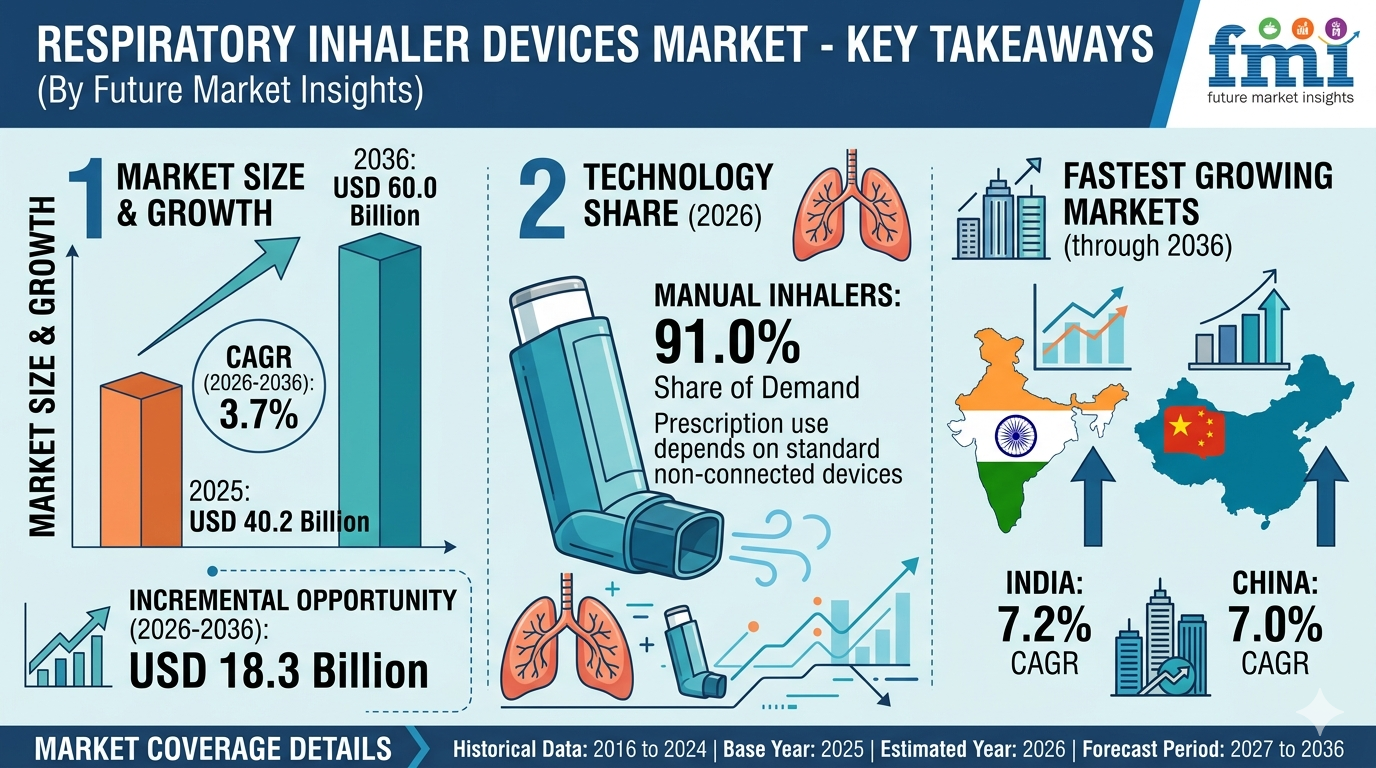
The global respiratory inhaler devices market is projected to witness strong expansion over the next decade, supported by the rising prevalence of respiratory disorders and a shift toward patient-centric inhalation therapies. The market is expected to grow steadily, creating an incremental opportunity of USD 18.3 billion between 2026 and 2036, according to the latest analysis by Future Market Insights (FMI).
Market growth is being shaped by increasing numbers of chronic respiratory cases, growing consumer awareness regarding advanced inhalation options, and rapid integration of smart digital technologies into drug delivery systems. Inhaler devices have evolved from simple emergency rescue tools into essential regulatory-approved components for daily maintenance therapy. While traditional manual inhalers continue to dominate installations due to their massive prescribed base, manufacturers are increasingly integrating advanced options such as connected digital inhalers and soft mist systems to comply with modern clinical expectations and improve patient adherence tracking.
Respiratory Inhaler Devices Market Snapshot (2026–2036)
Incremental opportunity outlook toward 2036: USD 18.3 billion
Dominant technology category: Manual inhalers (91.0% share in 2026)
Dominant product type segment: Metered Dose Inhalers (71.6% share in 2026)
Dominant disease indication segment: Asthma (36.7% share in 2026)
Fastest-growing countries: India (7.2% CAGR) and China (7.0% CAGR)
Primary demand channel: Hospitals (34.9% sales share in 2026)
Momentum in the Market
Beginning from steady regional adoption levels, the global respiratory inhaler devices market demonstrates accelerated growth throughout the forecast period as chronic disease management becomes an absolute priority across multiple countries. Between 2026 and 2036, expanding diagnostic capabilities and rising pollution-related pulmonary issues are expected to significantly boost demand for reliable inhalation systems. Increasing urbanization and higher environmental risk factors are encouraging healthcare providers and manufacturers to prioritize efficient pulmonary drug deposition technologies.
From 2036 onward, innovation in intelligent, sensor-based delivery formats and integration with digital health tracking systems is expected to further strengthen market expansion. Smart inhalers capable of recording dosing metrics and giving real-time feedback to pulmonologists are emerging as key differentiators in new clinical care models.
The Reasons Behind the Market’s Growth
Demand for respiratory inhaler devices is rising due to multiple clinical and technological factors reshaping the healthcare ecosystem.
Rising Prevalence of Chronic Airway Diseases
Expanding numbers of patients suffering from asthma, chronic obstructive pulmonary disease (COPD), and pulmonary arterial hypertension are creating a continuous need for daily maintenance and acute rescue devices.
Technological and Digital Integration
The introduction of electronic dose counters and Bluetooth-enabled sensors is encouraging patients to manage their chronic therapies effectively, driving up the replacement and adoption rates of modern devices.
Environmental and Urbanization Challenges
Increasing global air pollution, occupational exposure to industrial fumes, and changing lifestyles are accelerating respiratory disease vulnerability, necessitating broader access to portable inhalers.
Growing Shift toward Single-Inhaler Combinations
The medical preference for combination treatments (like ICS/LABA and triple therapies) delivered via a single reliable inhaler is keeping refill frequencies high and stabilizing long-duration device pipelines.
Top Segment Application Type
Metered Dose Inhalers Lead Product Demand
Metered Dose Inhalers (MDIs) account for the majority of installations globally, supported by long prescriber familiarity, vast cost efficiencies, and an irreplaceable role in acute relief scenarios.
Product and Technology Analysis
Dry Powder Inhalers (DPIs): Highly favored for breath-actuated delivery, removing the coordination challenge for patients.
Soft Mist Inhalers (SMIs): Expanding quickly due to lower propellant pressure, easier inhalation mechanics, and climate-friendly designs.
Digital Inhalers: Projecting a prominent expansion rate because automated adherence tracking supports personalized care.
Short-Acting Beta2 Agonists: Retaining a substantial drug class share (24.4% in 2026) to manage large-scale rescue treatment needs.
Regional Development: Developing and Mature Care Architecture Drives Expansion
The global respiratory care network is evolving rapidly, supported by expanding clinical infrastructure in emerging economies and cost-efficient localized manufacturing partnerships.
North America & Europe: Dominated by mature healthcare setups focusing on premium line extensions, therapy optimization, and digital health tool reimbursements.
India & China: Representing the fastest-expanding markets through 2036, driven by expanding diagnosis rates, massive patient pools, and a push for affordable healthcare tools.
United Kingdom & South Korea: Showing stable demand where localized public health pathways and environmental propellant regulations shape procurement choices.
Strategic partnerships between specialized device CDMOs and multinational drug innovators are optimizing supply channels while accelerating product availability across retail, online, and institutional networks.
Challenges, Trends, Opportunities, and Drivers
Drivers
Rising global burden of chronic asthma and COPD
Growing medical emphasis on inhalation therapy benefits
Continuous innovation in drug-device co-formulations
High patient preference for portable, handheld delivery formats
Opportunities
Smart and telemetry-integrated digital inhaler systems
Propellant-free, environmentally safe soft mist platforms
Tailored inhalation designs for pediatric and geriatric populations
Expansion of affordable respiratory access in emerging economies
Trends
Transition toward intelligent, Bluetooth-enabled adherence tracking
Widespread medical adoption of single-inhaler triple therapies
Phasing out of high-emission chemical propellants
Growing patient reliance on homecare and mail-order pharmacies
Challenges
High acquisition costs for advanced digital and biologics-compatible systems
Widespread patient technique errors reducing real-world efficacy
Lengthy approval frameworks and strict regional medical guidelines
Country Growth Outlook
The market’s growth trajectory is closely tied to healthcare spending and disease management implementation across primary economies:
United States: Driven by incremental innovation, adherence-focused care, and high premium device penetration.
India: Posting a leading 7.2% CAGR through 2036 due to expanding public formularies and growing patient access.
China: Advancing at a 7.0% CAGR through 2036 fueled by industrial urbanization and vast healthcare modernization.
United Kingdom: Characterized by strong public procurement attention on eco-friendly designs and dose consistency.
South Korea: Accelerated by industrial activity, yellow dust exposure, and high clinical trust in dry powder inhalers.
The Competitive Environment
The global respiratory inhaler devices market is moderately concentrated around prominent respiratory drug companies with well-established inhaler franchises and extensive distribution networks. Leading companies include:
GSK plc.
AstraZeneca plc
Novartis AG
Teva Respiratory LLC
Boehringer Ingelheim International GmbH
Cipla Ltd.
Lupin Ltd.
These players are investing heavily in dose consistency, low-emission propellant redesigns, and digital health software while forming strategic collaborations with device providers to safeguard supply chains and extend the lifecycle of their clinical portfolios.
Future Outlook: Toward Connected and Safer Pulmonary Mobility
The global respiratory inhaler devices market is entering a transformative decade shaped by digital healthcare, environmental safety adjustments, and stricter adherence expectations. Future inhaler systems are expected to function as highly connected medical modules working alongside telemedicine networks and predictive disease management applications. As healthcare systems mature and the clinical focus on tracking daily compliance strengthens, respiratory inhalers will remain central to achieving safer, highly optimized, and patient-friendly therapeutic outcomes globally.
Report Link: https://www.futuremarketinsights.com/reports/respiratory-inhaler-devices-market

 English
 French
 Spanish
 Portuguese
 Deutsch
 Turkish
 Dutch
Dutch
 Italiano
 Russian
 Romaian
 Portuguese (Brazil)
 Greek
Greek