


Everything About White Label AI Chatbot Platforms for Modern Businesses
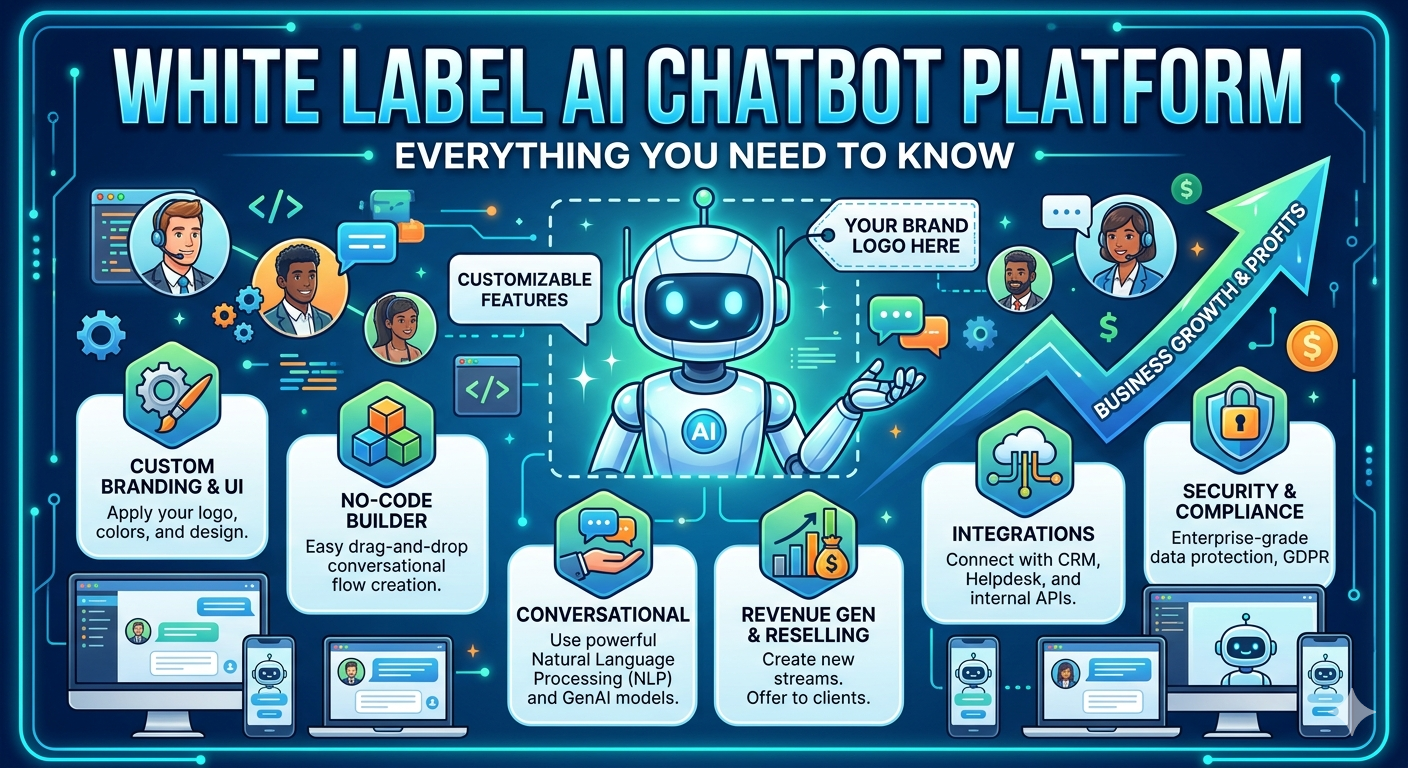
Artificial Intelligence is changing the way businesses interact with customers, automate workflows, and improve digital communication. AI chatbots are now widely used for customer support, ecommerce assistance, lead generation, appointment scheduling, sales automation, and personalized user engagement.
As AI adoption continues growing across industries, many startups and agencies are launching branded chatbot services through white label AI chatbot platforms. These systems allow businesses to create their own AI chatbot products without building the entire infrastructure from scratch.
Instead of spending years developing AI technology internally, businesses can use pre-built white label platforms to launch scalable AI solutions under their own branding.
In this article, we will explore how white label AI chatbot platforms work, their essential features, advantages, monetization methods, technology stack, and why they are becoming one of the fastest-growing opportunities in the AI software industry.
Introduction to White Label AI Chatbot Platforms
A white label AI chatbot platform is a ready-made AI software solution that businesses can customize and rebrand as their own product.
The core platform is developed and maintained by the provider, while businesses customize:
-
Brand identity
-
Website domain
-
Dashboard interface
-
Pricing models
-
User management
-
Platform appearance
This allows agencies, SaaS companies, and startups to enter the AI market quickly without handling complex backend AI development.
White label chatbot software is commonly used for:
-
Customer service automation
-
AI sales assistants
-
Ecommerce support
-
Lead generation systems
-
Business workflow automation
-
Website AI chat systems
Many businesses prefer white label solutions because they reduce development costs, infrastructure complexity, and product launch time.
Why White Label AI Platforms Are Growing Fast
The AI automation market is expanding rapidly as businesses increasingly invest in scalable customer engagement solutions.
Several factors are contributing to the rise of white label AI chatbot software:
-
Increasing demand for AI-powered tools
-
Faster SaaS business launches
-
Lower development expenses
-
Growth of subscription-based software
-
Rising business adoption of conversational AI
Instead of building advanced AI infrastructure internally, companies can use white label systems to launch scalable AI products more efficiently.
Platforms such as Candy AI Clone show how customizable AI infrastructure can help businesses quickly enter the competitive AI software market.
How White Label AI Chatbot Systems Function
Modern white label chatbot platforms operate through a scalable multi-layer architecture.
AI and Backend Infrastructure
The platform provider usually manages:
-
AI models
-
APIs
-
Databases
-
Hosting systems
-
Cloud infrastructure
-
Security architecture
This removes most technical challenges for businesses and resellers.
Branding and Platform Personalization
Businesses can customize:
-
Logos
-
Brand colors
-
Dashboard layouts
-
Domain configuration
-
Pricing plans
-
Client portals
This allows the software to appear as a completely independent SaaS product.
User and Billing Management
Most platforms also include:
-
Customer dashboards
-
Subscription management
-
Usage tracking
-
Team permissions
-
Reporting systems
These features help businesses scale operations more efficiently.
Important Features of White Label AI Chatbot Platforms
Modern AI chatbot software includes advanced conversational and automation capabilities.
Conversational AI Technology
The most important component of any chatbot platform is the conversational AI engine.
Modern systems support:
-
Natural language processing
-
Context-aware responses
-
Personalized communication
-
Multi-language conversations
Advanced AI models create more realistic and engaging interactions.
Multi-Platform Communication
Most chatbot platforms integrate with:
-
Websites
-
WhatsApp
-
Telegram
-
Facebook Messenger
-
Slack
-
Instagram
This enables businesses to automate communication across multiple digital channels.
AI Knowledge Base Integration
Chatbots can be trained using:
-
Website content
-
FAQs
-
PDFs
-
Product documentation
-
Support articles
This helps businesses create customized AI assistants for specific industries and use cases.
Human Agent Support Transfer
Many white label platforms include live chat handoff systems where conversations move from AI chatbots to human agents when needed.
This improves customer support quality and issue resolution.
Performance Analytics
Analytics systems often include:
-
Conversation tracking
-
User engagement reports
-
AI response monitoring
-
Lead generation analytics
These insights help businesses improve chatbot performance.
Benefits of White Label AI Chatbot Software
White label AI solutions offer several major advantages for businesses.
Faster Product Development
Building an AI chatbot platform internally requires significant time and technical expertise.
White label software allows businesses to launch AI products much faster using pre-built infrastructure.
Lower Infrastructure Costs
Developing AI systems from scratch often requires:
-
AI engineers
-
Backend developers
-
Cloud hosting
-
Security infrastructure
-
Continuous maintenance
White label platforms help reduce these operational expenses.
Recurring SaaS Revenue Opportunities
Many businesses use white label AI chatbot software to create recurring-income SaaS businesses through:
-
Monthly subscriptions
-
Enterprise pricing
-
Usage-based billing
-
AI automation services
This creates strong long-term monetization potential.
Simplified Technical Maintenance
The platform provider usually handles:
-
AI model updates
-
Infrastructure scaling
-
Security patches
-
Backend maintenance
This allows businesses to focus more on customer acquisition and growth.
Platforms like Candy AI Clone demonstrate how scalable AI infrastructure can support customizable and profitable AI software products.
Recommended Technology Stack for White Label AI Chatbots
The technology stack directly affects scalability, AI quality, and system performance.
Frontend Frameworks
Popular frontend technologies include:
-
React
-
Next.js
-
Vue.js
-
Flutter
These frameworks help create responsive chatbot interfaces and user dashboards.
Backend Development Technologies
Most AI chatbot systems use:
-
Node.js
-
Python
-
FastAPI
-
Express.js
These technologies support scalable APIs and real-time communication systems.
AI Language Models
Popular conversational AI models include:
-
OpenAI models
-
Claude
-
Llama
-
Mistral
These models power intelligent AI interactions.
Database and Memory Infrastructure
Commonly used systems include:
-
PostgreSQL
-
MongoDB
-
Redis
-
Vector databases
These technologies help support AI memory and personalized conversations.
Cloud Infrastructure Services
Popular cloud providers include:
-
AWS
-
Google Cloud
-
Microsoft Azure
Cloud infrastructure is critical for managing AI workloads and growing user traffic.
Monetization Strategies for White Label AI Platforms
White label chatbot software supports multiple business models.
Subscription Pricing
Many businesses charge recurring monthly fees based on:
-
User limits
-
AI usage
-
Team accounts
-
Feature access
Enterprise Services
Large organizations may pay for:
-
Dedicated infrastructure
-
Private AI deployments
-
Advanced integrations
-
Custom AI training
Usage-Based Billing Systems
Some platforms monetize based on:
-
API requests
-
AI token consumption
-
Message volume
-
Generated content
This creates flexible pricing options for different business sizes.
Industries Using White Label AI Chatbots
White label AI chatbot platforms are widely used across industries such as:
-
Ecommerce
-
Healthcare
-
Education
-
Real estate
-
Finance
-
Marketing agencies
-
SaaS businesses
AI automation is becoming increasingly important for improving efficiency and customer engagement.
Challenges in White Label AI Chatbot Businesses
Despite their advantages, white label AI chatbot systems also face challenges.
AI Response Quality
Poor AI responses can negatively impact customer trust and platform reputation.
Infrastructure Expenses
Large-scale AI systems can become expensive because of:
-
GPU hosting
-
AI inference costs
-
API usage
-
Voice processing infrastructure
Data Security and Compliance
Businesses must ensure:
-
User privacy
-
API security
-
Regulatory compliance
-
Infrastructure protection
Strong backend architecture is essential for long-term scalability.
Final Thoughts
White label AI chatbot platforms are becoming one of the most promising opportunities in the modern AI software industry. They allow businesses to launch scalable AI products quickly without building complex infrastructure from scratch.
By combining conversational AI, automation systems, customization tools, and SaaS monetization models, white label chatbot platforms create major growth opportunities for startups, agencies, and enterprise companies.
As AI adoption continues increasing globally, businesses that invest in scalable and customizable AI chatbot solutions will gain a strong competitive advantage in the evolving digital market.

 English
 Arabic
 French
 Spanish
 Portuguese
 Deutsch
 Turkish
 Dutch
Dutch
 Italiano
 Romaian
 Portuguese (Brazil)
 Greek
Greek