


Ship Hull Inspection Services Market Forecast 2033 Fueled by Increasing Demand for Vessel Safety and Regulatory Compliance
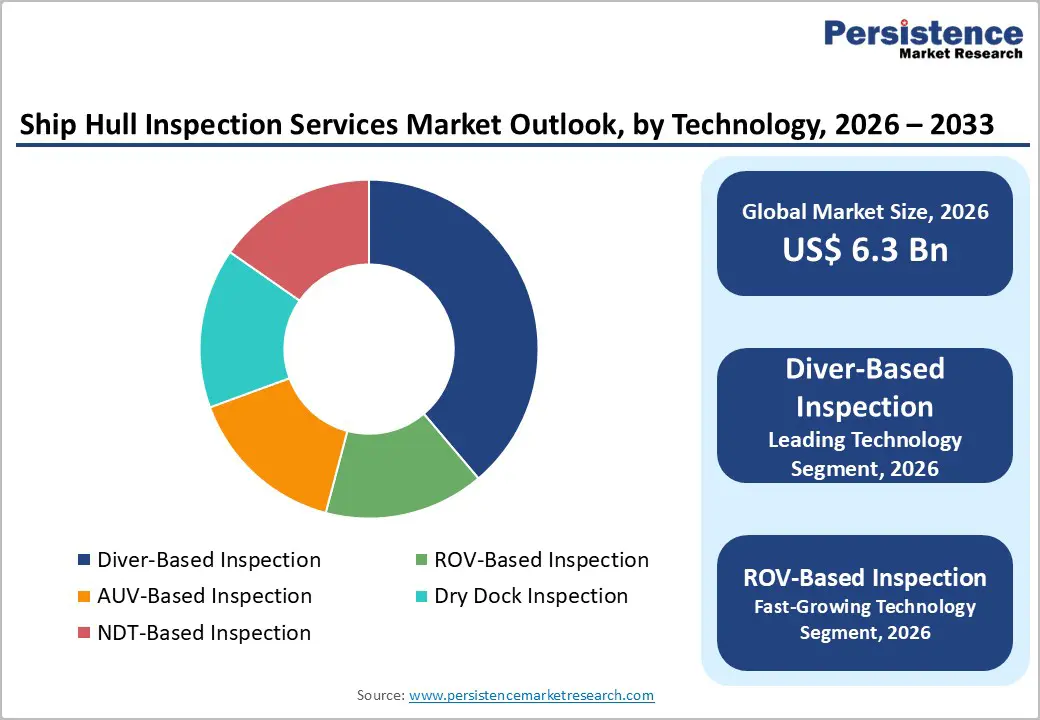
The global ship hull inspection services market size is expected to be valued at US$ 6.3 billion in 2026 and projected to reach US$ 8.2 billion by 2033, growing at a CAGR of 3.9% between 2026 and 2033.
According to Persistence Market Research Insights, ship hull inspection services have become increasingly important as shipping companies, naval operators, and offshore industries prioritize vessel safety, regulatory compliance, and operational efficiency. Hull inspections play a critical role in detecting corrosion, structural fatigue, cracks, biofouling, and coating deterioration that can impact vessel performance and safety. As global maritime trade continues to expand and aging fleets require regular maintenance, demand for advanced hull inspection services is expected to remain strong throughout the forecast period.
Asia Pacific leads the global ship hull inspection services market with approximately 38% share in 2025, anchored by China’s dominance in global shipbuilding order book tonnage and the region’s large commercial and naval fleet operations. Countries such as China, South Korea, Japan, and India continue to invest heavily in maritime infrastructure, commercial shipping, and naval modernization, supporting steady demand for inspection and maintenance services.
Market Trends
One of the most significant trends shaping the ship hull inspection services market is the increasing adoption of robotic and drone-based inspection technologies. Traditional underwater inspections often require divers, dry docking, and lengthy operational downtime. However, remotely operated vehicles (ROVs), autonomous underwater vehicles (AUVs), and drone inspection systems are transforming the process by enabling faster, safer, and more cost-efficient inspections.
Digital imaging, ultrasonic testing, 3D mapping, and AI-powered defect detection are also becoming more common across commercial shipping and offshore sectors. These technologies improve inspection accuracy while minimizing human risk and reducing vessel downtime. Shipping companies are increasingly integrating predictive maintenance strategies supported by real-time inspection data analytics to optimize fleet performance and maintenance schedules.
Another important trend is the growing emphasis on environmentally compliant hull maintenance. Biofouling and damaged coatings can significantly increase fuel consumption and emissions. Inspection service providers are therefore offering integrated inspection and cleaning solutions that help operators meet environmental and fuel efficiency standards.
Market Drivers
Rising global maritime trade remains a major growth driver for the ship hull inspection services market. Commercial vessels operate continuously across harsh marine environments, making periodic inspections essential for structural integrity and safe operations. Growing international shipping activity directly increases the need for routine hull inspection, maintenance, and repair services.
Stringent maritime safety regulations are also accelerating market demand. Regulatory organizations and classification societies require regular hull inspections to ensure compliance with safety and environmental standards. Vessel owners are under pressure to maintain operational certification while minimizing accident risks, which continues to drive investment in advanced inspection services.
The expansion of offshore oil & gas activities and renewable marine energy projects further supports market growth. Offshore platforms, support vessels, and subsea structures require continuous inspection to ensure safe operations under challenging marine conditions. The increasing deployment of offshore wind farms is also creating new opportunities for specialized marine inspection services.
Market Restraints and Challenges
High operational costs remain one of the key challenges in the ship hull inspection services market. Advanced inspection technologies, specialized equipment, skilled divers, and dry dock operations involve significant investment. Smaller fleet operators often face budget constraints that limit the frequency of inspections and technology adoption.
Harsh underwater environments and weather conditions can also complicate inspection procedures. Strong currents, poor visibility, marine growth, and corrosion exposure create technical difficulties during underwater inspections, increasing operational complexity and service costs.
Another challenge is the shortage of highly skilled marine inspection professionals. The industry requires certified inspectors, engineers, divers, and robotics specialists capable of handling advanced diagnostic systems and underwater technologies. Workforce shortages may slow service expansion and technological adoption in some regions.
Market Opportunities
The integration of artificial intelligence and digital twin technologies presents substantial growth opportunities for market participants. AI-powered inspection systems can analyze structural damage patterns and predict maintenance requirements before critical failures occur. Digital twin platforms allow ship operators to monitor hull conditions virtually and optimize maintenance planning.
The growing adoption of autonomous shipping technologies is also expected to create new demand for smart inspection systems. Autonomous and remotely operated vessels require advanced monitoring and inspection capabilities to ensure long-term operational safety.
In addition, rising investments in naval defense modernization programs are supporting demand for high-performance hull inspection services. Governments worldwide are expanding naval fleets and upgrading aging vessels, creating long-term opportunities for inspection and maintenance service providers.
Get Free Sample Now: https://www.persistencemarketresearch.com/samples/28279
Segmentation Analysis
By Service Type
Underwater inspection services dominate the market due to their critical role in evaluating hull integrity without requiring dry docking. These inspections help vessel operators reduce downtime while ensuring compliance with safety regulations.
Non-destructive testing (NDT) services are expected to witness significant growth during the forecast period. Ultrasonic testing, magnetic particle inspection, and radiographic inspection techniques are increasingly used to detect hidden structural defects without damaging vessel components.
By Vessel Type
Commercial cargo vessels account for the largest market share owing to the massive global shipping fleet and continuous maintenance requirements associated with long-distance maritime trade operations.
Naval vessels are projected to register strong growth as governments continue investing in fleet expansion, modernization programs, and advanced maintenance infrastructure.
By Technology
Traditional diver-based inspections continue to maintain a significant share due to widespread adoption across established maritime operations. However, robotic and drone-assisted inspection technologies are emerging as the fastest-growing segment due to their efficiency, safety, and reduced operational downtime.
AI-driven predictive inspection systems are also gaining traction as shipping companies seek data-driven maintenance strategies and improved operational reliability.
Regional Outlook
Asia Pacific dominates the global ship hull inspection services market and is expected to maintain its leadership position throughout the forecast period. The region benefits from strong shipbuilding activity, extensive commercial shipping networks, and expanding naval operations. China remains the largest contributor due to its dominance in shipbuilding and maritime trade infrastructure.
Europe represents the second-largest market, supported by advanced maritime technologies, strict environmental regulations, and strong offshore energy activities. Countries such as Norway, Germany, and the Netherlands are investing heavily in digital marine inspection solutions and offshore infrastructure maintenance.
North America maintains steady growth driven by naval modernization initiatives, offshore oil & gas activities, and increasing adoption of robotic inspection technologies across commercial fleets.
The Middle East and Africa are witnessing growing demand due to expanding port infrastructure, offshore energy projects, and rising investments in maritime trade connectivity.
Competitive Landscape
The global ship hull inspection services market features a mix of established marine engineering companies, inspection specialists, and technology providers competing through innovation, digital capabilities, and service efficiency. Companies are increasingly investing in robotic inspection systems, AI-powered analytics, and remote monitoring solutions to strengthen their competitive positioning.
Strategic partnerships between ship operators, classification societies, and technology firms are becoming increasingly common as the industry transitions toward predictive maintenance and automated inspection frameworks. Market participants are also expanding their service portfolios by integrating underwater cleaning, coating assessment, corrosion monitoring, and structural diagnostics into comprehensive vessel maintenance solutions.
As the maritime industry continues prioritizing operational safety, environmental compliance, and fleet optimization, demand for advanced ship hull inspection services is expected to remain strong across commercial, naval, and offshore sectors through 2033.

 English
 Arabic
 Spanish
 Portuguese
 Deutsch
 Turkish
 Dutch
Dutch
 Italiano
 Russian
 Romaian
 Portuguese (Brazil)
 Greek
Greek