


Game of Skill vs Game of Chance: How the Supreme Court is Shaping the Future of Online Gaming in India
Introduction
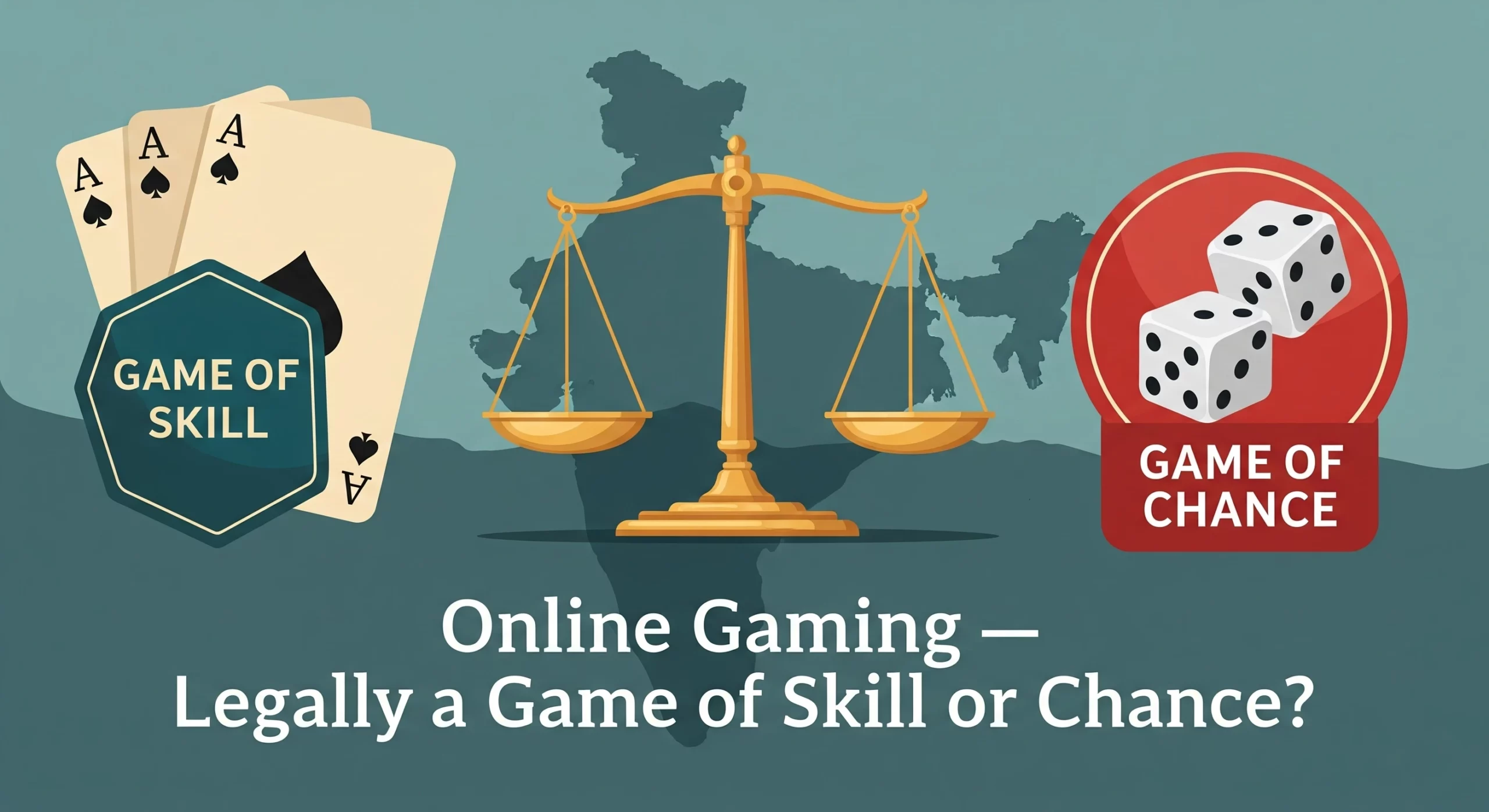
India’s online gaming industry has entered a decisive phase. Over the past decade, the surge of real-money gaming platforms, fantasy leagues, poker, and rummy apps has turned a recreational activity into a multi-billion-dollar sector. Yet, this growth has sparked a fundamental legal debate — should these games be treated as games of skill or games of chance?
This distinction is not merely academic. It determines whether a game is considered a legitimate business protected under Article 19(1)(g) of the Indian Constitution or an activity that could be restricted under gambling laws. The courts, and particularly the Supreme Court of India, have played a critical role in shaping this interpretation. Understanding the evolution of the game of skill vs game of chance debate is essential for policymakers, gaming companies, and players alike.
The Legal Foundation of the Debate
India’s gambling laws trace back to the Public Gambling Act of 1867, a colonial statute that prohibited public gambling and the keeping of common gaming houses. However, the law specifically exempted games of “mere skill.” This exemption set the stage for decades of judicial interpretation about what exactly constitutes a game of skill.
The central question is this: when does human expertise outweigh luck? The answer to this question has evolved through a series of court judgments, with the Supreme Court at the center of the discourse.
Early Judicial Recognition of Skill-Based Games
The first major ruling on this subject came in R.M.D. Chamarbaugwala vs. Union of India (1957). The Supreme Court held that competitions involving substantial skill are business activities protected by the Constitution. This was a landmark moment — it drew a clear line between gambling, which depends purely on chance, and legitimate competition, which relies on skill, knowledge, and judgment.
The Court emphasized that “the expression ‘mere skill’ means the presence of skill as a dominant factor even though chance cannot be entirely eliminated.” This standard, known as the predominance test, remains the benchmark for determining whether a game qualifies as a game of skill or chance.
Application of the Predominance Test
Following Chamarbaugwala, Indian courts applied the predominance test to various games. In State of Andhra Pradesh vs. K. Satyanarayana (1968), the Supreme Court ruled that rummy is a game of skill because it requires memorization, strategic thinking, and the ability to discard or retain cards based on observation. The judgment clarified that the presence of some element of chance — such as the initial shuffle — does not make a game gambling if skill dominates the outcome.
This interpretation extended protection to rummy and similar games under Article 19(1)(g), granting them the same constitutional legitimacy as any other business activity.
The Modern Context: Online Gaming and State Regulations
With the advent of digital gaming platforms, the game of skill vs game of chance debate has taken on new dimensions. States such as Tamil Nadu, Karnataka, and Andhra Pradesh have attempted to prohibit online real-money games, citing social and moral concerns. However, gaming companies have consistently challenged these bans in courts, arguing that games like rummy, fantasy sports, and poker are based primarily on skill.
For instance, in 2021, the Madras High Court struck down the Tamil Nadu Gaming and Police Laws (Amendment) Act, which banned online skill-based games. The Court held that the law was unconstitutional because it imposed a blanket prohibition on games that had already been recognized as skill-based.
This judicial protection reinforced the principle that states cannot outlaw a game merely because it involves monetary stakes if skill remains the dominant factor.
The Role of the Supreme Court in Fantasy Sports
Perhaps the most impactful development came with the game of skill vs game of chance supreme court judgement concerning fantasy sports. The Supreme Court, in multiple cases including Varun Gumber vs. Union Territory of Chandigarh (2017) and Avinash Mehrotra vs. State of Rajasthan (2021), affirmed that fantasy sports like Dream11 are predominantly skill-based.
The Court observed that users must analyze player statistics, match conditions, and performance trends to create their teams. Success in fantasy gaming depends on a participant’s knowledge and strategy rather than luck. Consequently, fantasy sports were declared as games of skill, providing them immunity from gambling restrictions.
This recognition paved the way for India’s thriving fantasy sports industry, which now contributes significantly to the digital economy through job creation, investment, and advertising.
The Supreme Court’s Evolving Interpretation
The Supreme Court’s consistent stance has provided much-needed legal clarity. However, it also left open questions regarding the monetization and commercialization of such games. While the Court has recognized the role of skill, it has not completely dismissed the potential for misuse, addiction, or social harm.
The All India Gaming Federation (AIGF) and similar industry bodies have since advocated for uniform national regulations distinguishing between games of skill and chance. The idea is to prevent arbitrary bans and promote responsible gaming standards.
This need became even more pressing after states continued passing conflicting laws despite Supreme Court guidance. For instance, while Rajasthan and Punjab recognize fantasy sports as skill-based, Telangana and Assam maintain stricter prohibitions under their respective gaming statutes.
Such inconsistencies create a fragmented regulatory landscape that confuses investors, developers, and users alike.
Key Criteria for Determining Skill vs Chance
The judiciary has established certain parameters to determine whether a game falls within the domain of skill:
-
Requirement of Knowledge and Experience: Players must apply previous learning or training.
-
Strategic Decision-Making: Games that reward planning, analysis, or foresight lean toward skill.
-
Dominance Over Randomness: The outcome must depend more on player input than pure luck.
-
Possibility of Improvement Over Time: If performance improves through practice, it is likely a skill-based game.
These benchmarks have been used repeatedly in courts while analyzing poker, fantasy leagues, and rummy.
The game of skill vs game of chance test is, therefore, not just a legal construct but a practical assessment of how players influence outcomes.
The Economic Significance of Skill-Based Gaming
India’s online gaming market was valued at over USD 3.1 billion in 2024 and is expected to grow at a CAGR of 25–30% in the next five years. The sector contributes to employment, tax revenue, and technological innovation, including data analytics and user engagement models.
Recognizing games of skill as legitimate business activities ensures investor confidence and fosters industry development. Conversely, uncertainty around classification can lead to overregulation, stifling innovation and pushing legitimate operators underground.
The Supreme Court’s interpretation has therefore become not only a legal precedent but also a critical economic policy signal.
The Ethical and Social Concerns
Despite judicial clarity, critics argue that even skill-based games carry addiction risks, especially among younger users. The possibility of losing real money, aggressive marketing, and lack of financial literacy have raised legitimate policy concerns.
Several High Courts have recommended that the central government introduce a regulatory authority to oversee online gaming platforms. This would ensure fair play, protect consumers, and enforce self-exclusion mechanisms for vulnerable players.
Balancing innovation and regulation is the challenge ahead. A legal distinction alone cannot ensure ethical practices; effective governance and user education are equally vital.
The Central Government’s Response
In 2023, the Ministry of Electronics and Information Technology (MeitY) notified the Information Technology (Intermediary Guidelines and Digital Media Ethics Code) Amendment Rules, which introduced a new framework for Online Gaming Intermediaries (OGIs).
Under these rules, only games of skill certified by self-regulatory bodies can be legally offered in India. These bodies must evaluate whether a game involves skill predominance, ensuring compliance with existing laws and user protection standards.
This marks the first step toward a national recognition mechanism, aligned with the game of skill vs game of chance supreme court judgement principles. It seeks to harmonize state-level differences while maintaining a strong consumer protection layer.
Need for Uniform Legislation
Experts have long argued that India requires a central gaming statute, similar to the approach adopted in the UK or Singapore. Such a law should provide:
-
Clear definitions of skill and chance-based games.
-
Standard licensing and taxation frameworks.
-
Mandatory disclosure and audit requirements for operators.
-
Consumer safeguards, including age verification and deposit limits.
A unified law would eliminate the uncertainty caused by state-specific prohibitions, streamline compliance, and boost India’s credibility as a gaming innovation hub.
Looking Ahead: The Role of Technology and AI
Emerging technologies like artificial intelligence, blockchain, and predictive analytics are adding complexity to the debate. AI-driven matchmaking, algorithmic fairness, and outcome tracking can enhance transparency and help regulators verify whether skill truly determines success.
Meanwhile, blockchain-based systems can create immutable records of transactions and gameplay data, further reinforcing fairness in skill-based platforms.
In the coming years, legal recognition may depend not just on the type of game but also on how transparently it operates.
Conclusion
The debate over game of skill vs game of chance in India is far from over, but the direction is clear. Through its progressive judgments, the Supreme Court has affirmed that games where skill predominates are constitutionally protected business activities.
However, the challenge lies in translating these judgments into consistent regulatory frameworks across states. The future of India’s online gaming industry depends on this clarity. With fair rules, transparent oversight, and responsible player engagement, the sector can continue to grow while minimizing social risks.
As the line between skill and chance becomes sharper through technology and jurisprudence, India stands at a turning point one where balanced regulation could transform the nation into a global leader in legitimate, skill-based digital gaming.

 English
 Arabic
 Spanish
 Portuguese
 Deutsch
 Turkish
 Dutch
Dutch
 Italiano
 Russian
 Romaian
 Portuguese (Brazil)
 Greek
Greek