


Global Rehabilitation Robots Market Assessment Exploring Tech Progress, Clinical Demand, and Growth Trends
Market Overview
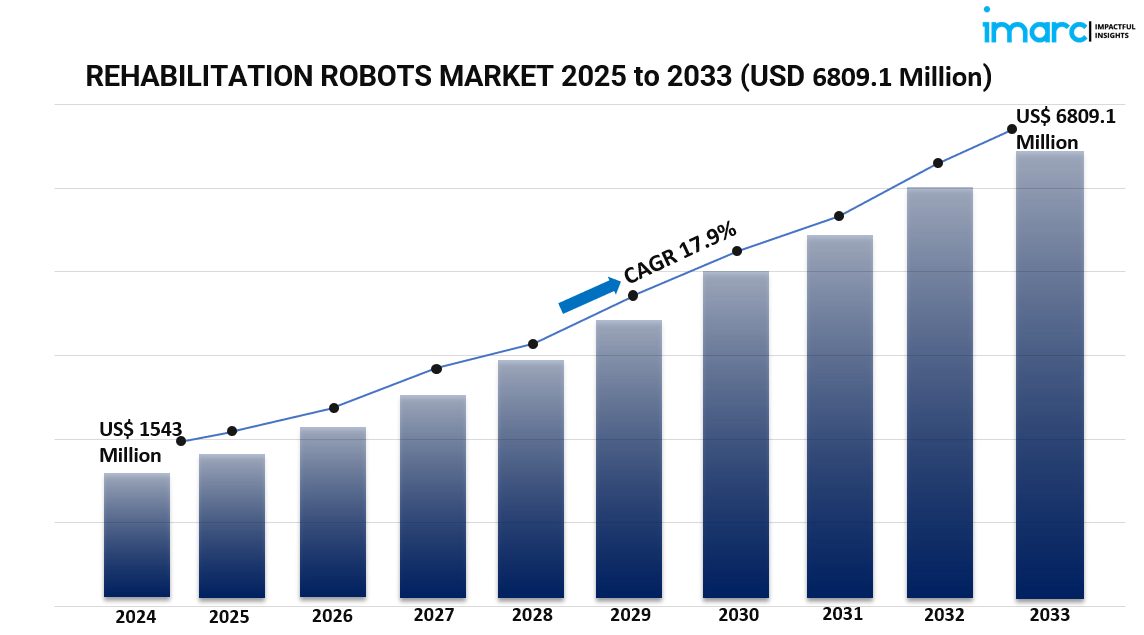
The global rehabilitation robots market size reached USD 1,543 Million in 2024 and is expected to grow to USD 6,809.1 Million by 2033, with a CAGR of 17.9% during the forecast period of 2025-2033. This growth is driven by factors such as the increasing aging population, rising prevalence of disabilities, advancements in technology, and supportive government initiatives. For more information, visit the Rehabilitation Robots Market.
Study Assumption Years
- Base Year: 2024
- Historical Year/Period: 2019-2024
- Forecast Year/Period: 2025-2033
Rehabilitation Robots Market Key Takeaways
- Current Market Size: USD 1,543 Million in 2024
- CAGR: 17.9% during 2025-2033
- Forecast Period: 2025-2033
- The market is propelled by a rise in individuals experiencing paralysis, quadriplegia, and amputations.
- Growing geriatric population escalates demand due to higher susceptibility to health disorders.
- Integration of voice-recognition algorithms and VR/video game combinations improve device functionality and patient motivation.
- North America leads adoption with advanced healthcare infrastructure; Europe and Asia-Pacific are significant growth regions.
- High initial costs and technological limitations challenge market expansion, but advances in AI and machine learning aid growth.
Sample Request Link: https://www.imarcgroup.com/rehabilitation-robots-market/requestsample
Market Growth Factors
The increasing aging population is a primary driver of market growth. According to the World Health Organization, the global population of adults aged 60 and older outweighed children under five in 2020, with projections to nearly double from 12% to 22% by 2050. Aging correlates with higher incidences of chronic diseases such as stroke, Parkinson's disease, and arthritis, which impair mobility and independence. Approximately 73% of people with osteoarthritis are older than 55 years. Rehabilitation robots assist these seniors by helping them regain mobility, strength, and function after injuries or surgeries, significantly boosting demand.
Rising prevalence of epilepsy and other chronic diseases is expanding the need for rehabilitation services. Rehabilitation robots aid physical therapy and recovery by improving mobility and independence for affected individuals. For example, in January 2023, HN Reliance Foundation Hospital acquired the Lokomat exoskeleton from Hocoma AG, enhancing precision physiotherapy. Additionally, robots reduce caregiver strain by assisting therapy sessions; in April 2024, Stony Brook University began developing the Caregiving Robot Assistant (CART) for ALS patients, leveraging AI and mechanical engineering to alleviate caregiving difficulties.
Technological advancements are crucial growth enablers. Wearable exoskeletons use sensors to detect movement intention and provide powered support, promoting natural movement and reducing muscle fatigue. Innovations like IIT-INAIL's TWIN exoskeleton simplify patient use. Integration of AI algorithms allows robots to analyze and adapt therapy protocols dynamically, optimizing outcomes. Fourier Intelligence's July 2023 launch of a humanoid robot with ChatGPT-like cognitive intelligence exemplifies the fusion of AI and rehabilitation robotics, further driving market expansion.
Market Segmentation
By Type:
- Therapeutic Robots: Designed to assist in therapeutic interventions and rehabilitation exercises, featuring AI, sensors, and interactive interfaces to tailor and monitor patient progress.
- Exoskeleton Robots: Wearable devices augmenting human mobility, providing powered limb support for individuals with impairments to perform daily activities more independently.
- Assistive Robots: Aid individuals with disabilities or age-related impairments in daily tasks, ranging from simple task-specific robots to autonomous systems.
- Others
By Patient Type:
- Adult: Focuses on adults with chronic conditions such as stroke, spinal cord injury, and orthopedic issues, providing intensive therapy for mobility and independence.
- Pediatric: Targets children with developmental delays, cerebral palsy, and neuromuscular disorders, delivering structured therapies to promote motor, cognitive, and social development.
By End User:
- Rehabilitation Centers: Use therapeutic robots for intensive therapy sessions improving motor function, range of motion, and strength post-injury or surgery.
- Hospitals: Employ rehabilitation robots for recovery after surgeries and fractures, facilitating early mobilization and monitoring progress.
- Others
By Region:
- North America (United States, Canada)
- Asia Pacific (China, Japan, India, South Korea, Australia, Indonesia, Others)
- Europe (Germany, France, United Kingdom, Italy, Spain, Russia, Others)
- Latin America (Brazil, Mexico, Others)
- Middle East and Africa
Regional Insights
North America dominates the rehabilitation robots market, driven by advanced healthcare infrastructure, substantial investments in medical technology, and a high prevalence of chronic diseases and disabilities. Europe and Asia-Pacific are also significant markets, characterized by growing adoption of robotic technologies and increasing healthcare expenditures, respectively. The forecast period 2025-2033 will see continuous growth with a global CAGR of 17.9%.
Recent Developments & News
- June 2024: North Carolina State University researchers developed an AI-based method using computer simulations to train robotic exoskeletons for energy savings during walking, running, and stair climbing.
- May 2024: Samsung completed the development and mass production of the Bot Fit, a wearable assistive robot.
- March 2024: The Roboped team from Regina Maria National Pedagogical College in Ploiești won Samsung Electronics Romania's Solve for Innovation contest with a speech therapy robot prototype for children aged 5-8.
Key Players
- Bionik Laboratories Corp.
- Ekso Bionics Holdings Inc.
- Hocoma AG (DIH International Ltd.)
- Kinova Inc.
- KUKA Aktiengesellschaft (Midea Group)
- Parker-Hannifin Corporation
- Rehab-Robotics Company Limited
- ReWalk Robotics Ltd.
- Rex Bionics Ltd.
- Siemens Aktiengesellschaft
- Tyromotion GmbH
Customization Note:
If you require any specific information that is not covered currently within the scope of the report, we will provide the same as a part of the customization.
Request for customization: https://www.imarcgroup.com/request?type=report&id=2384&flag=E
About Us
IMARC Group is a global management consulting firm that helps the world’s most ambitious changemakers to create a lasting impact. The company provide a comprehensive suite of market entry and expansion services. IMARC offerings include thorough market assessment, feasibility studies, company incorporation assistance, factory setup support, regulatory approvals and licensing navigation, branding, marketing and sales strategies, competitive landscape and benchmarking analyses, pricing and cost research, and procurement research.
Contact Us
IMARC Group,
134 N 4th St. Brooklyn, NY 11249, USA,
Email: sales@imarcgroup.com,
Tel No: (D) +91 120 433 0800,
United States: +1-201971-6302

 English
 Arabic
 French
 Spanish
 Portuguese
 Deutsch
 Turkish
 Dutch
Dutch
 Italiano
 Russian
 Romaian
 Portuguese (Brazil)