


The Parent’s Guide to Amblyopia: How Early Action Can Change a Child’s Future Vision.
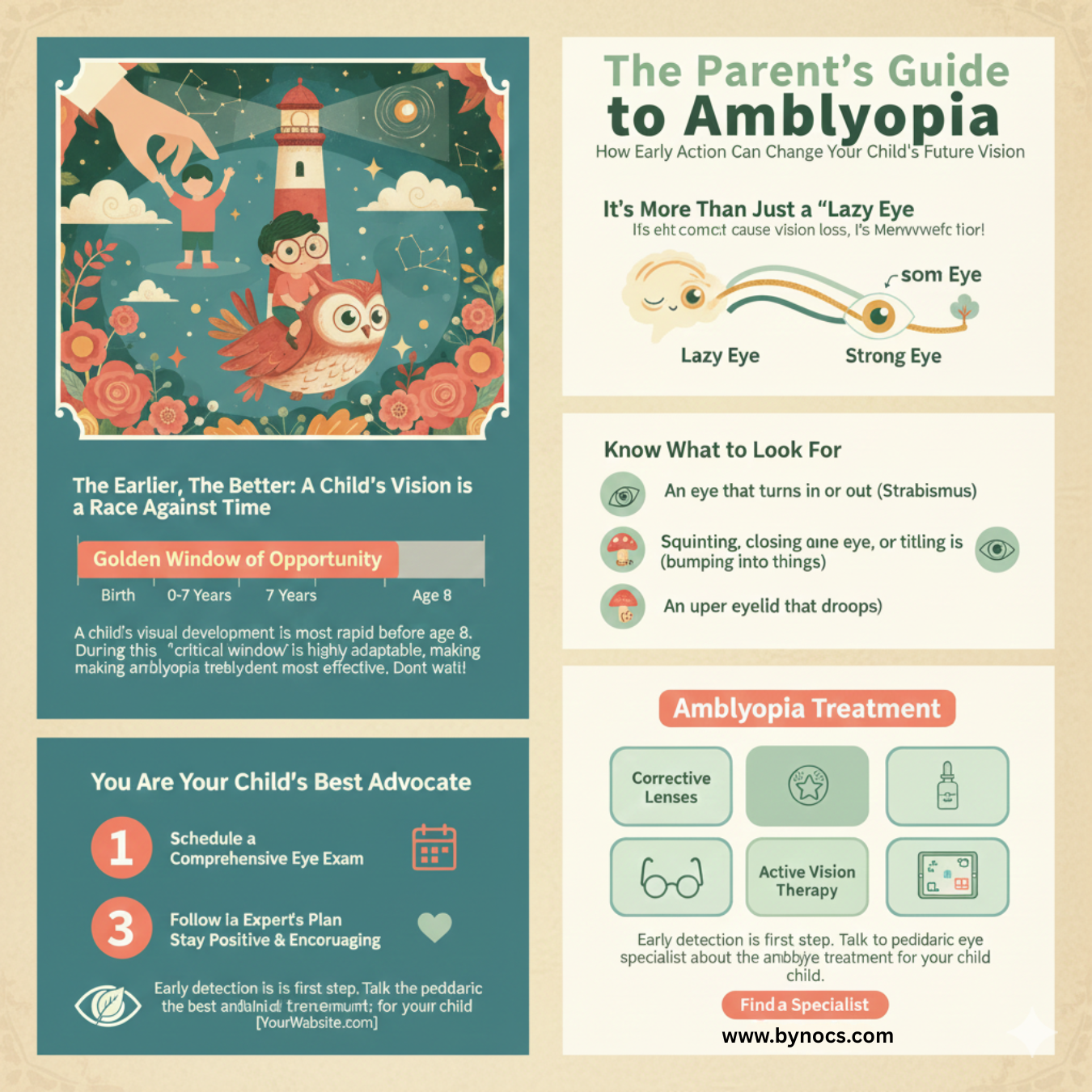
It's a note that can make your heart sink a slip of paper from the school nurse, a comment from a teacher, or just a gut feeling you get while watching your child play. You’ve noticed something is a little... off.
Maybe your child tilts their head when they focus. Maybe they complain of headaches, or you notice one eye seems to wander slightly. Or, most confusing of all, maybe they just failed a vision screening despite seeming to see perfectly fine.
If this has led you to the word "Amblyopia," you're probably feeling worried and overwhelmed.
Take a deep breath. You are in the right place.
Amblyopia, commonly known as "lazy eye," is the most common cause of vision impairment in children. It’s a condition that can be "silent," but it's also highly treatable. This guide is here to walk you through what it is, why early action is so critical, and how you, as a parent, can be the hero in your child's vision story.
What Is Amblyopia (Lazy Eye)?
First, let's clear up a common myth. The eye isn't actually "lazy." In fact, Amblyopia is not an eye problem at all it’s a brain-eye connection problem.
It’s a neuro-developmental condition where the brain, for some reason, learns to favor one eye over the other. To avoid a blurry, doubled, or misaligned image, the brain simply "turns down the volume" on the weaker eye, learning to rely almost 100% on the stronger one.
This is called suppression.
If this suppression continues, the neural pathway for the weaker eye doesn't develop properly, and its vision gets worse. This doesn't just affect how clearly your child sees; it affects their ability to develop stereopsis, or true 3D depth perception.
What Causes It? (The "Why My Child?" Question)
If you've received this diagnosis, it's important to know this is not your fault. The causes of amblyopia are often subtle and present from a very early age.
The three main causes are:
-
Strabismus (Eye Turn): This is the most obvious cause. One eye looks straight ahead while the other turns inward, outward, up, or down. To avoid double vision, the brain simply ignores the turned eye.
-
Refractive Error (The "Hidden" Cause): This is the most common and sneakiest cause. One eye has a much different prescription than the other (it's more farsighted, nearsighted, or astigmatic). The world looks crystal clear to the "good" eye and very blurry to the other. The brain, given the choice, simply uses the clear picture and ignores the blurry one.
-
Deprivation: This is the most rare. Something physically blocks the vision in one eye, like a droopy eyelid (ptosis) or a pediatric cataract.
The "Silent" Problem: Why Amblyopia Is So Hard to Spot
"But my child never complained about their vision!"
This is what almost every parent says, and it makes perfect sense. A child with amblyopia doesn't know their vision is different. Their "good" eye is doing all the work, and the world they see has always looked this way. They have no way to know it's supposed to look different.
This is why regular eye exams are so important. But in between visits, you can watch for subtle signs:
-
Head Tilting: Tilting their head to one side when watching TV or reading.
-
Covering One Eye: You might notice them casually covering one eye with their hand.
-
Clumsiness: Frequent tripping, or difficulty with hand-eye coordination (like catching a ball or building with blocks). This is a classic sign of poor depth perception.
-
Squinting or Shutting One Eye: Especially when in bright sunlight.
-
A Visible Eye Turn: This is the most obvious sign of strabismus.
Why "Waiting to See" Is Not the Answer
If there is one single takeaway from this guide, it's this: Do not wait.
The human brain is an amazing thing. In childhood, it has an incredible ability to change and adapt called neuroplasticity. A child's brain is like "wet cement" it's designed to be molded.
This high level of neuroplasticity creates a "critical window" for vision development. During this time, the brain is actively learning how to see. When amblyopia treatment is started early, we are simply redirecting this natural, powerful development. We are taking advantage of the brain's own ability to rewire itself.
The goal is to get both eyes to work as a team before the brain's visual pathways are set in stone.
What Does "Amblyopia Treatment" Actually Involve?
The goal of treatment is simple but powerful: re-establish and strengthen the brain-eye connection. The very first step is to correct the underlying problem this almost always means getting a pair of glasses to give the weaker eye its best possible chance to send a clear image.
A doctor will then prescribe a specific amblyopia treatment plan. This plan is designed to force the brain to stop suppressing and start "talking" to the weaker eye again.
The most common and effective treatments include:
-
Occlusion Therapy (Patching): This is the "classic" lazy eye treatment. By covering the strong, dominant eye with an adhesive patch for a few hours each day, the brain is forced to use the weaker eye to see. It’s a simple, low-tech, and highly effective way to build that neural pathway.
-
Atropine Drops: For children who won't tolerate a patch, atropine eye drops can be a great alternative. A drop placed in the stronger eye temporarily blurs its vision, which also encourages the brain to pay attention to the weaker eye.
-
Modern Binocular Therapies: This is an exciting new frontier for amblyopia treatment. Instead of just strengthening one eye in isolation (like patching), these active therapies often use specialized digital games or activities. They are specifically designed to break suppression and teach the brain to fuse the two images, training the eyes to work as a team.
The Parent's Role: You Are the "At-Home" Champion
Let's be honest: treatment, especially patching, can be a struggle. It's often called the "patch battle" for a reason. This is where your role is most important.
Your child's eye doctor provides the plan, but you provide the consistency and positivity that makes it work.
-
Make it Routine: Link treatment time to another daily activity (e.g., "We wear our patch while we watch our morning cartoons").
-
Make it Fun: Use sticker charts, rewards, and positive reinforcement. Decorate the patch.
-
Stay Positive: Your child will feed off your energy. Treat it as a normal, positive part of the day, not a punishment.
You are the coach, the cheerleader, and the one who makes sure the "brain training" happens every day. Your consistency is the magic ingredient that turns the treatment plan into a real-world success.
Conclusion
Finding out your child has amblyopia can be scary, but it is not a "life sentence" for poor vision. It is a common, manageable condition with a clear path forward.
Remember: it's a brain problem, not a "lazy" eye. It's silent, so don't blame yourself for not spotting it sooner. And most importantly, it is highly treatable, especially when you act early.
By taking that first step scheduling a comprehensive eye exam you are seizing the opportunity to change your child's visual future, giving them the gift of clear, strong, and binocular vision for a lifetime.
Frequently Asked Questions (FAQs)
Q: What is the difference between amblyopia (lazy eye) and strabismus (squint)?
A: They are related but different. Strabismus is an alignment problem where the eyes point in different directions. Amblyopia is a vision problem where the brain ignores one eye. Strabismus is a very common cause of amblyopia, but you can also have amblyopia without any visible eye turn.
Q: Will my child "grow out of" a lazy eye?
A: No. This is a common and dangerous myth. Amblyopia is an active developmental problem that will not get better on its own. In fact, if left untreated, it leads to permanent, irreversible vision loss.
Q: Why didn't my child's school vision screening catch this?
A: School screenings are wonderful, but they are very basic. They usually only test for 20/20 distance vision. A child can easily pass this test by "cheating" with their good eye. A comprehensive eye exam from an optometrist or ophthalmologist is the only way to test for all the components of vision, including amblyopia.
Q: Can amblyopia be treated in older children or adults?
A: While early treatment is always best (the "critical window"), research in neuroplasticity has shown that older children, teens, and even adults can see significant improvement with dedicated vision therapy. It's never too late to ask for an evaluation.
Q: How long does treatment usually take?
A: This completely depends on the child, the severity of the amblyopia, and most importantly compliance with the treatment. It can range from a few months to a few years. Consistency is the key to faster results.

 English
 Arabic
 French
 Portuguese
 Deutsch
 Turkish
 Dutch
Dutch
 Italiano
 Russian
 Romaian
 Portuguese (Brazil)
 Greek
Greek