


BIS Certificate & BIS Certification – Complete Guide 2025
Learn everything about BIS Certificate and BIS Certification in India. Process, documents, products covered, benefits, validity, and compliance explained.
Introduction
In India, product quality and consumer safety are regulated through strict standards. To ensure that products meet these standards, the Government of India mandates compliance with the Bureau of Indian Standards (BIS). Obtaining a BIS Certificate is essential for manufacturers who want to legally sell or import regulated products in the Indian market.
BIS Certification acts as proof that a product conforms to Indian Standards related to quality, performance, and safety. This blog provides a detailed explanation of BIS certification, its importance, process, documentation, and benefits in simple and easy-to-understand language.
What is BIS Certification?
BIS Certification is a conformity assessment system administered by the Bureau of Indian Standards. It ensures that products meet prescribed Indian Standards (IS) before being sold in the Indian market.
Once approved, manufacturers are allowed to use the BIS standard mark on their products. This mark assures consumers that the product has been tested and verified for safety and quality.
What is a BIS Certificate?
A BIS Certificate is the official license issued by BIS after successful evaluation of a product and manufacturing process. This certificate confirms that:
-
The product complies with the relevant Indian Standard
-
The manufacturing unit follows quality control systems
-
Product testing has been conducted in BIS-recognized laboratories
The BIS Certificate is mandatory for many products and is a legal requirement under Indian law.
Products Covered Under BIS Certification
BIS Certification applies to a wide range of products, including:
-
Electrical and electronic appliances
-
LED lighting products
-
Batteries and power adapters
-
Cement and steel products
-
Household goods such as pressure cookers and helmets
-
Toys and children’s products
For these categories, selling products without a BIS Certificate is prohibited.
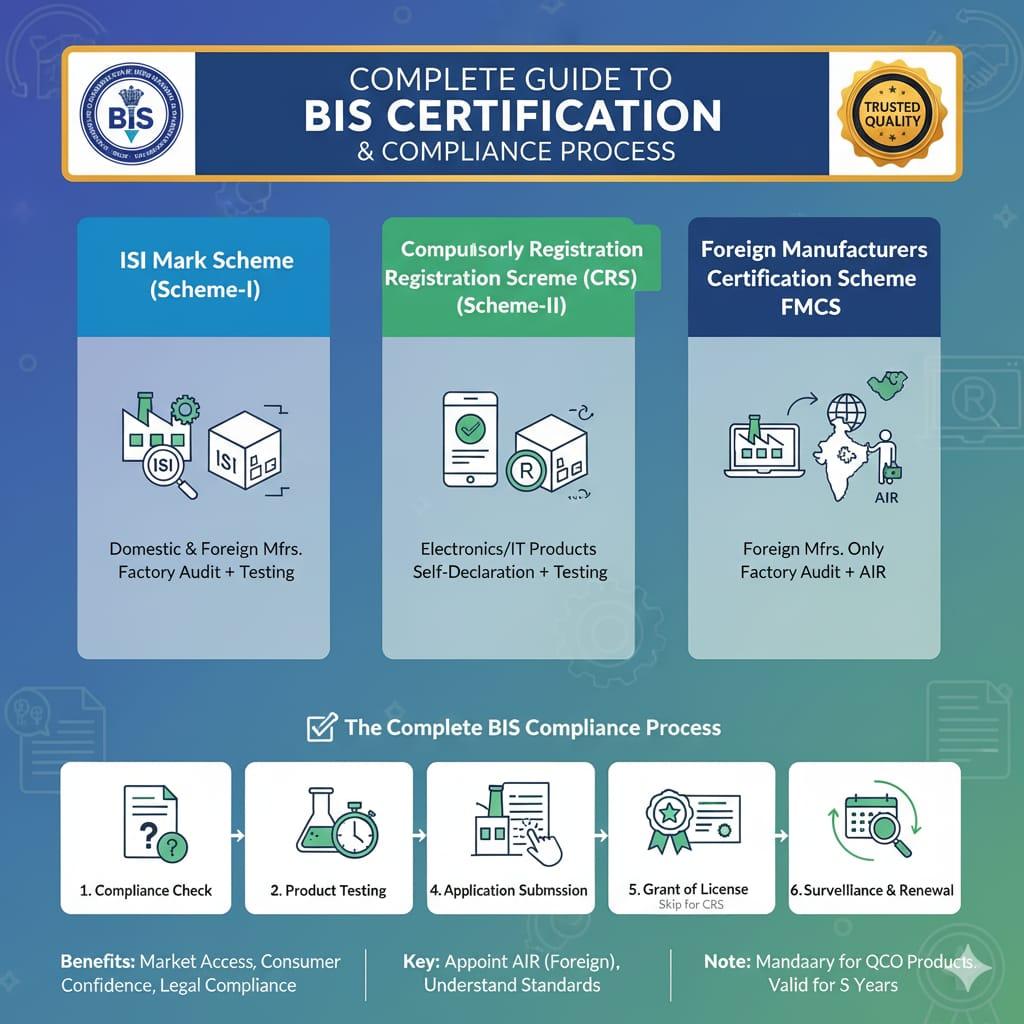
Types of BIS Certification Schemes
There are different BIS certification schemes depending on the manufacturer’s location and product type:
-
ISI Certification Scheme – For domestic manufacturers
-
FMCS (Foreign Manufacturers Certification Scheme) – For foreign manufacturers
-
CRS (Compulsory Registration Scheme) – Mainly for electronics and IT products
Choosing the correct scheme is critical for successful BIS Certification.
Process to Obtain BIS Certificate
The BIS Certification process generally includes the following steps:
1. Identify Applicable Indian Standard
Each product must comply with a specific Indian Standard.
2. Product Testing
Samples are tested in BIS-recognized laboratories to ensure compliance.
3. Application Submission
The manufacturer submits the BIS Certification application along with required documents and test reports.
4. Factory Inspection
BIS officials may conduct a factory audit to verify production and quality systems.
5. Grant of BIS Certificate
After successful verification, BIS issues the BIS Certificate allowing the use of the standard mark.
Documents Required for BIS Certification
Some commonly required documents include:
-
Company registration documents
-
Factory address and layout
-
Product test reports
-
Manufacturing process flow
-
Quality control and testing details
-
Authorization letters (if applicable)
Accurate documentation helps in faster approval.
Validity and Renewal of BIS Certificate
A BIS Certificate is issued for a specific period and must be renewed before expiry. Renewal depends on continued compliance with standards and satisfactory surveillance by BIS.
Failure to renew on time may result in suspension or cancellation of the certification.
Benefits of BIS Certification
Obtaining BIS Certification offers several benefits:
-
Legal approval to sell products in India
-
Enhanced consumer trust and credibility
-
Improved product quality and consistency
-
Competitive advantage in the market
-
Reduced risk of penalties and recalls
A BIS Certificate demonstrates commitment to quality and safety.
Common Challenges in BIS Certification
Manufacturers often face challenges such as:
-
Understanding applicable Indian Standards
-
Delays due to incorrect documentation
-
Managing factory inspections
-
Choosing the correct certification scheme
Expert guidance can simplify the process and reduce delays.
Conclusion
A sunconsultants.co.in. and BIS Certification are essential for manufacturers and importers who wish to operate legally in the Indian market. BIS certification not only ensures compliance with government regulations but also builds trust among consumers and business partners.

 English
 Arabic
 French
 Spanish
 Portuguese
 Deutsch
 Dutch
Dutch
 Italiano
 Russian
 Romaian
 Portuguese (Brazil)
 Greek
Greek