


Business Analyst Career: Skills, Pay & Career Growth

A business analyst career favours professionals who think clearly, communicate effectively, and influence decisions in complex environments across teams
Most professionals don’t wake up one day and decide their career isn’t working. It happens slowly.
Your calendar fills up. Meetings increase. Reports get shared. Yet somewhere along the way, you feel less involved in decisions that matter. You’re executing tasks but not shaping outcomes. And then you notice something else: certain people in the room always seem to influence direction, clarify confusion, and guide teams forward.
Those people are often business analysts.
The business analyst career has quietly become one of the most valuable paths for professionals who want visibility, influence, and long-term relevance. It doesn’t rely on hype or constant technical reinvention. Instead, it rewards structured thinking, communication, and the ability to turn uncertainty into clarity.
In a time where organizations are overwhelmed with information but starved of insight, business analysts have become essential.
Who Is a Business Analyst?
A business analyst is a professional who helps organizations understand problems clearly before trying to solve them.
They work at the intersection of
-
Business objectives
-
Data and information
-
Processes and systems
-
People and decision-making
Unlike roles that focus purely on execution, business analysts focus on understanding first. They ask questions others skip. They challenge assumptions. They ensure teams are solving the right problem, not just the obvious one.
A business analyst doesn’t replace managers, developers, or data teams. They connect them. And that connection is where real value is created.
Key Responsibilities of a Business Analyst
While responsibilities vary by industry and organization, the core work of a business analyst remains consistent.
Typical responsibilities include:
-
Requirement gathering and documentation: Understanding what stakeholders truly need, not just what they ask for.
-
Process analysis and improvement: Identifying inefficiencies and recommending better ways of working.
-
Stakeholder communication: Acting as a bridge between business users, technical teams, and leadership.
-
Translating business needs into solutions: Ensuring goals are clearly defined before implementation begins.
-
Supporting change and implementation: Helping teams adopt new systems, processes, or strategies smoothly.
This role often puts business analysts at the center of important initiatives, giving them a clear view of how decisions shape outcomes.
Why the Business Analyst Career Is Gaining Momentum
Organizations today face increasing complexity.
Markets shift quickly. Customer expectations evolve. Technology changes how work gets done. In this environment, poor decisions are expensive, and unclear decisions are dangerous.
This is why the business analyst career is gaining momentum.
Companies are realizing they need professionals who can:
-
Bring structure to ambiguity
-
Reduce misalignment across teams
-
Improve decision quality
-
Ensure investments deliver real value
Business analysts help organizations slow down just enough to think clearly—before moving forward with confidence.
Who Is the Business Analyst Career Meant For?
One of the strongest advantages of this career is how accessible it is.
You don’t need to be a programmer.
You don’t need an advanced technical background.
You don’t need to start from zero.
The business analyst career is well-suited for:
-
Professionals in business, operations, finance, or marketing
-
IT or technical professionals who want more business involvement
-
Project coordinators or consultants
-
Career switchers looking for stability and growth
What matters most is mindset:
-
Curiosity
-
Logical thinking
-
Clear communication
-
Comfort asking “why”
If you enjoy understanding how things work and explaining ideas clearly, business analysis is a natural fit.
How to Start a Business Analyst Career
Starting a business analyst career doesn’t require a dramatic career reset. It requires intentional steps.
A practical path often looks like this:
-
Understand business fundamentals: Learn how organizations define goals, measure success, and manage processes.
-
Learn analysis frameworks and techniques: This includes requirement analysis, process mapping, and stakeholder analysis.
-
Practice real-world scenarios: Case studies, simulations, and applied learning help build confidence.
-
Validate your knowledge: Certification plays a key role in proving your readiness to employers.
The goal isn’t to know everything; it’s to show structured thinking and problem-solving ability.
Can You Become a Business Analyst Without Experience?
This is one of the most common questions, and the answer is yes.
Many successful business analysts started without the title “business analyst” on their résumé. What they had instead were transferable skills:
-
Communication
-
Problem-solving
-
Documentation
-
Process understanding
Certification helps bridge the experience gap by validating that you understand industry-recognized frameworks and practices. For entry-level professionals and career switchers, this validation can be the difference between being overlooked and being shortlisted.
Tools and Technologies Used by Business Analysts
Business analysts don’t rely on one single tool. Their effectiveness comes from understanding how tools support thinking, not replace it.
Commonly used tools include:
-
Excel and SQL for data exploration
-
Power BI or Tableau for visualization
-
JIRA and Confluence for requirement tracking
-
Process mapping tools such as BPMN or flowcharts
The emphasis is not on mastering every tool, but on knowing when and why to use them.
Skills That Shape a Successful Business Analyst Career
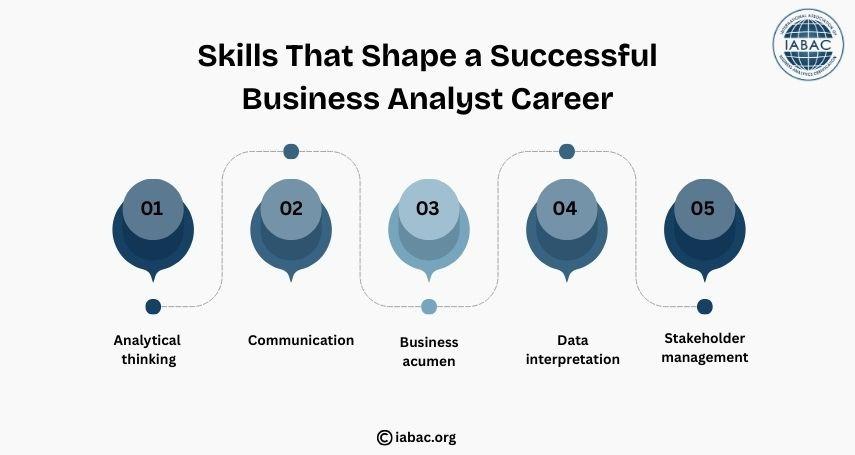
A strong business analyst is built on skills that compound over time.
Key skills include:
-
Analytical thinking – breaking complex problems into clear components
-
Communication – explaining ideas to diverse audiences
-
Business acumen – understanding how value is created
-
Data interpretation – using information to support decisions
-
Stakeholder management – balancing expectations and priorities
These skills grow with experience, making the role more strategic over time.
Business Analyst Salary and Growth Potential
Compensation in the business analyst career reflects impact and experience.
-
Entry-level business analysts earn competitive starting salaries
-
Mid-level professionals see steady increases as responsibilities expand
-
Senior business analysts and consultants command significantly higher compensation
What drives growth is not tenure alone, but the ability to influence outcomes and reduce organizational risk.
Career Growth and Progression Paths
The business analyst role opens multiple long-term paths, including:
-
Senior Business Analyst
-
Business or Strategy Consultant
-
Product Owner or Product Manager
-
Program or Project Leadership roles
Because business analysis builds decision-making capability, many professionals naturally move closer to leadership over time.
Industries Hiring Business Analysts
Business analysts are valued wherever decisions matter.
Common industries include:
-
Technology and software
-
Banking and financial services
-
Healthcare and life sciences
-
Retail and e-commerce
-
Manufacturing and supply chain
-
Consulting and professional services
This flexibility gives professionals resilience across economic cycles.
Is the Business Analyst Career Future-Proof?
Few careers remain relevant as industries evolve. Business analysis is one of them.
Why? Because it’s not dependent on a single technology or trend. As systems change, organizations still need professionals who can:
-
Clarify goals
-
Reduce confusion
-
Guide decisions
That need doesn’t disappear; it grows.
Common Challenges Business Analysts Face
The role is rewarding, but not effortless.
Common challenges include:
-
Ambiguous requirements
-
Conflicting stakeholder priorities
-
Resistance to change
-
Pressure to simplify complex issues
These challenges are also what make the role valuable. Each one strengthens judgment and credibility.
Is Business Analyst Certification Worth It?
In competitive job markets, experience alone is often not enough.
Certification:
-
Validates knowledge objectively
-
Signals commitment and seriousness
-
Aligns skills with industry standards
-
Helps employers assess capability quickly
This is where professional certification becomes a strategic investment.
How IABAC Supports Business Analyst Career Growth
IABAC (International Association of Business Analytics Certification) focuses on certifying professionals in business analytics and analysis roles.
IABAC certifications are designed to:
-
Emphasize practical, job-relevant knowledge
-
Align with real business scenarios
-
Support beginners and experienced professionals
-
Provide globally recognized credibility
For many professionals, certification through IABAC becomes the turning point that transforms learning into confidence and recognition.
How to Prepare for Business Analyst Interviews
Interviews for business analyst roles focus less on memorized answers and more on thinking processes.
Preparation should include:
-
Explaining how you approach problems
-
Demonstrating structured analysis
-
Communicating clearly and concisely
-
Using examples to show impact
Certification helps here by giving you a common language and framework to explain your approach.
Common Mistakes New Business Analysts Make
Some mistakes can slow early progress, including:
-
Over-focusing on tools instead of understanding problems
-
Ignoring business context
-
Weak stakeholder communication
-
Lack of structured learning
Awareness and guided learning help avoid these pitfalls early.
The business analyst career isn’t about shortcuts or quick wins. It’s about relevance.
In organizations filled with noise, business analysts bring clarity.
In moments of uncertainty, they bring structure.
In complex environments, they bring direction.
If you’re looking for a career that grows with experience, adapts across industries, and places you closer to meaningful decisions, business analysis is worth serious consideration.
Learning builds understanding.
Certification builds credibility.
Action builds momentum.
The question isn’t whether organizations need business analysts.
They already do. The real question is whether you’re ready to become one.

 English
 French
 Spanish
 Portuguese
 Deutsch
 Turkish
 Dutch
Dutch
 Italiano
 Russian
 Romaian
 Portuguese (Brazil)
 Greek
Greek