


Water Geysers in Your Lawn – What Just Happened? .
You walk outside, coffee in hand, half-awake, and there it is. A mini Old Faithful erupting straight out of your lawn. Water blasting upward, soaking everything around it. Grass bending sideways, mud bubbling, sprinkler system hissing like it’s angry at you. And the first thought is usually not very technical. It’s more like, what on earth just broke?
A water geyser in your lawn almost always means something failed underground. Not a mystery. Not magic. Just pressure, pipes, and one weak point finally giving up. Lawns are quiet until they’re not. When irrigation lines rupture, they announce it loudly.
Let’s break down what actually happened, why it happens, what parts are usually involved, and how sprinkler repair fits into stopping this from turning into a recurring nightmare.
The Short Answer (Before We Go Deeper)
A geyser usually means:
-
A cracked PVC sprinkler pipe
-
A blown fitting or coupling
-
A sprinkler head snapped off or popped out
-
Excessive water pressure stressing the system
-
Damage from roots, soil shifting, or lawn equipment
The irrigation system is pressurized. When that pressure finds an escape path, water doesn’t politely leak. It explodes upward.
Why Lawn Sprinkler Systems Fail So Suddenly
Sprinkler systems don’t slowly warn you most of the time. They sit underground, working day after day, until one weak section fails. That failure is often instant and dramatic.
PVC irrigation pipes are rigid. They don’t flex much. So when stress builds up, from pressure spikes or soil movement, the pipe doesn’t stretch. It cracks. Once cracked, water follows the easiest route up, usually straight through the soil to the surface.
And soil is surprisingly bad at holding back pressurized water.
Common Causes of Lawn Water Geysers
1. Broken Sprinkler Pipe Underground
This is the most common cause. A broken sprinkler line creates a direct opening where pressurized water escapes.
PVC pipes can crack due to:
-
Age and material fatigue
-
Improper installation depth
-
Freeze damage in colder climates
-
Ground settling after heavy rain
-
Tree root intrusion pressing against the line
Once the pipe splits, water shoots upward until the valve shuts off or the system is disabled.
2. Snapped or Missing Sprinkler Head
Sometimes the geyser isn’t a pipe at all. It’s a broken sprinkler head.
Lawn mowers, cars, foot traffic, kids playing, even dogs running can snap sprinkler heads clean off. When the system turns on, water blasts straight out of the exposed riser.
This kind of geyser is usually more focused and vertical, almost like a fountain. Easy fix, but messy while it’s happening.
3. Failed Sprinkler Fitting or Coupling
Fittings are weak points by nature. Elbows, tees, couplings, and threaded adapters all experience stress.
A blown sprinkler fitting often happens when:
-
Glue joints were rushed or poorly bonded
-
Threads were overtightened
-
Mixed materials were used incorrectly
-
Water pressure exceeds system tolerance
When a fitting fails, it separates or cracks, creating instant chaos underground.
4. Excessive Water Pressure
High water pressure is a silent killer of irrigation systems.
Most residential sprinkler systems are designed for pressures between 30 to 60 PSI. Anything higher puts stress on:
-
Pipes
-
Valves
-
Sprinkler heads
-
Seals and O-rings
Without a pressure regulator, spikes can cause sudden blowouts. The geyser is the symptom, not the root problem.
5. Valve Failure Causing Continuous Flow
Sometimes the geyser doesn’t stop even after the zone should shut off. That points to a faulty sprinkler valve.
Debris, worn diaphragms, or solenoid issues can prevent valves from closing properly. Water keeps flowing, pressure keeps building, and the weakest spot eventually fails.
What It Looks Like When Different Parts Fail
Not all geysers look the same. The pattern tells you a lot.
-
Tall, narrow spray: likely a broken sprinkler head or riser
-
Wide bubbling area: cracked underground pipe
-
Muddy pooling with low spray: leaking joint or fitting
-
Continuous water even when system is off: valve stuck open
These visual clues help narrow down the sprinkler repair needed.
Immediate Steps to Take When You See a Geyser
First thing. Don’t panic. Second thing. Shut off the water.
-
Turn off the irrigation controller
-
Shut off the main sprinkler system supply valve
-
Avoid stepping around the geyser area, soil may be unstable
-
Let the area drain before digging
Water-saturated soil collapses easily. Digging too soon can make repairs harder.
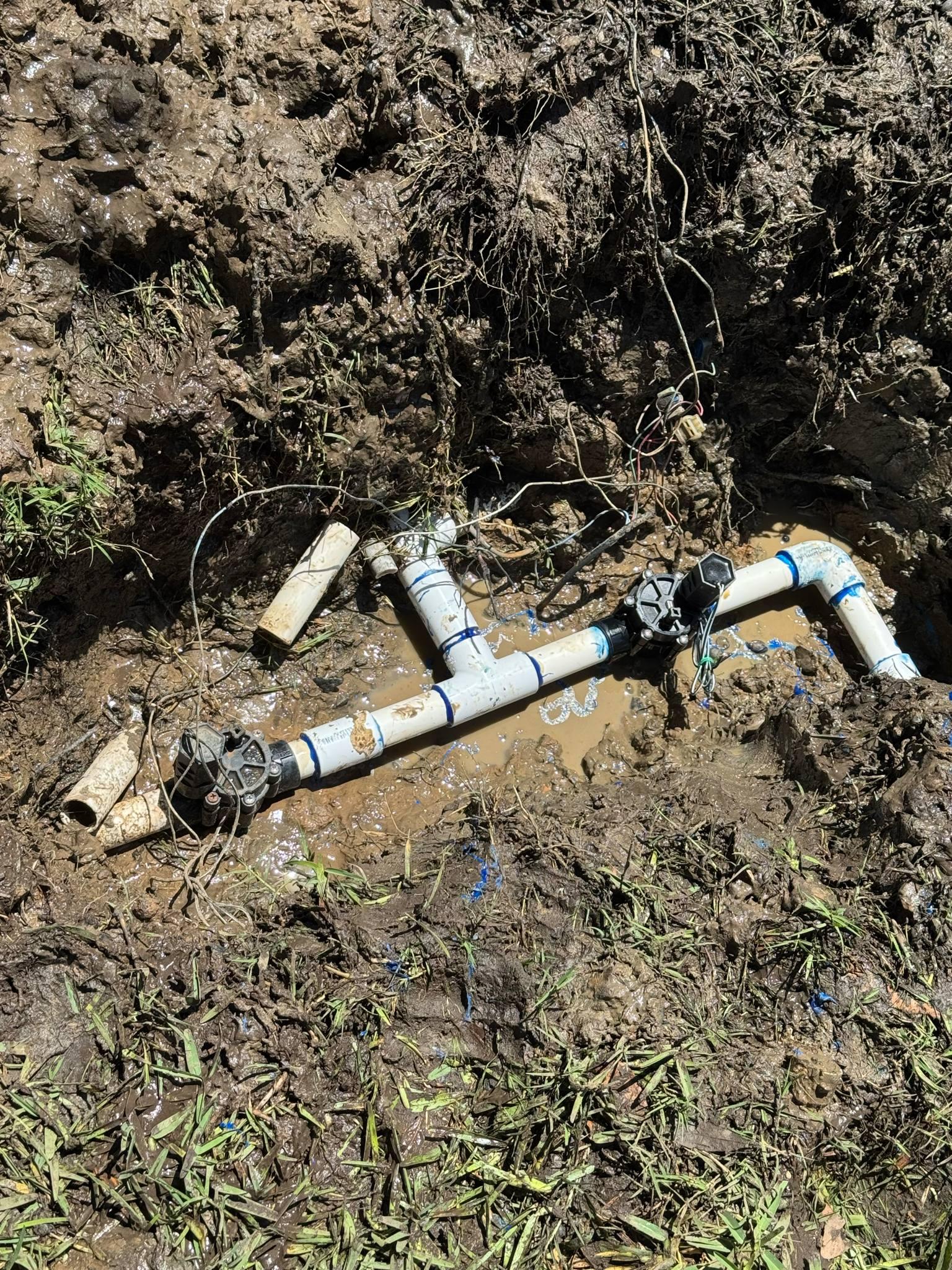
Digging It Up – What You’re Likely to Find
Once the water is off and the ground settles, excavation reveals the truth.
Most homeowners are surprised how shallow sprinkler lines are. Often only 6 to 12 inches deep. You’ll typically see:
-
White or gray PVC pipe
-
Black poly tubing in some systems
-
Mud packed tightly around joints
-
A clean crack or separated fitting
This is where sprinkler pipe repair becomes unavoidable.
Typical Sprinkler Repair Solutions
PVC Pipe Repair
For cracked pipes:
-
Cut out the damaged section
-
Install a new pipe segment
-
Use PVC couplings or repair couplings
-
Prime and glue properly, no shortcuts
Flexible repair couplings can help in tight spaces or where soil movement is common.
Sprinkler Head Replacement
If it’s a broken head:
-
Unscrew the damaged sprinkler head
-
Flush debris from the riser
-
Install a matching replacement head
-
Adjust spray pattern and arc
Always match nozzle type and flow rate to avoid pressure imbalance.
Fitting and Joint Repair
Failed fittings must be replaced entirely. Re-gluing cracked fittings never holds.
Use:
-
Proper PVC primer and cement
-
Correct fitting size and thread type
-
Teflon tape on threaded connections
Rushed joints are future geysers waiting to happen.
Valve Repair or Replacement
If a valve caused the blowout:
-
Inspect diaphragm and seals
-
Clean debris from valve body
-
Replace solenoid if stuck
-
Replace valve if housing is cracked
Valve issues often require more experience, especially in valve manifolds.
Why Geysers Often Happen at the Worst Time
They always seem to happen:
-
During summer heat
-
Right after fertilizing
-
When guests are over
-
Early morning before work
That’s because sprinkler systems run most frequently during hot weather. More cycles mean more stress. Weak points finally fail when demand is highest.
Preventing Future Lawn Geysers
You can’t prevent every failure, but you can reduce the odds.
-
Install a pressure regulator
-
Schedule seasonal sprinkler inspections
-
Replace aging PVC sections proactively
-
Avoid driving or parking on irrigation zones
-
Adjust heads so they retract fully
Routine sprinkler system maintenance costs far less than emergency repairs and water damage.
Signs a Geyser Is Coming (Yes, There Are Some)
Sometimes the system whispers before it screams.
Watch for:
-
Unexplained soggy patches
-
Sudden drops in sprinkler head pressure
-
Dirt washing up around heads
-
Hissing sounds underground
-
Spikes in water bills
These are early warnings of leaks or failing components.
DIY or Call for Professional Sprinkler Repair?
Small fixes like replacing a sprinkler head are DIY-friendly. But underground pipe repairs, valve issues, or repeated failures usually need a professional.
A licensed sprinkler repair technician brings:
-
Pressure testing tools
-
Leak detection experience
-
Proper fittings and parts
-
Faster diagnosis
They also see patterns homeowners miss, like systemic pressure problems.
Why Ignoring a Geyser Is a Bad Idea
Letting it run or patching it poorly leads to:
-
Washed-out soil and roots
-
Lawn damage and dead patches
-
Foundation moisture issues
-
Sky-high water bills
-
Repeated pipe failures nearby
Water always finds the next weak spot.
The Bigger Picture: Your Sprinkler System Is a Network
A geyser isn’t just a single failure. It’s a sign the system is under stress somewhere.
Sprinkler systems are networks. Pipes, valves, heads, and controllers all rely on balanced pressure and proper installation. One failure often hints at others coming.
Fix the break, yes. But also ask why it broke there, at that moment.
Final Thought (Not a Perfect Ending, Just a Real One)
Seeing a water geyser erupt from your lawn is jarring. It feels sudden, chaotic, wasteful. But it’s also a very clear message. Something gave out.
With proper sprinkler repair, pressure control, and a bit of preventative care, it doesn’t have to happen again next season. Or the season after that.
Water belongs in the grass, not launching itself skyward like it’s trying to escape your yard.

 English
 Arabic
 Spanish
 Portuguese
 Deutsch
 Turkish
 Dutch
Dutch
 Italiano
 Russian
 Romaian
 Portuguese (Brazil)
 Greek
Greek