


Real-Time vs. Delayed Data: What You Need to Know Before Choosing a Free Stock API
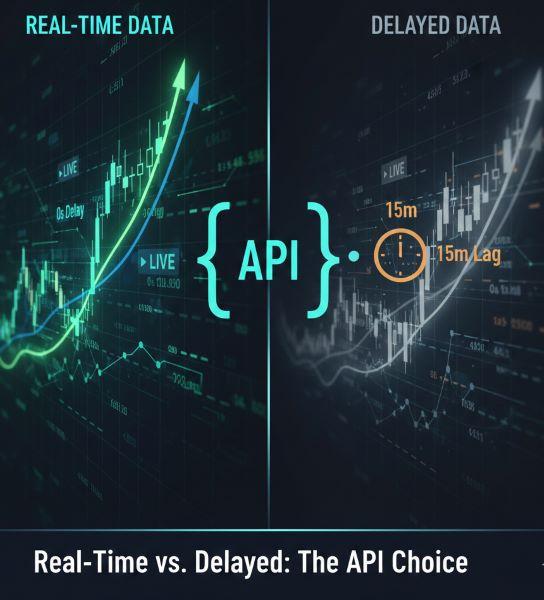
Understanding financial market data is essential whether you’re developing a finance app, building a trading tool, or monitoring investments. At the heart of market data is a choice every developer or investor must make: real-time data vs delayed data. This decision becomes even more critical when selecting a free stock API or stock price API for your project.
In this guide, we’ll break down the differences between these two data types, explore why it matters for developers and businesses, look at real examples, and recommend how to make the best choice , including why Marketstack stands out as a leading option.
What Is Stock Market Data?
Before comparing data speeds, it’s helpful to understand what stock market data includes. At its simplest, market data comprises information about financial instruments , like stocks and indices , including prices, volume, and trends. A stock price API lets your application fetch this data programmatically, typically over HTTP in JSON format. Some APIs offer additional insights such as historical prices, corporate actions, or market indices.
Real-Time Data: The Pulse of the Market
Real-time data refers to information that’s as current as possible , refreshed instantly or within seconds of market events. This is the data most traders rely on when timing trades, triggering alerts, or driving automated strategies.
Key Features of Real-Time Data:
- Updated every few seconds to minutes
- Used in trading apps, live dashboards, hedge fund systems
- Allows rapid decision-making
- Often comes with higher costs or stricter licensing
While some platforms claim “real-time” access, users often find that truly free real-time data is extremely rare due to the expense of licensing market feeds; most free services either delay the data slightly or limit reliability.
Who Needs Real-Time Data?
- Algorithmic traders
- Financial analysis platforms
- Active traders building dashboards
- Market monitoring applications
Delayed Data: Slow, But Efficient and Affordable
In contrast, delayed data is stock information that lags behind actual market changes , typically by about 15 minutes or more. Many free APIs only offer delayed data unless you upgrade to a paid tier.
Advantages of Delayed Data
- Available at no cost in many APIs
- Lower bandwidth and fewer licensing restrictions
- Sufficient for historical analysis, trend tracking, and educational tools
Typical Use Cases
- Portfolio overview dashboards
- Long-term investment platforms
- Research and backtesting tools
- Personal finance apps
For example, several free market data services offer delayed quotes as part of their baseline access, enabling developers to get started without paying high fees.
Key Differences: Real-Time vs. Delayed Stock Data
|
Feature |
Real-Time |
Delayed |
|
Update Speed |
Seconds to Minutes |
15–20+ Minutes |
|
Cost |
Higher |
Typically Free |
|
Best For |
Active trading & automation |
Research & analysis |
|
Access |
Often Requires Paid Plan |
Common in free plans |
|
Licensing |
Strict + Paid |
Looser + Affordable |
Understanding these differences helps you match the data type to your needs without overspending or overengineering.
Free vs Paid: The True Cost of “Free” Stock APIs
When choosing a free stock API, you’ll find that many services offer a free tier with limitations such as:
- capped monthly requests
- delayed quotes
- limited exchanges
- no real-time updates
Take Marketstack, a powerful stock market API that offers a robust free plan, including:
- End-of-day data with up to 12 months of history
- Coverage of 30,000+ tickers across 2,700+ global exchanges
- HTTPS encryption and easy REST JSON responses
- Free API key with 100 requests per month to get started instantly
For developers needing more than basic EOD data , such as intraday updates , Marketstack’s paid plans unlock real-time and high-frequency data with granular time intervals.
Other free options exist, such as StockData.org, which lets you access real-time, historical, and intraday data from multiple exchanges.However, most platforms impose limitations on free tiers, especially for real-time access.
Why Accurate Timing Matters
Let’s say you’re building an app to alert users when their selected stock hits a target price. If your data is delayed by 15 minutes, the price displayed could be outdated by the time it reaches your users , leading to poor user experience or incorrect actions. Conversely, if you fetch real-time data every second, you risk exceeding API rate limits or incurring higher costs.
Balancing performance, cost, and real-time needs is vital.
Top Free and Freemium Stock Market APIs
Here are some noteworthy options to consider:
- Marketstack – Offers free global market data, easy integration, and real-time options with premium plans.
- StockData.org – Another free provider with real-time, historical, and news data via a simple REST interface.
- Fcsapi.com – Provides free access to real-time and historical stock price data with API keys.
- DataBento – Offers real-time and historical feeds with free credits for testing.
Each has different limits and strengths, so consider your exact needs before choosing.
Best Practices When Choosing a Free Stock API
To make the most of your data source, keep the following in mind:
✔️ Define Your Need First
Are you building a live trading interface or a portfolio tracker? This determines if real-time data is critical.
✔️ Check Rate Limits and Quotas
Free plans usually have monthly or daily caps.
✔️ Look at Exchange Coverage
Global projects require worldwide tickers; others may only need US data.
✔️ Understand Licensing Terms
Some data may be restricted in terms of redistribution or commercial use.
✔️ Test Before You Commit
Start with free tiers to ensure performance matches expectations.
FAQs
Q1. What’s the difference between real-time and delayed stock data?
Real-time data is updated instantly as the market changes, while delayed data arrives after a set lag (often 15 minutes). Real-time is essential for active trading, while delayed is fine for research and dashboards.
Q2. Is there really a free real-time stock API?
Fully free real-time data is rare due to licensing costs. Most providers, including Marketstack, offer real-time data on paid plans, while free tiers provide delayed or limited data.
Q3. Can I use a free stock API for commercial applications?
It depends on the provider’s terms. Some allow commercial use on certain plans, others restrict it. Always read the API’s licensing and terms of service.
Q4. What APIs are best for historical prices?
Marketstack and platforms like StockData.org provide historical end-of-day and intraday prices suitable for research and backtesting.
Q5. Should I combine multiple APIs?
Yes , combining APIs (e.g., one for real-time and another for historical data) can help balance cost and capabilities.
Choosing the right API isn’t just about finding the cheapest or fastest data source , it’s about matching real-time vs delayed data to your project’s goals. Users building data-rich applications should consider quality, cost, request limits, and reliability.
If you’re just getting started and want a trusted market data solution that scales from free usage to high-volume needs, Marketstack is one of the top APIs available. It combines ease of use with flexibility, broad global coverage, and options for real-time or historical market insights.
👉 Ready to build your next financial app with reliable market data?
Get started with Marketstack’s powerful stock market API , free forever (100 monthly requests) , and scale as your needs grow.
🔗 Visit https://marketstack.com/ to get your free API key and start integrating today!
Recommended Resources: Step-by-Step Guide: How to Make Your REST APIs Accessible to AI Assistants Using MCPs

 English
 Arabic
 French
 Spanish
 Portuguese
 Turkish
 Dutch
Dutch
 Italiano
 Russian
 Romaian
 Portuguese (Brazil)
 Greek
Greek