


South Africa E-Commerce Market Overview, Trends and Forecast 2025–2033
Introduction to the South Africa E-commerce Market
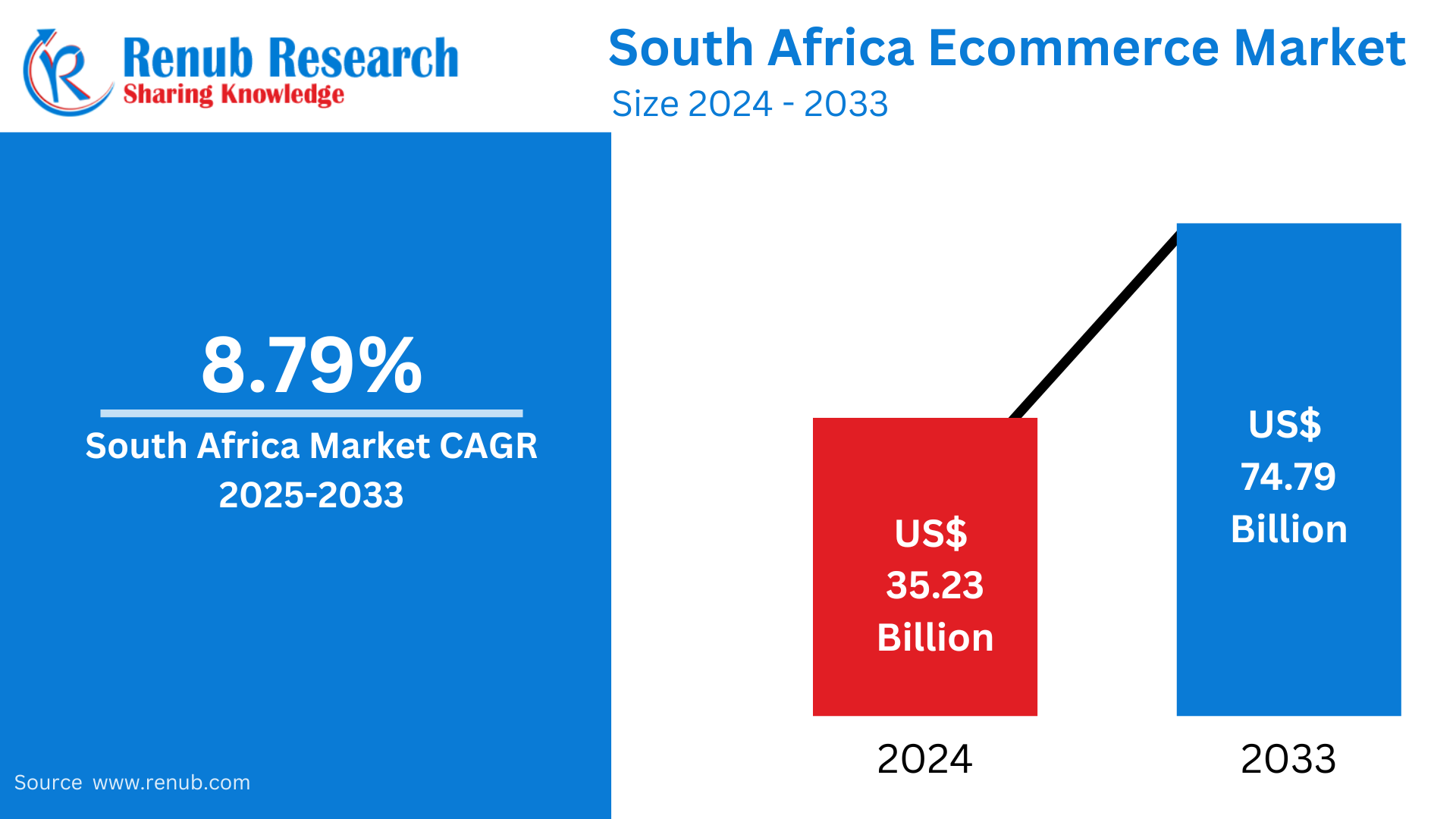
According to Renub Research South Africa e-commerce market is witnessing exceptional growth, driven by evolving consumer behavior, rising internet connectivity, expanding digital payments, and strong mobile commerce penetration. The market is projected to reach US$ 74.79 billion by 2033, increasing from US$ 35.23 billion in 2024, reflecting a CAGR of 8.79% from 2025 to 2033. The growing trust in online platforms, improved logistics infrastructure, innovative payment systems, and enhanced accessibility to online services are encouraging more consumers and businesses to adopt e-commerce as a mainstream retail channel. With global brands entering the market and local platforms strengthening their ecosystems, South Africa is positioned as one of Africa’s most promising e-commerce hubs.
South Africa E-commerce Market Overview
E-commerce in South Africa includes Business-to-Consumer (B2C), Business-to-Business (B2B), and Consumer-to-Consumer (C2C) platforms, enabling consumers to shop for a wide variety of goods ranging from electronics and apparel to groceries and home essentials. Increasing smartphone adoption, better internet infrastructure, and tech-savvy consumers have significantly transformed the retail landscape. Platforms such as Takealot, Amazon South Africa, Jumia, Zando, and several emerging e-retailers have expanded consumer choice and reshaped shopping experiences.
South African consumers today value convenience, product variety, price transparency, and doorstep delivery more than ever. E-commerce has also empowered small and medium businesses by providing access to a wider marketplace without the cost burden of physical stores. Furthermore, exposure to international brands and global retail trends has diversified product offerings and enhanced consumer expectations.
Download Free Sample Report:https://www.renub.com/request-sample-page.php?gturl=south-africa-e-commerce-market-p.php
High Internet Penetration and Mobile Usage Driving Growth
One of the strongest pillars supporting the South African e-commerce market is expanding internet penetration and smartphone adoption. More than two-thirds of the population has internet access, making digital shopping increasingly accessible. Mobile internet usage is surging due to affordable smartphones, improving connectivity, and cost-effective data plans.
The prevalence of mobile shopping apps and optimized websites enables consumers to browse products, compare prices, read reviews, and make secure transactions anytime and anywhere. This accessibility does not just benefit urban consumers but also extends opportunities to semi-urban and rural buyers, promoting inclusivity in the digital economy. As mobile commerce continues to expand, it significantly strengthens e-commerce growth momentum across the country.
Expansion of Digital Payment Solutions
The rapid growth of digital payments has played a vital role in accelerating e-commerce adoption. South Africa has experienced significant advances in secure online banking systems, digital wallets, mobile payments, and fintech innovation. Popular platforms such as PayFast, PayU, SnapScan, Zapper, Apple Pay, and Google Pay are revolutionizing cashless transactions.
Digital wallets offer speed, security, and user convenience, making them highly appealing. The government and financial institutions are also prioritizing digital financial inclusion, launching frameworks like the National Payment System Vision 2025 to encourage innovation, interoperability, security, and accessibility. As consumers gain confidence in secure digital financial systems, the propensity to shop online continues to grow steadily.
Changing Consumer Shopping Behavior
Consumer behavior in South Africa has undergone a fundamental transformation, especially after the COVID-19 pandemic. Convenience is now a major driver of purchasing decisions. Online shopping offers benefits such as time savings, home delivery, flexible payment options, discounts, access to global brands, and easy return policies.
Many consumers prefer researching products online by comparing prices, evaluating specifications, and reading reviews before making purchase decisions. Personalized marketing strategies, AI-powered product recommendations, and targeted promotions further enhance online shopping experiences. As lifestyle demands evolve, online platforms are becoming the preferred buying channel for daily essentials, electronics, fashion, luxury items, and even groceries.
Logistics and Delivery Challenges in the Market
Despite rapid growth, logistics remains one of the biggest challenges for the South African e-commerce ecosystem. Urban cities like Johannesburg, Cape Town, and Durban possess comparatively efficient delivery networks, but rural and remote regions still face delayed deliveries, complex last-mile logistics, and higher transportation costs. Road infrastructure limitations, geographic distances, and inconsistent courier accessibility impact delivery timelines and increase operational expenses.
To overcome these challenges, e-commerce companies are investing in warehousing networks, advanced delivery routing technology, partnerships with third-party logistics providers, and innovative delivery solutions such as pickup points and smart lockers. Strengthening logistics efficiency will be crucial to maintaining customer satisfaction and sustaining long-term market expansion.
Online Payment Security Concerns
Although digital payments are growing rapidly, cybersecurity concerns remain a barrier for some consumers. Fraud, phishing attacks, identity theft, and data breaches have caused hesitation among certain online shoppers. Many consumers still prefer cash transactions due to mistrust of online financial systems.
To combat this, e-commerce platforms and financial institutions are implementing stronger encryption methods, multi-factor authentication, fraud monitoring systems, and cybersecurity awareness campaigns. Educating consumers about safe online shopping practices and building trust through secure payment gateways is necessary to fully unlock South Africa’s e-commerce potential.
South Africa E-commerce Apparel and Accessories Market
The fashion, apparel, and accessories segment holds a dominant share of the South African e-commerce market. Increasing disposable incomes, aspirational lifestyles, global fashion exposure, and growing online shopping convenience are driving this segment. Leading platforms such as Zando, Takealot, Superbalist, and the entry of Amazon South Africa have expanded clothing options, styles, brands, and affordability.
Consumers benefit from size variety, home delivery, simple exchange policies, and attractive discounts. Mobile commerce plays a major role in apparel shopping, especially among younger consumers. Personalized fashion suggestions, targeted advertisements, and influencer marketing are further accelerating digital fashion retail. However, logistical costs and returns management still pose challenges for market players.
Growth of Digital Wallets in South Africa
The digital wallet market is gaining significant momentum as South Africans increasingly prefer seamless, fast, and contactless payment experiences. Digital wallets not only enhance convenience but also promote secure transactions in both online and physical retail. The post-pandemic emphasis on hygienic and cashless payments accelerated adoption, reinforcing digital wallets as an essential financial tool.
Local digital payment solutions alongside global platforms are helping advance financial inclusion. As more unbanked and underbanked populations gain access to digital financial systems, digital wallets are expected to play a transformative role in strengthening e-commerce growth.
South Africa E-commerce Market Segmentation Overview
The South Africa e-commerce market spans multiple product categories, including apparel and accessories, health and beauty, electronics, office supplies, toys, furniture, home furnishing, media products, and more. Each category is experiencing rising demand driven by lifestyle preferences and digital accessibility.
In payment segmentation, digital wallets lead alongside credit cards, debit cards, account-to-account transfers, Buy Now Pay Later solutions, cash on delivery, and prepaid systems. BNPL services are especially gaining popularity among young buyers seeking flexible payment plans. Cryptocurrency also begins to slowly emerge as an alternative payment category, although adoption remains limited.
Competitive Landscape and Key Market Players
The competitive environment of the South African e-commerce market is dynamic and expanding. Leading players include Takealot Online Pty Ltd, Amazon, Jumia, Zando, Evetech, Walmart-associated platforms, UCook, SoFresh, and Decathlon. These companies focus on product diversification, improved logistics, strong digital platforms, customer-focused strategies, and innovative payment models.
Local businesses and international brands are continuously investing in technology, data analytics, marketing intelligence, warehouse infrastructure, and customer support to enhance competitiveness. Strategic partnerships, mergers, acquisitions, and regional expansions are expected to intensify competition further.
Future Outlook of the South Africa E-commerce Market
The future of the South African e-commerce market is exceptionally promising. With rising digital literacy, continuous mobile internet growth, sophisticated payment technology, and increasing consumer trust, the market is expected to witness transformative development. Strengthening logistics, enhancing cybersecurity, expanding digital inclusion, and promoting innovation will play critical roles in shaping the next phase of e-commerce evolution.
South Africa’s e-commerce sector is poised not only to boost economic growth but also to empower entrepreneurs, create employment opportunities, promote technological advancement, and integrate the nation deeper into the global digital economy. As infrastructure improves and digital adoption widens, South Africa is set to remain one of Africa’s leading and fastest-growing e-commerce markets through 2033 and beyond.

 English
 Arabic
 French
 Spanish
 Portuguese
 Deutsch
 Turkish
 Italiano
 Russian
 Romaian
 Portuguese (Brazil)
 Greek
Greek