


What’s Driving Growth in the Middle East Industrial Gases Market
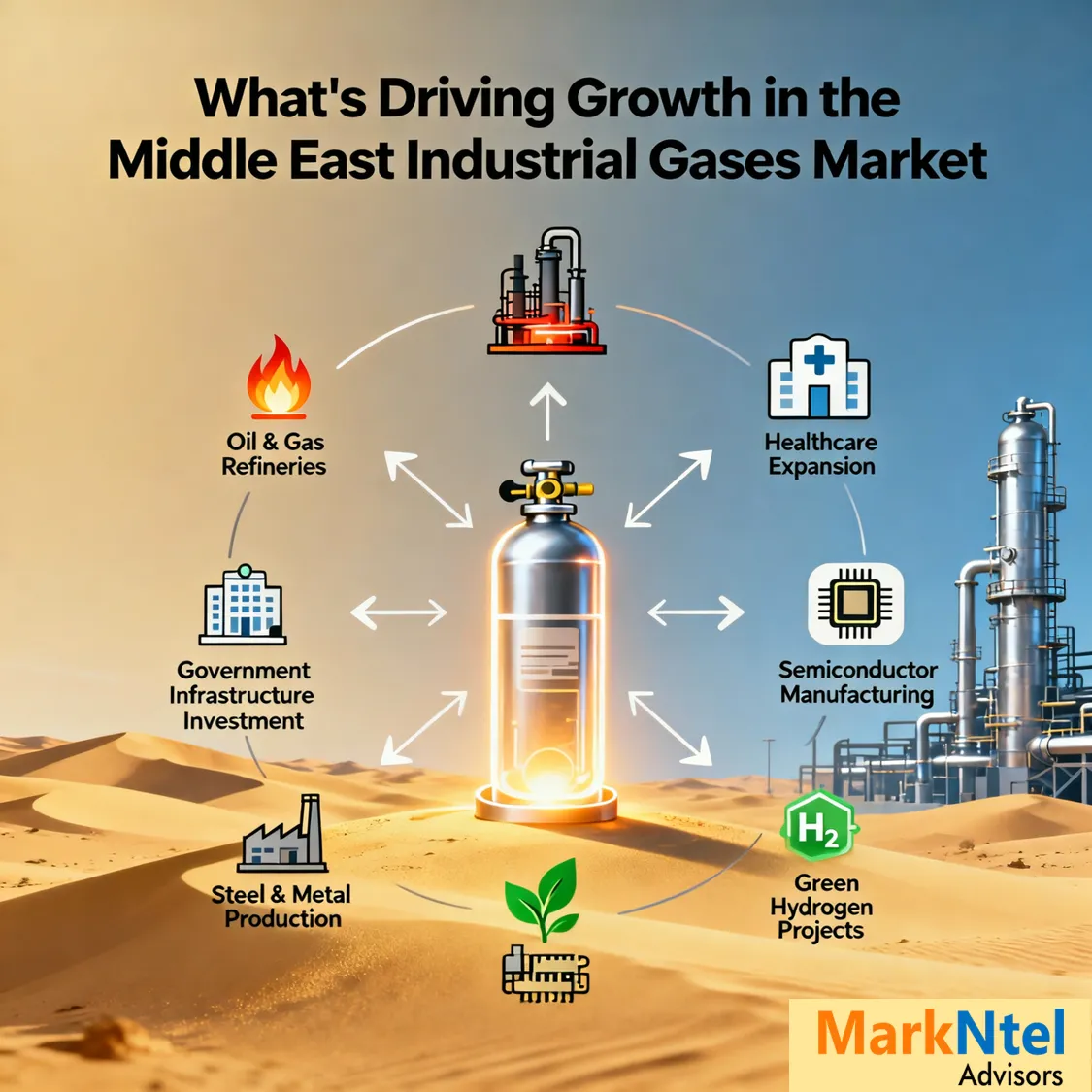
In the Middle East, industries run on more than just raw materials they rely on gases that power manufacturing, healthcare, energy, and infrastructure projects. From oxygen in hospitals to nitrogen in food packaging and hydrogen in energy applications, industrial gases form the invisible backbone of modern economies. According to MarkNtel Advisors, the Middle East industrial gases market is valued at around USD 10.06 billion in 2025 and is projected to reach USD 12.68 billion by 2032, growing at an estimated CAGR of 4.72% during the 2026–2032 forecast period. This growth reflects regional industrialization, healthcare expansion, and the increasing adoption of advanced technologies across multiple sectors.
Key Drivers of Market Growth
The growth of the Middle East industrial gases market is fueled by several interlinked factors. One of the primary drivers is industrial and manufacturing expansion. Countries like Saudi Arabia, the UAE, and Qatar have invested heavily in petrochemicals, refining, and construction. These industries require consistent and high-quality gas supply for processes such as welding, cutting, refrigeration, and chemical reactions.
Healthcare is another significant contributor. Hospitals and clinics increasingly depend on medical oxygen, nitrous oxide, and other specialty gases. The COVID-19 pandemic highlighted the critical role of medical gases, leading to both emergency preparedness and long-term demand growth.
Energy diversification also plays a role. Hydrogen, for example, is gaining attention as a cleaner energy source. Investments in hydrogen infrastructure are encouraging regional production and consumption, linking the industrial gases market to sustainability and low-carbon initiatives.
Urbanization and population growth further amplify demand. Food preservation, beverage carbonation, and refrigeration all rely on gases like carbon dioxide and nitrogen, creating steady consumption patterns in both commercial and domestic sectors.
Segmentation and Applications
The industrial gases market is diverse, with applications spread across multiple industries. Oxygen, nitrogen, argon, carbon dioxide, and hydrogen are among the most widely used.
· Oxygen is critical not only in healthcare but also in steel production and water treatment processes.
· Nitrogen finds applications in food packaging, electronics manufacturing, and inerting processes in chemical plants.
· Argon is commonly used in welding and high-quality metal fabrication.
· Carbon dioxide serves in refrigeration, beverages, and fire suppression systems.
· Hydrogen is emerging in energy, refining, and transportation as countries pursue low-carbon strategies.
Regional adoption patterns vary. Petrochemical hubs rely heavily on nitrogen and hydrogen, while urban centers show strong demand for medical oxygen and carbon dioxide. Companies operating in the Middle East industrial gases market must balance production, storage, and distribution to meet these varied demands efficiently.
Key Players Operating in the Middle East Industrial Gases Market
The Middle East industrial gases market is driven by a mix of established regional producers and multinational corporations, ensuring consistent supply across industries. Key players include Abdullah Hashim Industrial Gases, ADNOC Industrial Gas, Buzwair Industrial Gases, Dubai Industrial Gases, Gulf Cryo, Gulf Industrial Gases Company, Jordan Gases Company, Naga Gases, National Industrial Gas Plants, and Yateem Oxygen. These companies provide a broad range of products, from medical and industrial gases to specialty and energy-related gases. Together, they strengthen supply reliability, support large-scale industrial projects, and maintain high standards of safety, quality, and technological adoption throughout the region.
Technology and Distribution Trends
Technology and logistics play a crucial role in enabling the industrial gases market. Advanced cryogenic storage systems allow for safe long-term storage of liquefied gases, while pipeline networks support large-scale industrial applications. Digital monitoring and automation solutions optimize supply chain management, helping companies ensure uninterrupted service.
Consultancies and technology partners, including firms like Tech Formation, often assist gas producers in implementing data-driven systems, improving operational efficiency, and ensuring regulatory compliance. Such technological adoption is critical in a market where safety, purity, and consistency are non-negotiable.
Distribution channels in the Middle East vary by product and industry. On-site generation is common in large industrial facilities, while packaged cylinders and bulk liquid deliveries serve hospitals, small manufacturers, and remote operations. Logistics efficiency is essential, particularly in regions with challenging terrain or rapidly expanding industrial zones.
Challenges and Market Dynamics
Despite robust growth, the Middle East industrial gases market faces several challenges. High capital investment for production plants, storage facilities, and distribution infrastructure can limit new entrants. Regulatory compliance and safety standards are strict, reflecting the inherent risks of handling high-pressure gases and cryogenic liquids.
Supply chain disruptions, whether due to geopolitical factors, logistics constraints, or natural events, can have ripple effects across multiple sectors. Moreover, fluctuating energy prices impact production costs, as many gases require energy-intensive processes like air separation.
Competition is also intensifying. Global industrial gas companies are expanding in the region, while local manufacturers focus on specialized applications and regional supply reliability. Differentiation increasingly depends on technology adoption, customer service, and consistent quality rather than price alone.
Future Outlook
The Middle East industrial gases market is poised for steady growth. Industrialization, healthcare expansion, energy diversification, and technological adoption will continue to drive demand. Hydrogen and other low-carbon gases are likely to become more prominent as sustainability initiatives accelerate across the region.
Companies that integrate digital solutions, optimize logistics, and maintain strict safety and quality standards will be best positioned to capitalize on this growth. Partnerships between global and regional players may also create opportunities for innovation and efficiency, particularly in emerging segments like hydrogen and specialty gases.
Final Thoughts
The Middle East industrial gases market is both vast and nuanced. Its growth reflects a combination of industrial activity, healthcare needs, energy strategies, and urbanization trends. For businesses and investors, understanding the dynamics of production, distribution, and end-use applications is essential.
While gases may operate behind the scenes, their impact is visible everywhere—from hospitals and factories to energy plants and urban infrastructure. Navigating this market successfully requires a balance of strategic investment, technological adoption, and operational excellence. For those who pay attention, the opportunities in the Middle East industrial gases market are substantial and long-lasting.

 English
 Arabic
 French
 Portuguese
 Deutsch
 Turkish
 Dutch
Dutch
 Italiano
 Russian
 Romaian
 Portuguese (Brazil)
 Greek
Greek