


How to Get a BIS Certificate for Import
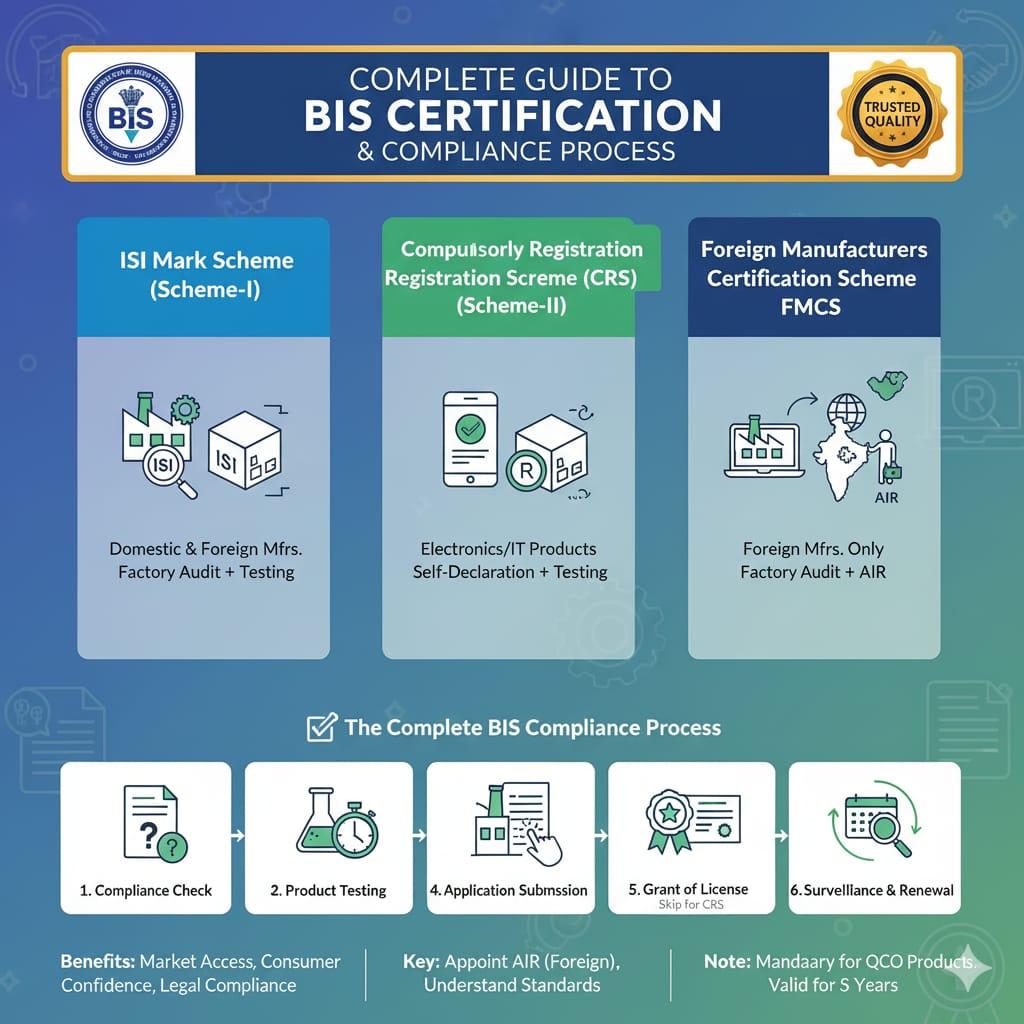
To import products into India that fall under mandatory BIS requirements, the first step is to identify the correct certification route. Begin by confirming whether your product is covered under the ISI Certification Scheme, which involves licensing, factory surveillance, and use of the ISI mark, or under the Compulsory Registration Scheme (CRS), which mainly applies to electronics and IT products. After identifying the scheme, determine the applicable Indian Standard (IS) and carefully review its scope, as it defines the required tests, labeling norms, and any exclusions.
Next, develop a structured compliance plan. List all product models and variants intended for import, map the relevant clauses of the standard, and collect the required documentation. This typically includes product drawings and specifications, a list of critical components, safety declarations, and quality management system (QMS) records. Proper preparation at this stage helps avoid delays during testing and application review.
Product testing must be conducted at a BIS-recognized laboratory experienced in your product category. Confirm sample quantities, testing timelines, and report formats before testing begins. While testing is in progress, prepare the application dossier, including business registration documents, brand authorization (if applicable), and labeling or marking artwork that clearly references the applicable IS. For products manufactured outside India, appoint an Authorized Indian Representative (AIR) to act as the local point of contact with BIS.
Under the CRS route, once the product successfully passes all required tests, test reports and supporting documents are submitted online through the BIS portal. After payment of applicable fees and approval by BIS, a Registration Number (R-number) is issued, allowing the product to be imported and sold in India.
For products covered under the ISI Scheme, BIS conducts a factory inspection of the manufacturing unit to assess production controls, in-house testing facilities, and marking procedures. After the license is granted, periodic surveillance and ongoing compliance are required.
After certification, importers must ensure strict adherence to BIS marking and packaging rules—using the ISI mark with the CM/L number or the CRS R-number along with the relevant IS reference. Maintain compliance records, monitor any changes in components, firmware, or suppliers, and establish a renewal schedule and process for adding new variants to keep your import portfolio fully compliant.

 English
 French
 Spanish
 Portuguese
 Deutsch
 Turkish
 Dutch
Dutch
 Italiano
 Russian
 Romaian
 Portuguese (Brazil)
 Greek
Greek