


DGFT Registration Services in India – Get Your IEC Without Hassle
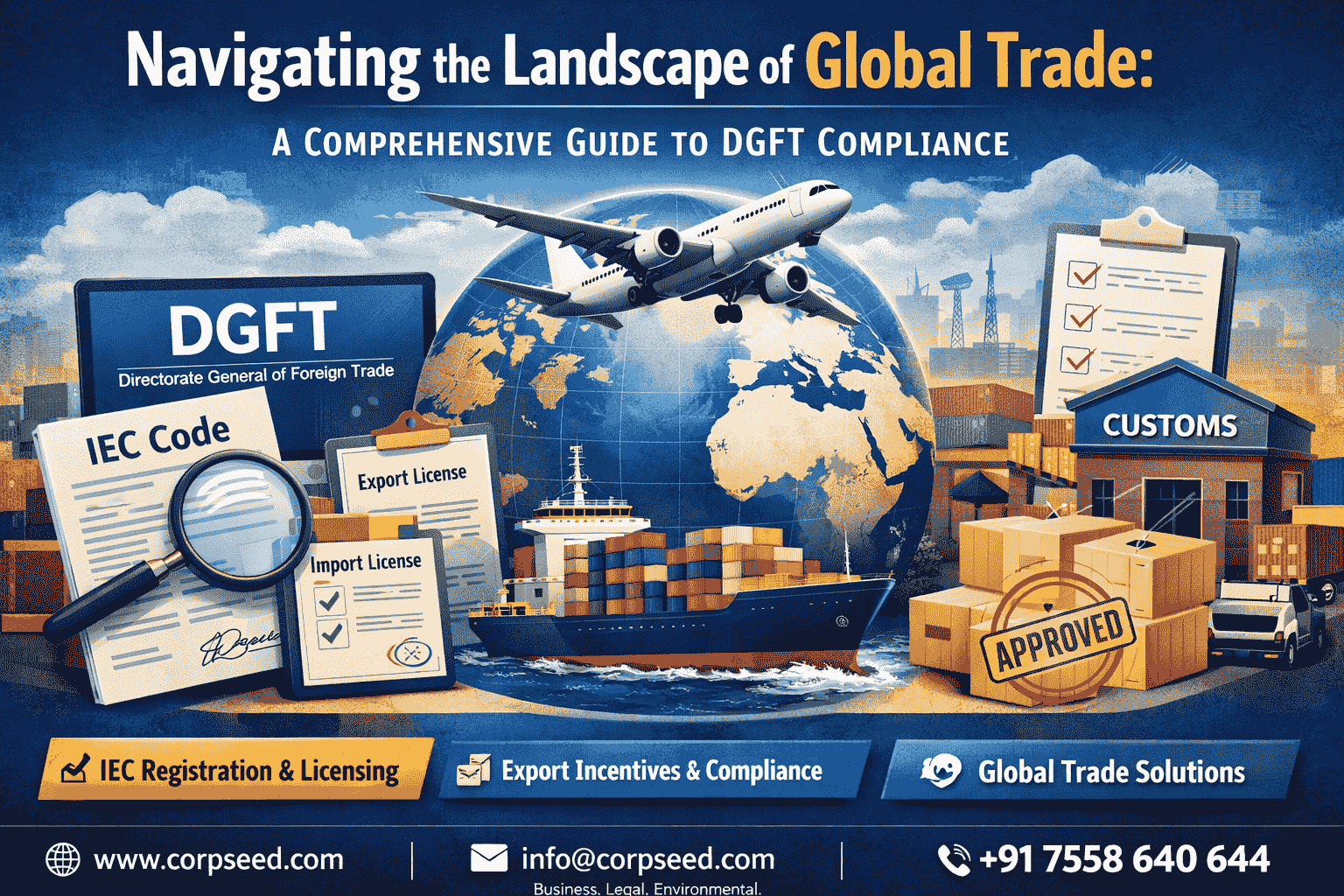
Overview
Compliance with national regulators forms the base of a successful export/import business globally. For a trader in India, the main player and regulator is the Directorate General of Foreign Trade (DGFT). Knowing how to effectively navigate the DGFT's digital resources is a legal requirement and a great opportunity for gaining an edge through increased efficiencies, saving time, and money.
The Role of DGFT in Modern Commerce
The Directorate General of Foreign Trade (DGFT) is part of the Ministry of Commerce and Industry and is tasked with the responsibility of assisting and regulating Foreign Trade. As we enter an age when increasing the "Ease of Doing Business" is paramount, the DGFT has evolved into a "Digital First" entity that eliminates the need for paper-based transactions.
For entrepreneurs who want to grow their businesses globally, the first step towards achieving that goal is registering with the DGFT. By registering with the DGFT, you will have a digital representation of your business that allows you to connect to Customs, Banks, and International Partners via one central portal. This centralization of all the administrative factors associated with running a business allows the Indian government to support the global competitiveness of Indian businesses as part of the Global Value Chain.
Understanding the Importance of an Import-Export Code (IEC)
The foundation of the registration process is the issuance of the IEC. This 10-digit code is mandatory for anyone looking to clear shipments through customs or send/receive money through banking channels for trade purposes.
Since the integration of the GST and DGFT systems, the PAN (Permanent Account Number) of the entity usually serves as the IEC. However, the formal activation via the portal remains a critical step for data synchronization across the ICEGATE and GSTN platforms.
Unlocking Opportunities with a DGFT License
While the IEC acts as your entry ticket, certain goods and categories require specific permissions to move across borders. This is where a DGFT License becomes essential. These licenses are generally categorized into two types:
-
Promotional Licenses: These are designed to provide incentives to exporters, such as the Duty Remission or Duty Exemption schemes (e.g., Advance Authorization or EPCG).
-
Restrictive Licenses: These are required for items listed under the "Restricted" category in the ITC (HS) classification.
Securing the right authorization ensures that your business avoids heavy penalties and prevents shipment seizures at the port of entry. It also allows you to leverage government schemes that can significantly reduce the cost of raw material imports for export-oriented manufacturing.
Strategic Benefits of Regulatory Compliance
The benefits of actively maintaining your profile on trade portals extend beyond legal compliance; they build the foundation for growth.
Building a Global Reputation: When a foreign buyer engages with an exporter in India, they are generally very interested in knowing whether or not the Indian exporter meets local regulations. A properly registered exporter sends the message to the international buyer that they are a legitimate business entity recognized by the local government.
Accessing Export Incentives: The Government of India has programs such as RoDTEP to assist exporters. However, to take advantage of these types of incentive programs, the exporter must be in good digital compliance.
Streamlining Logistics: The Single Window Interface for Facilitating Trade (SWIFT) allows for the easier processing of shipping/bill entry documents via a well-managed Trade Profile through a faster processing time.
Navigating Challenges in the Digital Transition
Many companies have encountered problems with managing the technical elements of their user-friendly portal after moving to a more streamlined interface. Common issues that arise for businesses are as follows:
A) Profile Management: Updating the "Importer-Exporter Profile" regularly to reflect any changes in the branch location and adding all directors who represent the company.
B) Digital Signature certificates (DSC): Correctly associated Class 3 Digital Signature Certificates for all secured filings.
C) Post Export Obligations: Keeping track of your "Export Obligation Discharge Certificate" (EODC) to facilitate closure of licenses, and prevent being placed on the "Denied Entity List" (DEL).
A regular auditing of your profile, combined with staying current on the Foreign Trade Policy (FTP) notifications, will be the best way to minimize the risks associated with these obstacles.
Conclusion: Building a Future-Ready Trade Business
The global trade environment is changing to increase transparency and digital accountability. When you put an emphasis on your DGFT Registration and understand the various requirements of each DGFT License, you place yourself in a position to succeed in a very competitive environment. Regulatory compliance shouldn't be seen as an obstacle. It is the foundation upon which your international brand is built.
FAQs
Q. What is the DGFT license for import?
A DGFT license for import is required to legally bring goods into India and ensures compliance with India’s foreign trade policy.
Q. What is a DGFT Certificate?
A DGFT Certificate is an official authorisation issued by DGFT that allows businesses to conduct import and export activities.
Q. Why DGFT license for gold import mandatory in India?
A DGFT license for gold import is mandatory and is issued only to eligible importers under DGFT guidelines.
Q. How can I check DGFT license status online?
DGFT license status can be checked online using the application or IEC details on the official DGFT portal.
Q. What is the DGFT code used for?
DGFT code, also known as IEC, is used to identify importers and exporters for customs clearance and foreign trade transactions.
Q. What is a special import license DGFT?
A special import license, DGFT, is issued for importing restricted or sensitive goods under specific conditions defined by DGFT.
Q. What is the DGFT registration fee in India?
DGFT registration fee is a one-time government fee payable online during the IEC application on the DGFT portal.
Q. When is a DGFT license for restricted items required?
A DGFT license for restricted items is required when importing goods listed as restricted under India’s foreign trade policy.
Also Read: https://www.corpseed.com/service/import-export-code

 English
 Arabic
 French
 Spanish
 Portuguese
 Deutsch
 Turkish
 Italiano
 Russian
 Romaian
 Portuguese (Brazil)
 Greek
Greek