


What Causes Hair Thinning That PRP Aims to Treat?
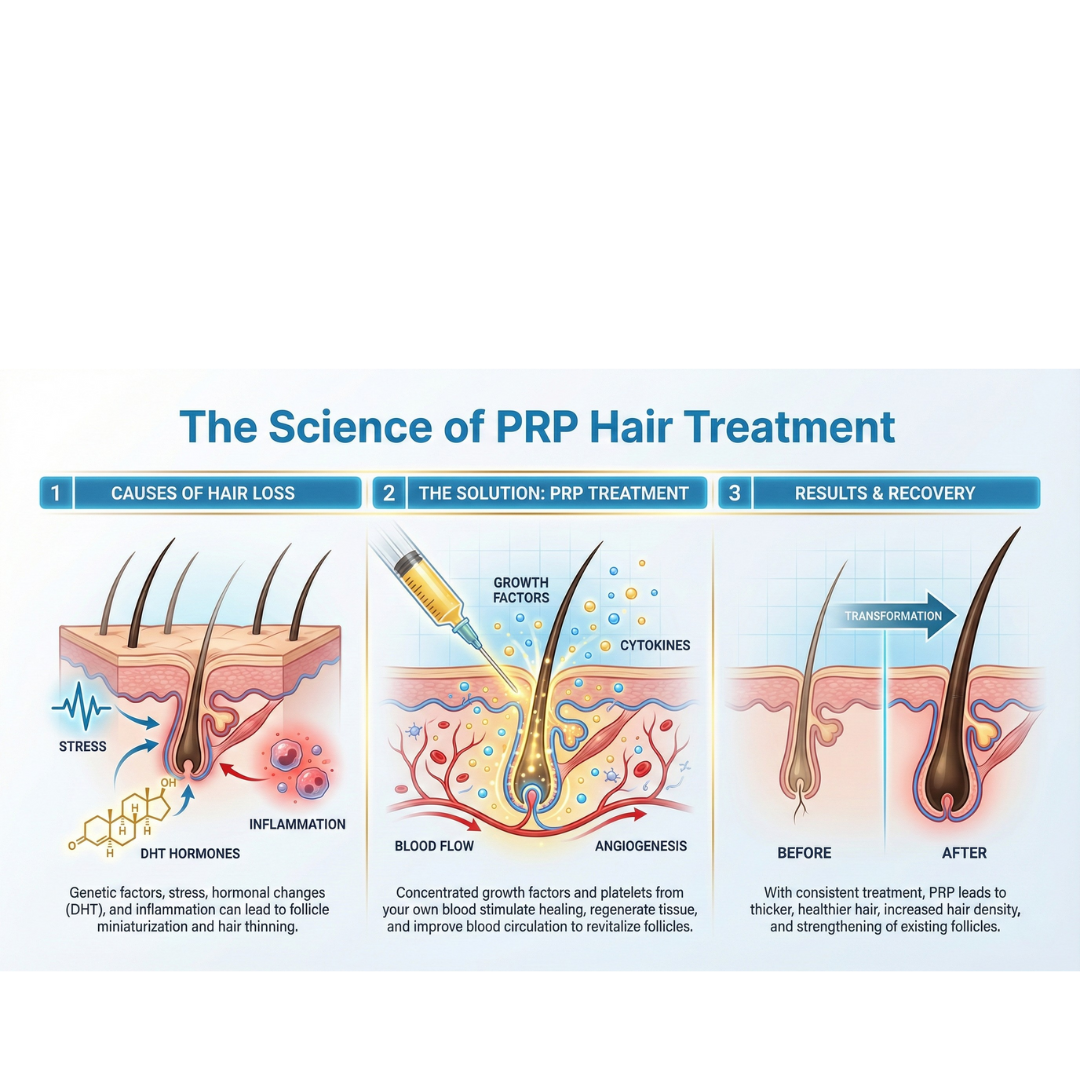
Hair thinning happens when active hair follicles slowly weaken, shrink, and spend less time producing healthy strands. The most common drivers are genetic sensitivity to hormones, reduced blood flow to the scalp, low-grade inflammation around follicles, stress-related shedding, and nutritional gaps. PRP targets these exact conditions by improving circulation, calming follicle stress, and reactivating cells that have gone dormant but are not yet dead.
This is why PRP is not meant for completely bald areas. It works best where hair still exists but is becoming finer, shorter, and slower to grow.
The Real Biology Behind Thinning Hair
In most adults, thinning is not sudden. It is gradual. A healthy follicle produces thick hair for years. Over time, in people with genetic sensitivity, the follicle becomes smaller with each growth cycle.
The hair that comes out looks weaker than the last one. Growth phases shorten. Rest phases become longer. Eventually, the strand becomes so fine that it barely covers the scalp.
This process is called follicle miniaturization. PRP is designed to interrupt this process before the follicle shuts down completely.
Hormonal Sensitivity and Pattern Hair Loss
In men and many women, follicles react to a hormone byproduct called DHT. This does not mean hormone levels are high. It means the follicle is sensitive.
In clinics, this shows up as thinning at the crown, widening part lines, or a receding hairline that creeps back slowly. Patients often say their hair still grows but feels flat and fragile.
PRP does not block hormones. What it does is strengthen the follicle environment so that growth cells can resist damage longer and perform better despite that sensitivity.
Reduced Blood Flow to the Scalp
Hair follicles are active tissue. They need oxygen and nutrients daily. Poor circulation starves them slowly.
This is common in people who work long desk hours, wear tight headgear, smoke, or have scalp tension from stress. In Dubai, heat exposure combined with dehydration can worsen this.
PRP increases local blood supply at the micro level. The growth factors in platelets signal the body to build better vascular support around follicles. This is one of the core reasons it improves hair density over time.
Inflammation Around the Follicle
Many thinning patients have mild scalp inflammation even if they have no visible dandruff or itching. This low-grade irritation damages the follicle environment.
Dermatologists often see this under magnification. The skin looks tight and shiny. Follicles appear congested.
PRP contains anti-inflammatory proteins that calm this environment. When inflammation reduces, the follicle can return to a normal growth rhythm.
Stress-Related Shedding
Chronic stress shifts hair into the resting phase. This condition is called telogen effluvium.
In Dubai, this is common among professionals dealing with high workload, sleep disruption, and frequent travel. They often notice sudden shedding in the shower or on pillows.
PRP does not remove stress from life. It helps follicles recover faster after the stress trigger ends. It shortens the recovery period and reduces the time hair remains in the inactive phase.
Nutritional Gaps and Poor Scalp Health
Hair is one of the first tissues affected when the body lacks iron, protein, or micronutrients. Even people who eat well can have absorption issues.
PRP does not replace nutrition. It works alongside it. Improving local growth signals, it allows follicles to use available nutrients more efficiently.
Clinics often combine PRP with blood work and dietary guidance because internal support and external stimulation must work together.
What PRP Actually Works On
PRP is effective only when follicles are weakened, not dead. It supports:
-
Miniaturized follicles that still produce thin hair
-
Areas with reduced density but visible strands
-
Stress-induced shedding after the trigger is removed
-
Early pattern thinning in men and women
It is not meant for shiny bald skin where follicles no longer exist.
This is why proper assessment matters. Ethical clinics in Dubai do scalp analysis before recommending treatment.
How This Looks in Real Clinics
Patients usually arrive saying their ponytail feels thinner or their scalp shows more under light. Men notice styling no longer hides the crown.
In the early stages, PRP slows the loss and thickens existing strands. In moderate stages, it improves coverage but does not recreate teenage density.
The goal is stabilization first. Visible thickening follows gradually over months.
This realistic expectation is what separates medical treatment from cosmetic promises.
Where PRP Fits in Dubai’s Hair Treatment Landscape
Dubai has a wide mix of transplant centers, cosmetic clinics, and dermatology practices. PRP sits in the medical middle ground.
It is chosen by people who are not ready for surgery or want to maintain transplanted hair. It is also used by women who cannot undergo a transplant due to diffuse thinning.
When patients ask about PRP hair treatment in Dubai, the honest answer is that results depend on timing. Early action brings better outcomes. Late action brings modest support.
Who Benefits the Most
PRP works best for:
-
Men in the early stages of crown or frontal thinning
-
Women with widening part lines
-
Post pregnancy hair recovery
-
Stress-induced shedding cases
-
People maintaining transplant results
It is not a rescue tool for long-standing baldness.
Conclusion
Hair thinning happens because follicles weaken under hormonal pressure, poor blood flow, inflammation, stress, and nutritional gaps. PRP targets these exact biological failures.
It does not create new follicles. It restores strength to those that are fading.
Used at the right stage, it slows loss, thickens existing hair, and extends the life of active follicles. Used too late, it can only offer limited support.
The key is understanding what your scalp is actually experiencing and acting before the follicles cross the point of no return.
FAQs
Does PRP stop genetic hair loss completely?
No. It slows progression and improves hair quality. Genetics still influence long term patterns.
Is PRP painful?
Mild discomfort is common. Most clinics use numbing techniques to reduce it.
How long before results appear?
Shedding may reduce in two months. Visible thickening usually appears after three to four months.
Can women do PRP safely?
Yes. It is commonly used for female pattern thinning and post pregnancy hair loss.
Is prp hair treatment in dubai suitable for advanced baldness?
It offers minimal benefit where follicles are already inactive. It works best in early and moderate thinning stages.

 English
 Arabic
 French
 Portuguese
 Deutsch
 Turkish
 Dutch
Dutch
 Italiano
 Russian
 Romaian
 Portuguese (Brazil)
 Greek
Greek