


How to Choose Steel Fabrication Suppliers in NZ (Without Getting Overcharged)
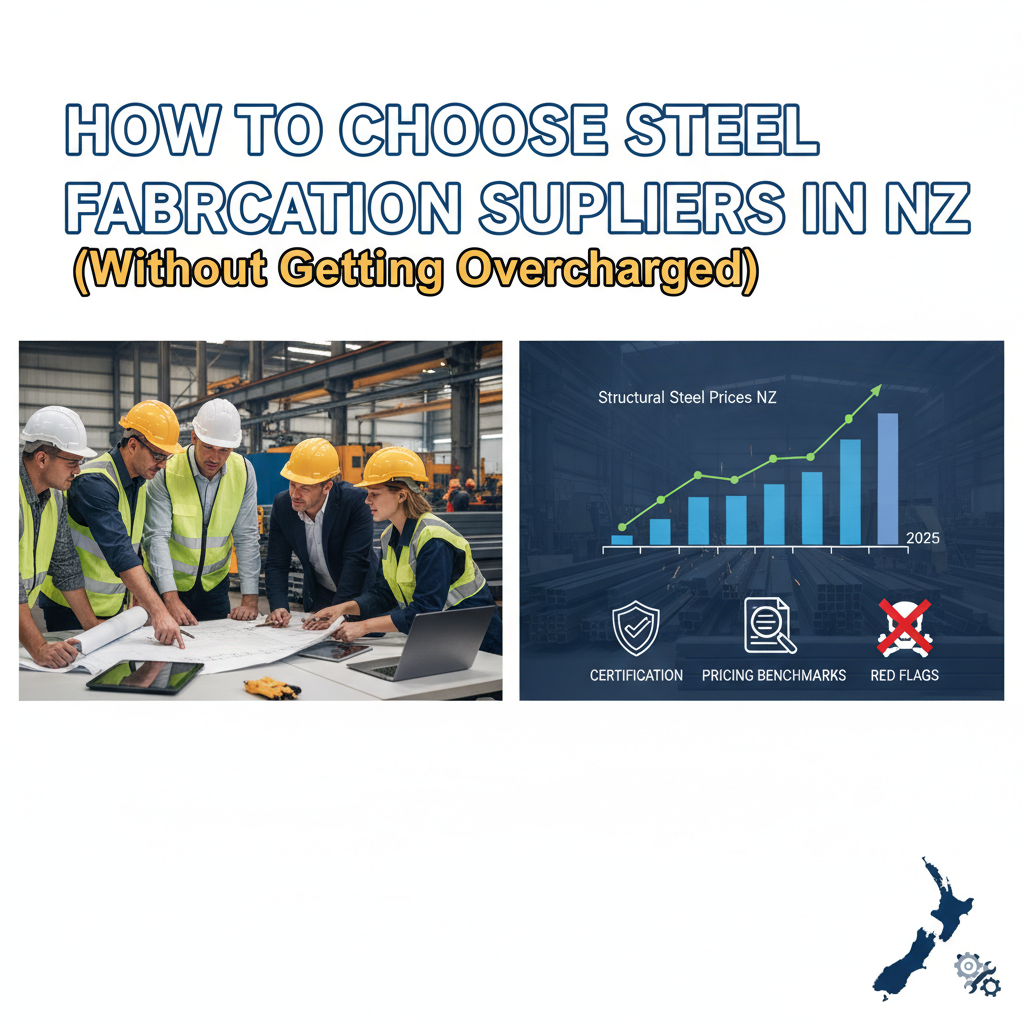
Choosing the right steel fabrication supplier in New Zealand can make or break your construction project budget. With the structural steel fabrication industry valued at $1.8 billion in 2025, and prices fluctuating significantly over the past few years, making the wrong choice can cost you tens of thousands of dollars or worse, compromise your project’s structural integrity.
Whether you’re managing a commercial build in Auckland, an industrial project in Christchurch, or infrastructure work anywhere across New Zealand, the supplier you choose impacts everything from your bottom line to your project timeline and compliance obligations.
The challenge? There are 272 businesses in the structural steel fabrication industry in New Zealand, each claiming to offer competitive pricing and quality workmanship. How do you separate the genuinely reliable suppliers from those who will overcharge you or deliver substandard work?
This comprehensive guide reveals exactly what you need to know to select steel fabrication suppliers in NZ who deliver exceptional value without compromising on quality, compliance, or reliability.
Understanding the NZ Steel Fabrication Market in 2025
Current Market Conditions
The New Zealand steel fabrication landscape has stabilised significantly compared to the volatile pandemic years. Construction costs increased by just 1.5% in the 12 months to November 2024, marking the slowest annual growth since QV CostBuilder began tracking data in 2015, following dramatic increases of 18.9% in 2021 and 11.3% in 2022.
However, price stability doesn’t mean uniform pricing across suppliers. Structural steel prices declined by 1.7% recently, but steel framing rose significantly by 4.7%, demonstrating that different steel products and services experience different market pressures.
What Drives Steel Fabrication Costs?
Understanding cost factors helps you evaluate quotes intelligently:
Material Costs: Raw steel prices fluctuate based on global supply chains. Steel’s market share in NZ construction is over 50% and growing, meaning demand remains strong even as international prices shift.
Fabrication Complexity: Simple structural beams cost significantly less per tonne than complex custom components requiring precision cutting, drilling, and assembly.
Certification and Compliance: Approximately 88% of structural steel is fabricated by SFC certified fabricators, and certified suppliers typically charge premium rates — but deliver guaranteed compliance.
Labour and Overhead: Workshop efficiency, equipment investment, and workforce qualifications directly impact pricing structures.
Volume and Timeline: Bulk orders and flexible timelines reduce costs, while rush jobs and small quantities increase them.
The True Cost of Choosing the Wrong Supplier
Before diving into selection criteria, understand what’s at stake when you prioritize lowest price over overall value:
Financial Risks
Rework and Remediation: Non-compliant fabrication discovered during inspection can require complete replacement, costing 2–3 times the original fabrication expense.
Project Delays: Late deliveries disrupt your construction timeline, incurring penalty clauses, extended equipment rentals, and labour costs.
Hidden Charges: Some suppliers quote low base prices but add excessive charges for delivery, modifications, site visits, or documentation.
Compliance and Legal Risks
Building Consent Issues: Non-compliant structural steel can prevent building consent approval or final Code Compliance Certificates.
Liability Exposure: Using uncertified fabricators increases your legal liability if structural failures occur.
Seismic Performance: New Zealand’s unique seismic requirements mean non-compliant steel could fail during earthquakes, with catastrophic consequences.
Essential Certification and Compliance Requirements
New Zealand has rigorous structural steel compliance frameworks that separate professional suppliers from questionable operators.
Steel Fabrication Certification (SFC)
Steel Fabrication Certification is an industry-led quality assurance scheme that ensures participating fabricators have appropriate personnel and quality management systems in place representing international best-practice.
The SFC scheme, based on European CE-marking standards, provides independent expert certification rather than relying on self-inspection and self-certification.
Why SFC Matters:
The SFC scheme provides independent expert certification of New Zealand fabrication and component manufacturing companies to ensure they have the appropriate quality management systems in place that enables them to consistently produce compliant fabricated product of the required standard.
SFC Construction Categories:
Fabricators are certified to different construction categories (CC1-CC4) based on risk and structural significance:
- CC1 and CC2: Low-rise buildings, car parks, simple structures
- CC3 and CC4: Critical seismic structures, high-rise buildings, major infrastructure
For significant commercial or infrastructure projects, insist on fabricators certified to at least CC3.
AS/NZS 5131 Compliance
AS/NZS 5131 is cited in the Building Code as the sole approved document for fabrication and erection as of July 2018. This standard defines fabrication and erection requirements for structural steelwork in New Zealand.
Key Requirements Include:
- Factory production control systems
- Competent welding personnel
- Quality management documentation
- Inspection and testing protocols
- Traceability of materials
ISO 3834 Welding Quality
Welding quality is critical for structural integrity, particularly in seismic events. ISO 3834 specifies quality requirements for fusion welding of metallic materials.
What to Verify:
- Welders qualified to AS/NZS 1554 standards
- Welding procedure specifications (WPS) documented
- Non-destructive testing (NDT) capabilities
- Welding coordination personnel qualifications
Material Conformity
The globalisation of steel supply chains introduces conformity risks. Ensure suppliers follow the SCNZ Guide to the Sourcing of Compliant Structural Steels.
Red Flag: Suppliers unable to provide complete material test certificates or third-party certification for imported steel products.
How to Evaluate Steel Fabrication Suppliers: 12 Critical Criteria
1. Certification Status (Non-Negotiable)
What to Check:
- Current SFC certification to appropriate construction category
- ISO 3834 welding quality certification
- Membership in Steel Construction New Zealand (SCNZ)
How to Verify: Visit the SFC website to confirm certification status. Don’t accept verbal claims request certificate numbers and expiry dates.
Warning Sign: Suppliers who claim “we meet all the standards” without providing certification documentation.
2. Experience and Track Record
What to Evaluate:
- Years in business (minimum 5+ years for complex projects)
- Portfolio of completed projects similar to yours
- References from recent clients in similar sectors
Questions to Ask:
- “Can you provide three references from projects completed in the last 12 months?”
- “Have you fabricated similar structures or components before?”
- “What was the largest project you’ve completed in terms of tonnage and complexity?”
Red Flag: Suppliers unwilling to provide verifiable references or who’ve only worked on small residential projects when you need commercial-scale fabrication.
3. Technical Capability and Equipment
Assess Workshop Facilities: Modern fabrication requires significant capital investment in equipment and technology.
Key Equipment to Look For:
- CNC cutting and drilling machines (precision and efficiency)
- Automated welding systems (consistency and quality)
- Shot blasting and coating facilities (corrosion protection)
- Overhead cranes (handling capacity)
- Quality inspection equipment (verification capability)
Site Visit: Request a workshop tour. Professional suppliers welcome inspections; questionable ones make excuses.
4. Quality Management Systems
Documentation to Request:
- Quality manual outlining procedures
- Factory production control system documentation
- Inspection and testing protocols
- Non-conformance management procedures
What This Reveals: Comprehensive quality systems indicate suppliers who consistently deliver compliant work. Vague or missing documentation suggests inadequate controls.
5. Personnel Qualifications
Critical Roles to Verify:
- Welding supervisor qualifications
- Quality manager credentials
- Engineering support capabilities
- Project management experience
Key Question: “What qualifications do your key personnel hold, and can you provide evidence?”
6. Capacity and Lead Times
Understand Realistic Timelines: Overall construction programmes for multi-level commercial projects using structural steel are generally 10–15% shorter compared to other materials, but fabrication still requires appropriate lead times.
Typical Lead Times:
- Simple structural frames: 4–6 weeks
- Complex custom components: 8–12 weeks
- Large-scale commercial projects: 12–16 weeks
Warning Sign: Suppliers promising unrealistically short lead times may compromise quality or overcommit their capacity.
7. Pricing Structure Transparency
Request Detailed Breakdowns: Professional quotes itemise:
- Material costs (per tonne, by steel grade)
- Fabrication labour (by process or hourly rate)
- Surface treatment and coating
- Quality control and testing
- Delivery and logistics
- Documentation and certification
Red Flag: Quotes with single lump-sum figures and no breakdown. This makes comparison impossible and hides potential mark-ups.
8. Material Sourcing Practices
Questions to Ask:
- “Where do you source your structural steel?”
- “Can you provide third-party certification for all materials?”
- “How do you ensure traceability from mill to final product?”
Best Practice: Suppliers should follow the SCNZ Structural Steel Distributor Charter requirements for material procurement.
Red Flag: Vague answers about material origin or inability to guarantee full traceability and certification.
9. Insurance and Financial Stability
Verify Coverage:
- Public liability insurance (minimum $10–20 million)
- Professional indemnity insurance
- Contract works insurance
Financial Health Indicators:
- Years of continuous operation
- Credit rating (if available)
- Evidence of completed major projects
Why This Matters: Financially unstable suppliers may cut corners, demand early payment, or be unable to remedy defects.
10. Communication and Project Management
Evaluate Responsiveness:
- How quickly do they respond to initial enquiries?
- Do they ask detailed questions about your requirements?
- Do they proactively identify potential issues or solutions?
Project Management Capabilities:
- Dedicated project coordinator assignment
- Regular progress reporting systems
- Clear change management procedures
- Issue escalation protocols
Red Flag: Slow responses during quotation phase indicate poor communication during project execution.
11. Site Erection Services
In 2018 SCNZ announced that the SFC scheme has been extended to include a site erection module, as New Zealand’s structural steel contractors typically provide complete project management.
Questions to Ask:
- “Do you provide site erection services?”
- “Are your erection crews SFC-certified?”
- “What safety systems do you have in place?”
Why This Matters: Fabricators who also erect take full responsibility from workshop to installation, reducing coordination issues and liability gaps.
12. After-Sales Support and Warranty
What to Clarify:
- Warranty period and coverage
- Defects liability period
- Maintenance recommendations
- Support availability for future modifications
Professional Standard: Minimum 12 month defects liability period for fabrication, longer for coating systems.
Understanding Steel Fabrication Pricing in NZ
Realistic Price Benchmarks
While exact pricing varies by project specifics, understanding general ranges helps you identify overcharging or suspiciously low quotes.
General Pricing Indicators:
Steltech welded members can cost 25% to 30% more per tonne than imported hot rolled sections, but this is offset by weight savings generated through optimising the design, with average weight savings of 25% to 35% over hot rolled beams.
This demonstrates that per tonne pricing alone doesn’t reveal true project cost fabrication efficiency and design optimisation matter significantly.
What Influences Your Quote:
- Steel Grade and Specification: Higher grade steels cost more but may allow lighter structural designs
- Fabrication Complexity: Custom drilling, welding, and assembly increase labour costs
- Surface Treatment: Hot-dip galvanising, painting, or powder coating add 15–30% to base costs
- Quality Requirements: Higher construction categories require more rigorous testing and documentation
- Project Size: Economies of scale apply — larger tonnages reduce per-unit costs
- Timeline: Standard lead times cost less than expedited fabrication
Total Cost of Ownership Analysis:
The cheapest initial quote often becomes the most expensive option when you factor in:
- Potential rework costs
- Delay penalties
- Additional inspection requirements
- Risk of non-compliance
- Long-term maintenance needs
Common Overcharging Tactics to Watch For
1. Excessive Mark-ups on Materials
Professional fabricators mark up materials by 10–20% to cover procurement, handling, and storage. Mark-ups exceeding 30% may indicate overcharging.
How to Check: Request material supplier invoices or specify approved steel suppliers in your contract.
2. Inflated Site Visit Charges
Reasonable charges cover actual travel, accommodation, and labour costs. Some suppliers inflate these dramatically.
Fair Benchmark: Site visits within 100km should incur minimal charges; remote locations warrant reasonable travel cost recovery.
3. Hidden Modification Fees
Changes during fabrication are common, but some suppliers exploit this with excessive variation charges.
Protection Strategy: Establish variation cost structures in your initial contract, including hourly rates and approval thresholds.
4. Documentation and Certification Fees
While certification costs are legitimate, some suppliers charge excessively for standard compliance documentation.
Fair Practice: Basic producer statements (PS3) and material certificates should be included. Only complex third-party inspections warrant additional fees.
5. Delivery and Logistics Gouging
Transport costs vary by distance and load size, but excessive delivery charges inflate total costs.
Benchmark: Request separate delivery quotes from independent transport companies to verify reasonableness.
Red Flags That Should Make You Walk Away
No matter how attractive the price, avoid suppliers showing these warning signs:
Certification Red Flags
❌ No SFC certification for projects requiring Construction Category 2 or higher ❌ Expired certifications or inability to provide current certificate numbers ❌ Vague claims about “meeting standards” without documentation ❌ Reluctance to provide access to certification bodies for verification
Pricing Red Flags
❌ Quotes significantly lower (>30%) than other qualified suppliers ❌ No pricing breakdown or transparency about cost components ❌ Unwillingness to commit to fixed pricing or escalation terms ❌ Excessive variation charges not clearly defined upfront
Operational Red Flags
❌ Refusal to allow workshop visits or constant excuses for delays ❌ Poor communication during quotation phase ❌ No dedicated project manager assigned to your work ❌ Inability to provide detailed project management plans
Quality Red Flags
❌ No documented quality management system or procedures ❌ Unclear material sourcing practices or traceability ❌ Limited testing capabilities or subcontracted inspections ❌ Poor references or inability to provide any verifiable references
Financial Red Flags
❌ Demands for large upfront payments (>30% before work commences) ❌ Lack of adequate insurance coverage ❌ Recent business name changes or ownership transfers ❌ Financial instability indicators like credit warnings
Experience Red Flags
❌ No similar projects in their portfolio ❌ Recently established (❤ years) for complex work ❌ Overpromising on timelines or capabilities ❌ Dismissive attitude toward your concerns or requirements
Rule of Thumb: If you see multiple red flags, move on. There are plenty of reputable suppliers in the NZ market.
Questions to Ask Potential Suppliers
Certification and Compliance
- “What is your current SFC certification level, and can you provide your certificate number?”
- “Are you certified to ISO 3834 for welding quality management?”
- “How do you ensure all materials meet AS/NZS specifications?”
- “What construction categories are you qualified to fabricate?”
- “Can you provide your most recent audit report summary?”
Experience and Capability
- “How many similar projects have you completed in the past two years?”
- “What is your current workshop capacity and typical lead times?”
- “Do you have engineering support available for design optimisation?”
- “What is the largest tonnage project you’ve successfully delivered?”
- “Can you provide examples of projects with similar complexity to ours?”
Quality Management
- “Walk me through your quality control process from order to delivery.”
- “What non-destructive testing capabilities do you have in-house?”
- “How do you manage non-conformances when they occur?”
- “What documentation will you provide to demonstrate compliance?”
- “How do you ensure traceability of all materials and processes?”
Pricing and Commercial Terms
- “Can you provide a detailed breakdown of your pricing?”
- “What are your payment terms and milestone structure?”
- “How do you handle variations and additional work?”
- “What warranty do you offer, and what does it cover?”
- “Are there any potential additional costs we should anticipate?”
Project Management
- “Who will be our main point of contact during the project?”
- “How frequently will you provide progress updates?”
- “What happens if you identify design or specification issues?”
- “How do you manage project timelines and communicate delays?”
- “Do you provide site erection services, and are they SFC-certified?”
Risk Management
- “What insurance coverage do you carry?”
- “How do you handle health and safety on-site?”
- “What contingency plans do you have for equipment breakdowns or material delays?”
- “Can you provide details of your quality and liability insurance?”
- “How do you manage supply chain risks for imported materials?”
Pro Tip: Professional suppliers welcome detailed questions and answer them comprehensively. Evasive or irritated responses indicate potential problems.
Conclusion: Making the Smart Choice
Choosing steel fabrication suppliers in New Zealand without getting overcharged requires diligence, knowledge, and a focus on value rather than just price.
Key Takeaways:
✅ Prioritise certification: SFC certification and AS/NZS 5131 compliance are non-negotiable for quality projects
✅ Look beyond price: The lowest quote often becomes the most expensive option when problems arise
✅ Do your due diligence: Reference checks, site visits, and detailed evaluations prevent costly mistakes
✅ Understand realistic pricing: Knowledge of market rates and cost drivers protects you from overcharging
✅ Ask the right questions: Comprehensive questioning reveals supplier capabilities and potential issues
✅ Watch for red flags: Multiple warning signs should make you walk away, regardless of price
✅ Build partnerships: Good suppliers become valuable long-term assets to your business
The Bottom Line:
The best steel fabrication supplier isn’t necessarily the cheapest — it’s the one who delivers compliant, quality work, on time and within budget, with transparent pricing and professional service.
By following the guidelines in this article, you’ll select suppliers who provide excellent value, protect your interests, and contribute to your project’s success.
Ready to Start Your Steel Fabrication Project?
Use this guide as your roadmap for supplier selection. Take your time, do your research, and choose the supplier who best aligns with your project needs and values.
The right choice now prevents expensive problems later and establishes partnerships that benefit your projects for years to come.

 English
 French
 Spanish
 Portuguese
 Deutsch
 Turkish
 Dutch
Dutch
 Italiano
 Russian
 Romaian
 Portuguese (Brazil)
 Greek
Greek