


Conveyor Belt Market Analysis: How Warehouse Automation and E-Commerce Are Reshaping Material Handling
Conveyor belts are a core component of modern material handling systems, enabling the efficient movement of goods across warehouses, distribution centers, and fulfillment hubs. With the rapid expansion of e-commerce and the growing need for warehouse automation, conveyor belt systems are undergoing significant transformation. These changes are reshaping how goods are stored, sorted, packed, and shipped, making conveyor technology a strategic investment rather than a supporting utility.
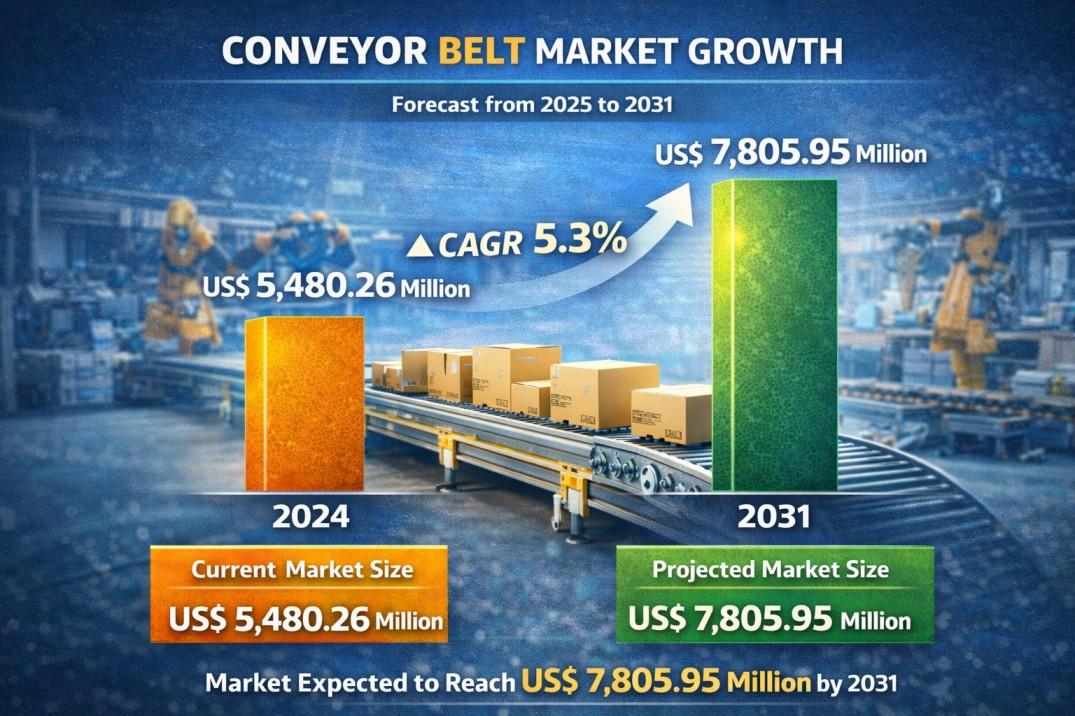
The conveyor belt market is projected to grow from US$ 5,480.26 million in 2024 to US$ 7,805.95 million by 2031, registering a CAGR of 5.3% during the forecast period. A major share of this growth is attributed to the accelerating adoption of automation in warehouses and logistics operations driven by e-commerce growth.
Impact of E-Commerce on Conveyor Belt Demand
E-commerce has fundamentally changed supply chain expectations. Consumers now expect faster deliveries, real time order tracking, and accurate fulfillment. This has forced retailers and logistics providers to invest heavily in automated warehouses capable of handling high order volumes with minimal errors. Conveyor belts play a central role in achieving these objectives by enabling continuous and controlled movement of products across picking, sorting, and packaging zones.
High speed conveyor systems reduce order processing time and improve throughput in fulfillment centers. As online retail volumes surge, especially during peak seasons, conveyor belts help warehouses scale operations without proportionally increasing labor costs. This makes them indispensable for large e-commerce players and third party logistics providers.
Why are conveyor belts critical for e-commerce warehouses
Conveyor belts enable fast, accurate, and scalable movement of goods, which is essential for meeting high order volumes and quick delivery expectations in e-commerce.
Warehouse Automation Driving Market Evolution
Warehouse automation is another key factor reshaping the conveyor belt market. Automated material handling systems integrate conveyors with robotics, sensors, and warehouse management software to create highly efficient workflows. Conveyor belts act as the backbone of these systems, linking automated storage and retrieval systems, robotic pickers, and sorting units.
Automation improves inventory accuracy, reduces workplace injuries, and enhances operational efficiency. Conveyor belts equipped with smart sensors and monitoring systems enable predictive maintenance and minimize downtime. As warehouses move toward smart and data driven operations, demand for advanced conveyor belt solutions continues to rise.
How does warehouse automation influence conveyor belt technology
Warehouse automation drives the adoption of smart conveyor systems integrated with sensors, robotics, and software to improve efficiency, reduce downtime, and optimize material flow.
Download the sample PDF: https://www.theinsightpartners.com/sample/TIPRE00014724
Market Drivers
-
Rapid Growth of E-Commerce
Rising online retail sales are increasing the need for fast and reliable warehouse material handling solutions. -
Expansion of Distribution and Fulfillment Centers
New warehouses and last mile delivery hubs are being built globally to support omnichannel retail strategies. -
Rising Labor Costs and Workforce Shortages
Automation using conveyor belts helps reduce dependency on manual labor and improve cost efficiency. -
Integration with Smart Warehouse Technologies
IoT enabled conveyors support real time tracking, analytics, and system optimization.
Market Opportunities
-
AI and Sensor Integrated Conveyor Systems
Intelligent conveyors can optimize routing, detect bottlenecks, and enhance system performance. -
Customized Conveyor Solutions for E-Commerce
Modular and flexible conveyor designs tailored for rapid order fulfillment present strong growth opportunities. -
Growth in Emerging Markets
Expanding e-commerce penetration in Asia Pacific, Latin America, and the Middle East is creating new demand.
Regional Trends
Asia Pacific leads the conveyor belt market due to rapid e-commerce growth, expanding warehouse infrastructure, and rising automation investments in countries such as China and India. North America follows closely, supported by advanced logistics networks and early adoption of warehouse automation technologies. Europe is also witnessing steady growth as retailers modernize supply chains to support faster deliveries and sustainability goals.
Key Market Players
-
Habasit AG
-
Forbo Holding AG
-
BEUMER Group
-
Fenner Dunlop
-
Dorner Mfg. Corp.
Future Outlook
From 2025 to 2031, the conveyor belt market will increasingly align with the evolution of automated and digital warehouses. Conveyor systems will become more intelligent, energy efficient, and adaptable to dynamic e-commerce demands. Companies that focus on flexible designs, smart integration, and scalable solutions will be well positioned as warehouse automation and e-commerce continue to redefine material handling worldwide.
Related URL
Automotive Seat Belt System Market Analysis by Size, Share & Growth 2031
https://www.theinsightpartners.com/reports/automotive-seat-belt-system-market
Active Seat Belt System Market Report by Share, Growth and Size: 2031
https://www.theinsightpartners.com/reports/active-seat-belt-system-market

 English
 Arabic
 French
 Spanish
 Portuguese
 Deutsch
 Turkish
 Dutch
Dutch
 Italiano
 Russian
 Romaian
 Portuguese (Brazil)