


Trichotillomania in Children – Causes, Signs & Treatment
The Ultimate Guide to Child Trichotillomania: Causes, Signs, and Clinical Treatment
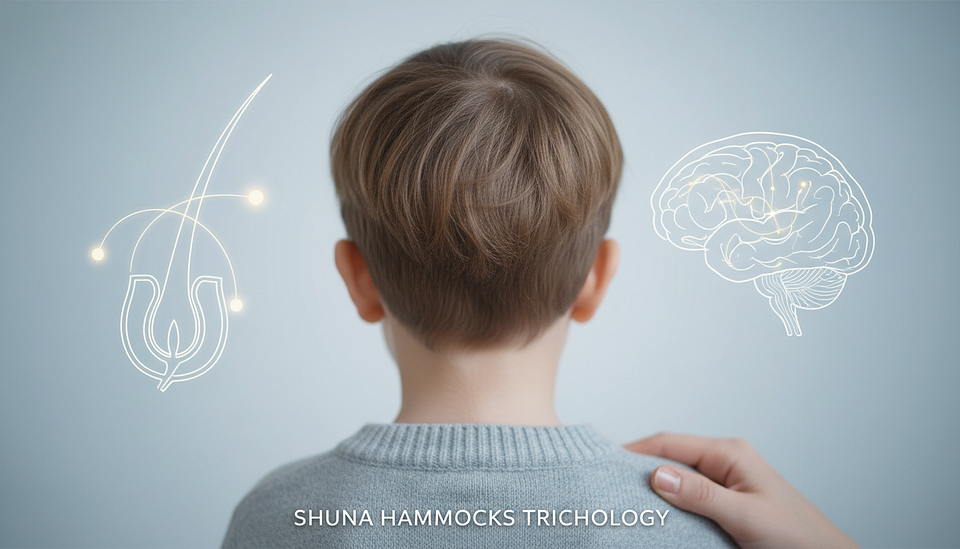
Trichotillomania, an impulse control disorder characterized by the repetitive pulling out of one’s own hair, can be a distressing experience for both parents and children. When addressing Child Trichotillomania, understanding the clinical nuances and the physiological impact on the scalp is paramount. As a leading trichology practice in West Sussex, Shuna Hammocks Trichology specializes in identifying the signs and providing a roadmap for recovery.
Understanding the Causes of Trichotillomania in Children
While the exact etiology of trichotillomania remains complex, it is often categorized as a Body-Focused Repetitive Behavior (BFRB). In children, the onset may be triggered by environmental stressors, anxiety, or even sensory processing differences. Unlike adult onset, pediatric cases often occur as a subconscious habit similar to thumb-sucking. Factors such as academic pressure, family changes, or chemical imbalances in the brain (involving neurotransmitters like serotonin and dopamine) can play a significant role. Identifying these triggers is the first step in effective management.
Recognizing the Signs: How to Identify Hair Pulling
Parents often first notice irregular patches of hair loss. Common signs of child trichotillomania include:
- Incomplete hair loss with hairs of varying lengths.
- Broken hair shafts and blunt ends.
- Repeatedly touching, twisting, or tugging at the scalp, eyelashes, or eyebrows.
- Hair regrowth that appears stubbly or prickly.
- Increased irritability or secretive behavior surrounding grooming habits.
Long-term Effects on Scalp and Follicle Health
If left unaddressed, chronic hair pulling can lead to follicular trauma and permanent scarring, known as traction alopecia. The mechanical stress placed on the follicle disrupts the natural growth cycle, often pushing hairs into the telogen (resting) phase prematurely. Professional intervention from a qualified trichologist is essential to ensure the scalp remains healthy enough to support regrowth once the pulling behavior is managed.
Effective Treatment Options and Support
Treating trichotillomania in children requires a multi-disciplinary approach. Behavioral interventions, such as Habit Reversal Training (HRT), are highly effective. From a trichological perspective, we focus on scalp health restoration and providing cosmetic solutions that reduce the urge to pull. At Shuna Hammocks Trichology, we offer a sensitive, non-judgmental environment to assess the damage and provide therapeutic treatments to stimulate the follicles.
Contact Business
Business Name: Shuna hammocks Trichology
Phone: 07860 387332
Address: Willow Suite, The Anderida Practice, Forest Row, West Sussex, RH18 5HE
Website: Visit our Website
Google Business Profile: View GMB
Maps Location: Find us on Maps
Knowledge Graph: View Knowledge Graph

 English
 Arabic
 French
 Spanish
 Portuguese
 Deutsch
 Turkish
 Dutch
Dutch
 Italiano
 Russian
 Romaian
 Greek
Greek