


Wind Power Fastener Market Strategic Insights and Future Potential 2026–2034
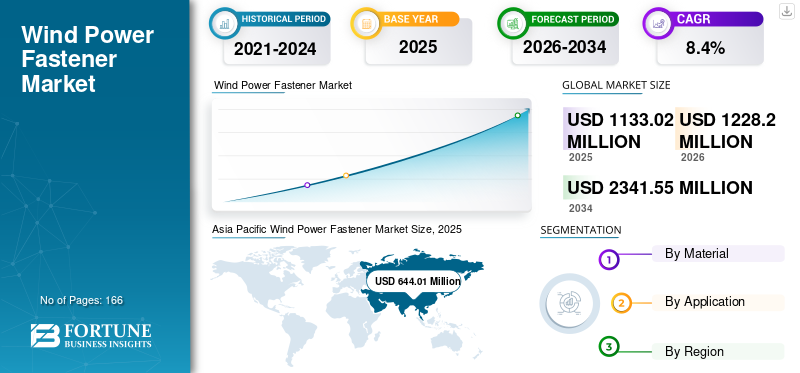
The global wind power fastener market size 2026 was valued at USD 1,133.02 million in 2025 and is projected to grow from USD 1,228.20 million in 2026 to USD 2,341.55 million by 2034, registering a CAGR of 8.40% during the forecast period (2026–2034).
Wind power fasteners are hardware components — including bolts, nuts, screws, and anchors — used in the construction, maintenance, and assembly of wind turbines. These components are critical in securing turbine blades, towers, nacelles, and other structural parts, ensuring the safety, stability, and long-term efficiency of wind energy systems.
Key Market Trends
Floating Wind Power Projects
The rise of floating offshore wind installations is one of the most significant trends shaping market demand. Unlike fixed offshore structures, floating platforms allow turbines to be positioned in deeper waters with stronger wind potential. A notable example is the world's largest floating wind farm, Hywind Tampen, launched off Norway's west coast in August 2023 by Equinor, with a capacity of 88 MW. Such projects are expanding the scope for specialized fastener applications.
Get a Free Sample PDF - https://www.fortunebusinessinsights.com/enquiry/request-sample-pdf/wind-power-fastener-market-104038
Growth Drivers
1. Increased Investment in Wind Energy
Global investment in wind generation is a core growth catalyst. According to the International Energy Agency, total investments in wind reached approximately USD 185 billion in 2022, reflecting a surge of around 20% from the prior year. This investment wave drives demand for more wind farms, each requiring large volumes of fasteners for structural assembly and maintenance.
2. Rise of Gigantic Wind Projects
Mega wind projects worldwide are fueling the need for highly specialized, large-scale fasteners. Key examples include the Jiuquan Wind Power Base in China, Dogger Bank Wind Farm in the U.K., and the Jaisalmer Wind Park in India. In the U.S., MidAmerican Energy's Wind Prime project — a USD 3.9 billion initiative planned in January 2022 — aimed to generate 2,042 MW from wind alone, illustrating the enormous component demand such projects create.
Restraining Factors
The high installation cost of wind energy infrastructure poses a challenge. When a significant portion of developer budgets is allocated to turbine construction, investment in specialized components like fasteners may be deprioritized. Additionally, growing competition from solar energy — now cost-competitive with wind — may divert investment. Pressure to cut costs can also lead to the adoption of cheaper, conventional fasteners over advanced alternatives, potentially slowing innovation in the segment.
Segmentation Analysis
By Material
- Carbon Steel holds the dominant market share due to its superior strength, durability, and ability to withstand the mechanical stresses of wind turbine operations.
- Stainless Steel (particularly corrosion-resistant austenitic grades) is seeing steady growth, driven by its use in harsh offshore environments where corrosion resistance is critical.
By Application
- Turbine Blades lead in application demand, as evolving blade technology — including recyclable blade designs by Siemens Gamesa — requires more and increasingly sophisticated fasteners.
- Nacelle applications also represent substantial demand, given the complexity of components housed within the nacelle, such as gearboxes and generators.
- Turbine Bases are projected to hold an 8.75% segment share in 2026.
Regional Insights
|
Region |
Highlights |
|
Asia Pacific |
Dominant region with 56.84% market share in 2025 (USD 644.01 million). China leads in both onshore and offshore wind installations. |
|
Europe |
Added a record 19.1 GW of wind capacity in 2022; Germany and France are key markets. |
|
North America |
60 GW of onshore wind capacity projected over the next five years, predominantly in the U.S. |
|
Latin America |
Brazil holds over 50% of the region's installed wind capacity; new installations reached 5.2 GW in 2022. |
Competitive Landscape
Key players profiled in the market include:
- Finework New Energy Technology (China) — market leader, recognized for high-strength wind blade fasteners
- Dokka Fasteners (U.K.)
- Beck Industries (France)
- Ningbo Datian Fastener Co., Ltd (China)
- Berdan Civata (Turkey)
- Sundram Fasteners (India)
- ITH Bolting Technology (Germany)
- All-Pro Fasteners (U.S.)
- Big Bolt Nut (India)
Notable recent developments include Berdan Civata's investment in hot forging press capabilities for bolts up to M155 diameter (May 2022) and Dokka Fasteners' expansion into Europe with a new manufacturing unit in Klaipėda, Lithuania (January 2022).

 English
 Arabic
 French
 Spanish
 Portuguese
 Deutsch
 Turkish
 Italiano
 Russian
 Romaian
 Portuguese (Brazil)
 Greek
Greek