


AI & ML in CRM: Transforming Customer Relationships in 2025
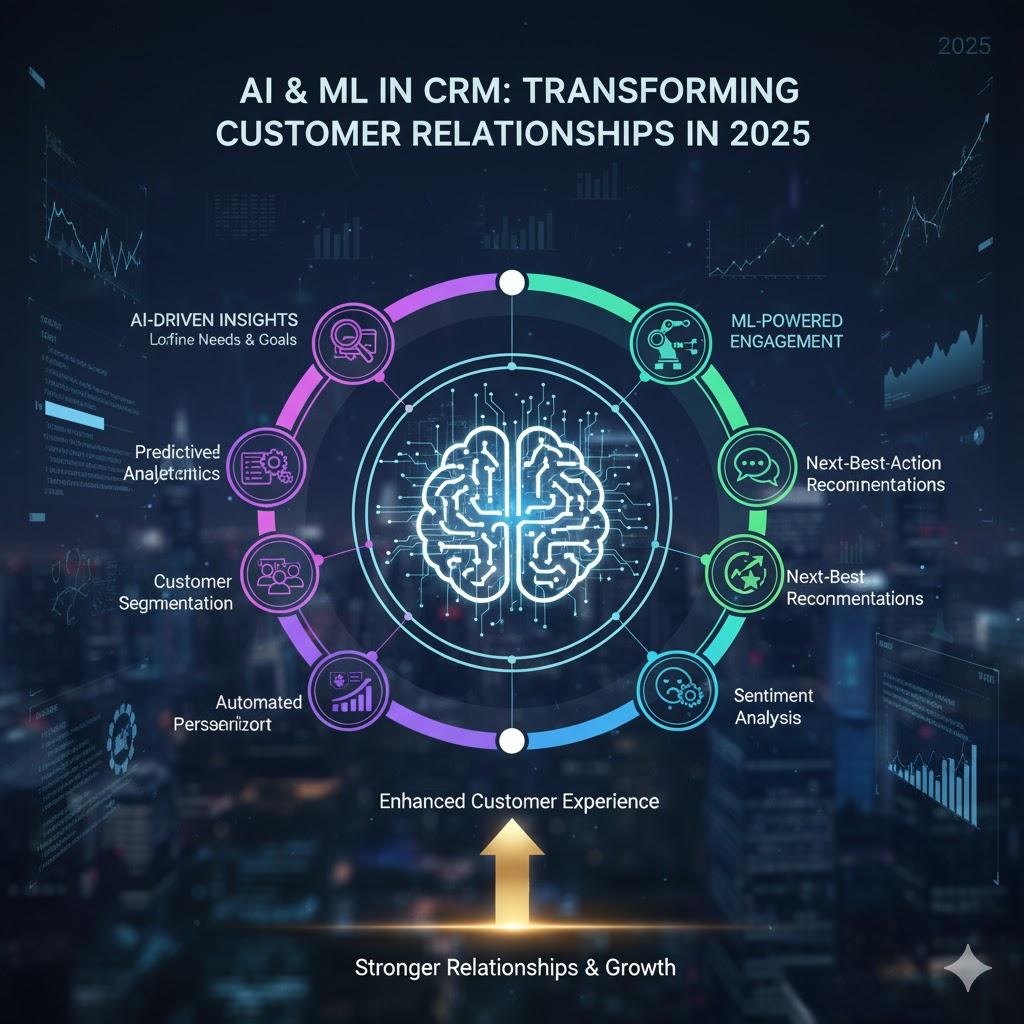
In today's hyper-competitive digital landscape, businesses can't rely solely on traditional methods of customer management. The rise of AI in CRM development is redefining how companies interact with their customers, predict behaviors, and automate complex tasks. By integrating machine learning CRM solutions, businesses are not only managing customer data but also understanding it — turning insights into actions in real time.
From predictive analytics to intelligent chatbots, the fusion of AI-powered CRM and machine learning is creating smarter, faster, and more efficient business ecosystems. Let's explore how these technologies are reshaping customer relationship management in 2025 and beyond.
1. The Evolution of CRM: From Manual to Intelligent Systems
Customer Relationship Management (CRM) systems were once simple tools for storing customer contact details and tracking sales activities. However, as businesses began to collect massive volumes of data, the limitations of traditional CRMs became evident. They lacked real-time analysis, automation, and adaptability — qualities that modern organizations require.
That's where AI in CRM development stepped in.
By integrating Artificial Intelligence (AI) and Machine Learning (ML) algorithms, CRM platforms have evolved into intelligent CRM systems that can:
-
Analyze patterns in customer behavior
-
Predict sales trends and churn risks
-
Automate repetitive marketing and sales tasks
-
Personalize customer experiences
Today, AI-driven CRMs are not just about storing information — they're about understanding relationships and making data-driven decisions.
2. What Is AI in CRM Development?
AI in CRM development refers to embedding artificial intelligence capabilities into CRM software to enhance functionality, automation, and predictive insights. It combines data analytics, natural language processing (NLP), and machine learning models to make CRMs more intelligent and proactive.
Instead of manually segmenting customers or creating static reports, AI-powered CRMs can:
-
Score leads based on conversion likelihood
-
Suggest the following best actions for sales teams
-
Identify cross-sell or up-sell opportunities
-
Provide sentiment analysis from emails and chats
For example, Salesforce Einstein and HubSpot's AI tools use machine learning to help businesses forecast revenue, automate workflows, and predict customer churn — all with high accuracy.
3. The Role of Machine Learning in Modern CRM Systems
Machine learning is the backbone of intelligent CRM systems. It enables CRMs to learn from historical data and continuously improve their predictions and recommendations.
Here's how machine learning CRM solutions are making a difference:
a. Predictive Analytics
Machine learning models analyze past interactions to predict future behaviors. Businesses can forecast which customers are most likely to make a purchase, renew a subscription, or churn.
b. Automated Data Entry and Cleaning
Manual data entry is prone to human error. Machine learning automates the process of data classification, enrichment, and correction, ensuring that CRM databases remain clean and accurate.
c. Lead Scoring and Prioritization
Not all leads are equal. AI in CRM development uses predictive algorithms to assign scores to leads based on behavior, demographics, and engagement — helping sales teams focus on high-value prospects.
d. Customer Segmentation
ML-powered CRMs automatically group customers into segments based on preferences, purchase history, and engagement. This allows businesses to deliver hyper-personalized marketing campaigns.
e. Sentiment Analysis
By processing textual data from emails, chats, and social media, machine learning models can gauge customer sentiment, helping businesses respond more effectively.
4. Key Features of AI-Powered CRM Systems
The latest AI-powered CRM platforms come equipped with features that go far beyond traditional CRM capabilities. These include:
1. Predictive Sales Forecasting
AI uses historical data and current trends to forecast sales performance, helping organizations make smarter inventory and budget decisions.
2. Chatbots and Virtual Assistants
AI-driven chatbots integrated within CRMs handle customer queries 24/7, freeing up human agents for complex issues.
3. Workflow Automation
Routine tasks like sending follow-up emails, assigning leads, and updating deal stages can be automated using AI triggers.
4. Personalized Recommendations
By analyzing customer preferences, intelligent CRMs suggest relevant products or services, improving cross-selling and upselling potential.
5. Real-Time Analytics Dashboards
Modern CRMs powered by AI and ML provide interactive dashboards that update in real time, giving managers instant insights into sales and marketing performance.
6. Voice Recognition and Natural Language Processing
AI systems with NLP capabilities allow sales teams to interact with CRMs using voice commands, enhancing productivity and convenience.
5. Benefits of Integrating AI and Machine Learning into CRM
Integrating AI in CRM development brings numerous business advantages that go beyond automation. Here are the key benefits:
a. Enhanced Customer Experience
AI helps businesses anticipate customer needs, personalize communication, and deliver a seamless customer journey across all touchpoints.
b. Improved Decision-Making
With access to predictive insights, managers can make data-driven decisions faster, reducing guesswork in marketing and sales strategies.
c. Increased Productivity
AI automates time-consuming tasks, allowing teams to focus on relationship-building and strategy rather than administration.
d. Better Lead Conversion Rates
By identifying the most promising leads and nurturing them with personalized content, AI-driven CRMs significantly improve conversion rates.
e. Cost and Time Efficiency
Machine learning CRM tools reduce the need for manual data processing, cutting operational costs and boosting ROI.
f. Data-Driven Marketing Campaigns
With AI analytics, marketers can target the right audience segments, optimize ad spend, and monitor performance in real time.
6. Real-World Examples of AI-Powered CRM Implementation
Let's look at how major companies are leveraging AI-powered CRM platforms to boost their customer engagement and sales.
Salesforce Einstein
Salesforce's AI engine provides predictive lead scoring, opportunity insights, and intelligent recommendations for sales teams.
HubSpot CRM
HubSpot integrates machine learning algorithms to automate workflows, improve lead scoring, and personalize email marketing campaigns.
Zoho CRM Plus
Zoho's AI assistant, Zia, offers insights, detects anomalies, and predicts customer behavior patterns to improve decision-making.
Microsoft Dynamics 365
Microsoft uses AI to unify data across departments, offering predictive insights into sales performance and customer satisfaction.
These examples show how leading brands are using machine learning CRM systems to optimize operations and enhance customer engagement.
7. Challenges in Implementing AI and ML in CRM Systems
While the benefits are substantial, integrating AI and ML into CRM systems is not without challenges:
1. Data Quality and Availability
AI models rely heavily on clean, structured data. Poor data quality can lead to inaccurate predictions and ineffective automation.
2. Integration with Legacy Systems
Older CRMs or non-cloud systems may not support AI integration, requiring migration to more modern infrastructures.
3. High Implementation Costs
Developing custom AI-powered CRM systems can be expensive initially, though the long-term ROI often justifies the investment.
4. Data Privacy Concerns
As CRMs handle sensitive customer data, ensuring compliance with privacy laws like GDPR is essential.
5. Skill Gap
Not all organizations have the technical expertise to implement and maintain AI-based CRM tools effectively.
8. Best Practices for Building an Intelligent CRM System
To maximize the value of AI in CRM development, businesses should follow these best practices:
-
Start Small, Scale Fast: Begin with pilot projects (e.g., automated lead scoring) and expand gradually.
-
Ensure Data Hygiene: Clean and normalize existing data before implementing AI models.
-
Integrate Across Departments: Connect CRM data from sales, marketing, and customer service for holistic insights.
-
Invest in Training: Educate teams to understand and leverage the capabilities of intelligent CRMs.
-
Prioritize Security: Use encryption and compliance frameworks to protect customer data.
9. The Future of AI in CRM Development
The future of AI in CRM development looks promising. Emerging technologies like generative AI, advanced natural language models, and deep learning will make CRMs even more intuitive and self-sufficient.
Here's what to expect:
-
Hyper-Personalization: CRMs will predict not just what customers want but when and how they prefer to engage.
-
Voice-Activated CRMs: Conversational AI will allow users to manage leads and reports hands-free.
-
Automated Decision-Making: AI will autonomously recommend pricing, offers, and sales strategies.
-
Emotion Detection: With sentiment and tone analysis, CRMs will adapt responses based on customer mood.
-
AI + IoT Integration: Connected devices will feed real-time behavioral data into CRMs for predictive maintenance and support.
As the demand for intelligent CRM systems continues to grow, businesses that adopt AI-driven solutions early will have a significant competitive advantage.
Conclusion
The integration of AI and machine learning in CRM systems is no longer optional — it's essential for businesses aiming to stay ahead in a customer-centric world. By leveraging AI-powered CRM platforms, companies can turn customer data into actionable insights, enhance engagement, and streamline every step of the sales and service journey.
Whether it's predictive lead scoring, real-time analytics, or automated communication, machine learning CRM tools are transforming how organizations interact with customers. The future belongs to businesses that harness the full potential of AI in CRM development — creating more intelligent, more adaptive, and more human customer relationships.

 Arabic
 French
 Spanish
 Portuguese
 Deutsch
 Turkish
 Dutch
Dutch
 Italiano
 Russian
 Romaian
 Portuguese (Brazil)
 Greek
Greek