


How Do Engineers Select Gravel for Heavy Civil Engineering Projects?
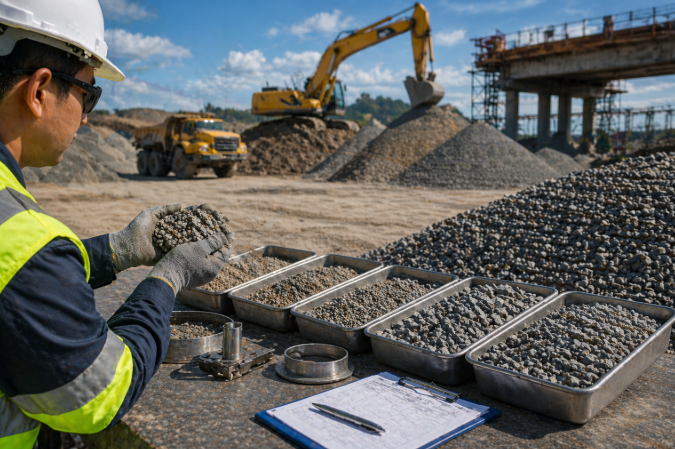
Ever had that moment where we are just sitting with a coffee, typing gravel prices near me in California and thinking… how can something so simple have so many options? We get it. It looks like just a pile of stones. Nothing fancy. But the second it enters a big construction project… things get real, real fast.
Because honestly… gravel is not just thrown around randomly. There is a bit of thinking, a bit of experience, and yeah… a lot of “let us not mess this up” behind it.
Let us walk through it like we are figuring it out together.
It Always Starts With… “What Is This For?”
Before anything else, we pause and ask… what job is this gravel supposed to do?
Is it going under a road where heavy trucks will keep passing all day?
Or is it for drainage where water needs to flow through without getting stuck?
See… same gravel, but totally different expectations.
If we pick the wrong type, it might look fine at first… but later? Problems. Sinking, shifting, cracks… not fun.
Size… Yeah, It Really Matters
At first glance, gravel just looks like random pieces. But when we look closer, size becomes a big deal.
We usually do not want all pieces to be the same size. That would be like stacking only big rocks… gaps everywhere.
So what do engineers do? They mix sizes.
Smaller pieces fill the gaps between bigger ones. Everything fits tighter… more stable. Less movement.
Too many large chunks? It gets loose.
Too much fine material? It packs too tight and water cannot pass.
So we try to find that sweet spot… not too loose, not too tight.
Shape… Smooth vs Rough
This one surprises a lot of people.
Rounded gravel… like the kind we see near rivers… feels nice, looks clean. But it moves. It rolls around.
Now crushed gravel… that is different. It has sharp edges. It grips. It kind of locks into place.
And when we are dealing with heavy loads… roads, bridges, foundations… we need that grip.
So yeah… looks do not win here. Stability does.
Strength… No Compromises
Let us be real… heavy civil projects are not gentle.
There are trucks, machines, constant pressure. Day after day.
So the gravel needs to be tough. Like… really tough.
If it breaks down easily, it creates weak spots. And weak spots lead to bigger issues later. Nobody wants to fix a road that just got built.
So we test it, press it, stress it… basically try to break it before it gets used.
Water… The Quiet Troublemaker
Water does not shout. It just slowly sneaks in and causes trouble.
That is why drainage matters more than we think.
Good gravel lets water pass through easily. It does not trap it underneath.
Because trapped water? That is where damage begins. Soft ground, shifting layers… and then repairs.
So even if no one sees it… drainage gravel is doing a lot of behind-the-scenes work.
What Is Available Nearby?
Now let us come back to real life for a second.
Even if we find the “perfect” gravel on paper… it still needs to be practical.
If it is coming from far away, transport costs go up. A lot.
So we look around. What is available nearby? What fits the job well enough without blowing the budget?
This is where those gravel prices near me searches actually start making sense.
Because cost is not just about the material… it is also about distance, supply, and demand.
Testing… Because Guessing Is Risky
Even after choosing, we do not just go… “yeah, this should work.”
We test it.
We check how it behaves under pressure… how it reacts to water… how stable it stays over time.
It is kind of like a trial run. Better to catch problems early than deal with a big mess later.
So… What Really Affects the Cost?
Somewhere in the middle of all this, we start noticing something…
There are many factors influence the cost of gravel for home or commercial projects.
Things like:
- Size and type of gravel
- Whether it is crushed or natural
- How far it needs to be transported
- Local demand and availability
So yeah… price is not random. There is always a reason behind it.
It Is Just Gravel… But Not Really
At the end of the day, gravel does not get much attention.
We drive over it. Build on top of it. Forget it is even there.
But it is holding everything together… quietly doing its job.
And maybe that is the interesting part. Something so simple… carrying so much responsibility.
FAQs
1. Why do gravel prices vary so much?
Prices change based on location, type, size, and transport distance. Gravel found nearby usually costs less than material brought from far away.
2. What type of gravel is best for road construction?
Crushed gravel with mixed sizes works best. It locks together well and creates a strong, stable base.
3. Can we use river gravel for heavy projects?
Not really ideal. River gravel is smooth and tends to shift. It is better for decoration or light use areas.
4. How do engineers test gravel quality?
They check strength, durability, size mix, and how it handles water. Samples are tested before actual use.
5. Does gravel help with drainage?
Yes, it does. Good gravel allows water to pass through easily, which helps prevent water buildup and damage.

 English
 Arabic
 French
 Spanish
 Portuguese
 Deutsch
 Turkish
 Dutch
Dutch
 Italiano
 Russian
 Romaian
 Greek
Greek