


Algebra 101: Essential Concepts Every Beginner Must Understand
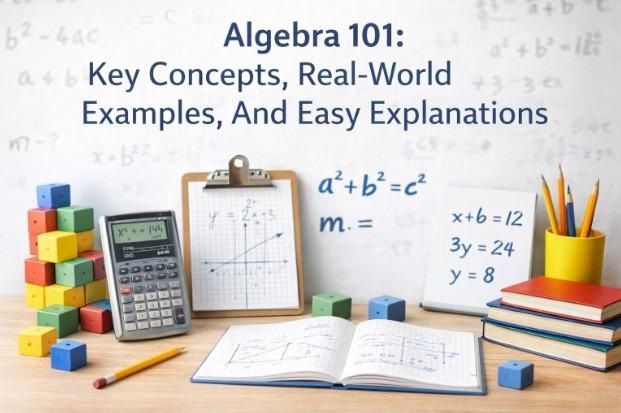
Introduction to Algebra 101
Understanding algebra is essential not only for academic success but also for developing logical reasoning skills. Algebra 101 is the foundation of higher mathematics, introducing learners to variables, constants, and equations. Unlike basic arithmetic, algebra encourages problem-solving using symbols to represent numbers. Beginners often perceive algebra as intimidating, but with structured guidance, the concepts become intuitive. Mastery of algebra 101 equips students to tackle real-world problems, from calculating finances to analyzing data trends.
Understanding Variables and Constants
At the core of algebra 101 are variables and constants. Variables are symbols, often letters, that represent unknown values, while constants are fixed numbers. For instance, in the expression 2x + 5 = 15, ‘x’ is the variable, and 5 is the constant. Recognizing the role of each component helps beginners manipulate equations correctly. Practicing translating real-world situations into algebraic expressions strengthens comprehension, making abstract concepts tangible. A clear understanding of variables and constants forms the first step toward solving more complex algebraic problems.
Mastering Basic Operations
Basic operations—addition, subtraction, multiplication, and division—are fundamental in algebra 101. Unlike arithmetic, these operations involve combining and simplifying variables and constants. For example, simplifying expressions like 3x + 2x = 5x introduces learners to combining like terms. Understanding order of operations, known as PEMDAS (Parentheses, Exponents, Multiplication/Division, Addition/Subtraction), ensures accurate problem-solving. By practicing these fundamental techniques, beginners develop confidence, preparing them for tackling equations, inequalities, and functions in future lessons.
Solving Equations and Inequalities
A critical aspect of algebra 101 is learning to solve equations and inequalities. Equations express equality between two expressions, while inequalities indicate relative size. Simple linear equations like 2x + 3 = 11 teach students how to isolate variables and balance equations. Gradually, learners progress to multi-step equations, introducing brackets, fractions, and negative numbers. Inequalities add a layer of complexity, requiring understanding of less than (<) and greater than (>) symbols. Mastery of these concepts is essential for higher-level math courses and practical applications in science, finance, and engineering.
Functions and Graphs
Functions represent relationships between input and output values, a fundamental concept in algebra 101. Understanding functions enables students to analyze patterns, predict outcomes, and model real-world scenarios. Graphing functions visually reinforces comprehension by showing how variables interact. Beginners learn to plot points, interpret slopes, and identify intercepts. This visual approach makes abstract algebraic concepts more concrete, aiding in retention and practical application. Proficiency in functions lays the groundwork for advanced topics such as quadratic equations, polynomials, and calculus.
Word Problems and Real-Life Applications
Applying algebra 101 concepts to word problems bridges the gap between theory and practice. Translating sentences into algebraic equations enhances analytical thinking. For example, calculating distances, costs, or quantities using equations demonstrates how algebra solves everyday challenges. Encouraging beginners to approach problems step by step reduces anxiety and improves problem-solving efficiency. Practical applications make learning algebra meaningful, reinforcing the relevance of variables, operations, and equations beyond the classroom.
Conclusion: Building a Strong Foundation
In conclusion, algebra 101 provides the essential building blocks for all future mathematics education. For those seeking interactive and supportive learning methods, utilizing learning apps for kids can enhance understanding and engagement, making the journey through algebra both enjoyable and effective. From understanding variables and constants to mastering equations, inequalities, and functions, beginners gain problem-solving skills that extend beyond academics. Incorporating practical applications through word problems ensures students see the real-world relevance of algebraic reasoning.

 English
 French
 Spanish
 Portuguese
 Deutsch
 Turkish
 Dutch
Dutch
 Italiano
 Russian
 Romaian
 Portuguese (Brazil)
 Greek
Greek