



Membrane Stack Disassembly — Maintenance View of a Silica Sol Manufacturing Plant
Membrane maintenance is where many electrodialysis installations lose uptime not because the membranes fail frequently, but because the disassembly and inspection process isn't designed into the plant from the start. If the stack can't be opened, inspected, and reassembled by the client's own team without specialist tools, every scheduled service becomes a dependency on the equipment supplier.
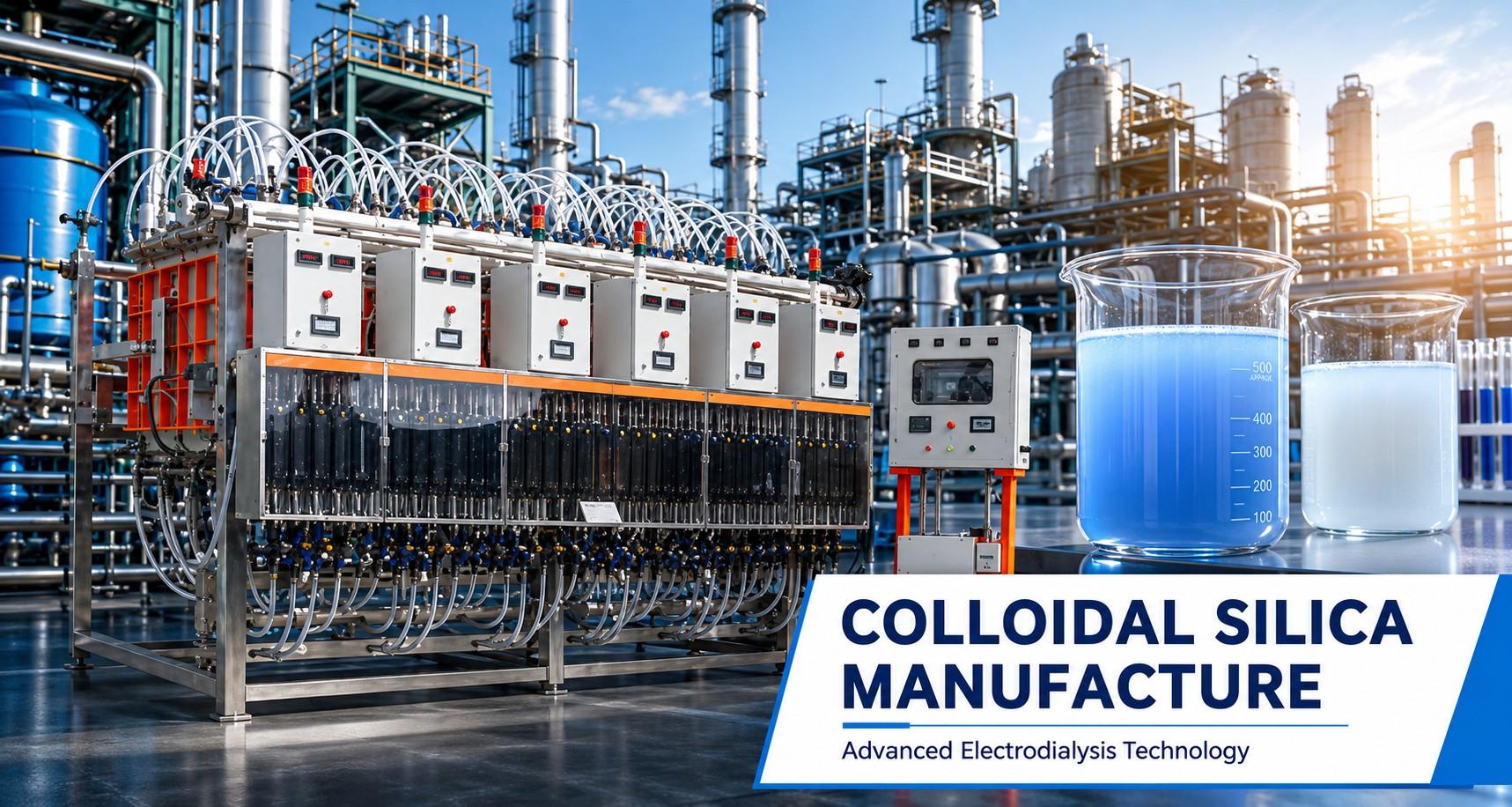
This image shows a stack disassembly from a silica sol manufacturing plant maintained by the client's operators after training by Laxminarayan Technologies. The cation exchange membranes, spacer gaskets, and electrode end frames are laid out in sequence the order matters for reassembly, and keeping them sequenced during inspection avoids misalignment when the stack is closed back up. Visible at this stage are the membrane surfaces and gasket seating faces, where silica scaling or gasket compression set would first become apparent.
In colloidal silica service, the product-side membranes are the most likely to show surface deposits over time, particularly if feed concentration or current density drifts above the operating window. Catching early-stage scaling at inspection before it affects flow distribution or ion transfer efficiency keeps membrane life within the expected service interval.
Laxminarayan Technologies includes onsite operator training as a standard part of every turnkey plant delivery. Training covers routine inspection, cleaning procedures, and fault diagnosis so the client's team can carry out first-level maintenance independently. Full technical support remains available for more complex interventions.
https://www.electrodialysis.in/appliction-colloidal-silica-manufacture/
Laxminarayan Technologies
H16, MIDC, Gokul Shirgaon, Kolhapur, Maharashtra 416234, India
ISO 9001 Certified | Est. 1986
Membrane maintenance is where many electrodialysis installations lose uptime not because the membranes fail frequently, but because the disassembly and inspection process isn't designed into the plant from the start. If the stack can't be opened, inspected, and reassembled by the client's own team without specialist tools, every scheduled service becomes a dependency on the equipment supplier.
This image shows a stack disassembly from a silica sol manufacturing plant maintained by the client's operators after training by Laxminarayan Technologies. The cation exchange membranes, spacer gaskets, and electrode end frames are laid out in sequence the order matters for reassembly, and keeping them sequenced during inspection avoids misalignment when the stack is closed back up. Visible at this stage are the membrane surfaces and gasket seating faces, where silica scaling or gasket compression set would first become apparent.
In colloidal silica service, the product-side membranes are the most likely to show surface deposits over time, particularly if feed concentration or current density drifts above the operating window. Catching early-stage scaling at inspection before it affects flow distribution or ion transfer efficiency keeps membrane life within the expected service interval.
Laxminarayan Technologies includes onsite operator training as a standard part of every turnkey plant delivery. Training covers routine inspection, cleaning procedures, and fault diagnosis so the client's team can carry out first-level maintenance independently. Full technical support remains available for more complex interventions.
https://www.electrodialysis.in/appliction-colloidal-silica-manufacture/
Laxminarayan Technologies
H16, MIDC, Gokul Shirgaon, Kolhapur, Maharashtra 416234, India
ISO 9001 Certified | Est. 1986
Membrane Stack Disassembly — Maintenance View of a Silica Sol Manufacturing Plant
Membrane maintenance is where many electrodialysis installations lose uptime not because the membranes fail frequently, but because the disassembly and inspection process isn't designed into the plant from the start. If the stack can't be opened, inspected, and reassembled by the client's own team without specialist tools, every scheduled service becomes a dependency on the equipment supplier.
This image shows a stack disassembly from a silica sol manufacturing plant maintained by the client's operators after training by Laxminarayan Technologies. The cation exchange membranes, spacer gaskets, and electrode end frames are laid out in sequence the order matters for reassembly, and keeping them sequenced during inspection avoids misalignment when the stack is closed back up. Visible at this stage are the membrane surfaces and gasket seating faces, where silica scaling or gasket compression set would first become apparent.
In colloidal silica service, the product-side membranes are the most likely to show surface deposits over time, particularly if feed concentration or current density drifts above the operating window. Catching early-stage scaling at inspection before it affects flow distribution or ion transfer efficiency keeps membrane life within the expected service interval.
Laxminarayan Technologies includes onsite operator training as a standard part of every turnkey plant delivery. Training covers routine inspection, cleaning procedures, and fault diagnosis so the client's team can carry out first-level maintenance independently. Full technical support remains available for more complex interventions.
https://www.electrodialysis.in/appliction-colloidal-silica-manufacture/
Laxminarayan Technologies
H16, MIDC, Gokul Shirgaon, Kolhapur, Maharashtra 416234, India
ISO 9001 Certified | Est. 1986
0 Comments
0 Shares
26 Views
0 Reviews




 Arabic
 French
 Spanish
 Portuguese
 Deutsch
 Turkish
 Dutch
Dutch
 Italiano
 Russian
 Romaian
 Portuguese (Brazil)
 Greek
Greek