


Geocell for Soil Stabilization, Roads & Slope Protection Guide
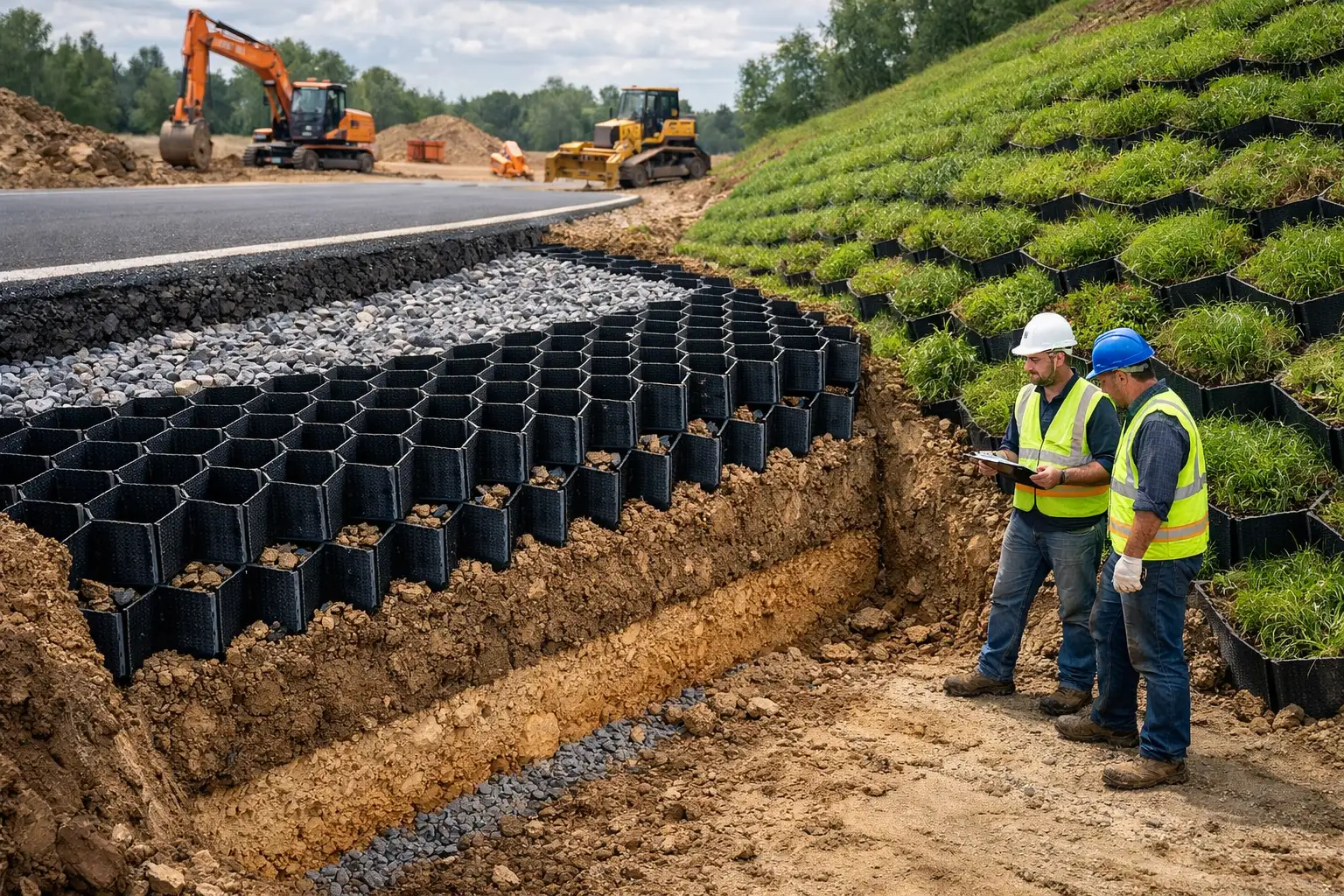
When you look at today’s infrastructure—highways, railways, embankments, or even hillside developments—it’s easy to admire the final result. But behind every strong and stable structure lies a carefully engineered foundation. One of the biggest challenges engineers face is dealing with weak or unstable soil. And that’s exactly where geocell technology is making a noticeable difference.
Instead of relying only on traditional construction techniques, engineers are now turning to smarter, more efficient solutions that not only improve performance but also reduce long-term costs. Geocell systems are one of those innovations that are quietly transforming how modern infrastructure is built.
The Problem with Weak Soil in Construction
Not all soil is suitable for construction. In fact, many project sites deal with loose, soft, or water-affected soil that cannot support heavy loads effectively. This often leads to problems like uneven settlement, cracks in roads, slope failure, and even structural damage over time.
Traditionally, solving this issue meant removing poor soil and replacing it with better-quality material. While effective, this approach can be expensive, time-consuming, and not always environmentally friendly.
That’s why engineers are increasingly looking for solutions that can improve existing soil instead of replacing it. Geocell systems offer exactly that.
What Makes Geocell Different?
Geocell is a three-dimensional cellular confinement system that looks like a honeycomb when expanded. It is usually made from durable polymer materials and is filled with soil, gravel, or sand.
The idea is simple but powerful—once the cells are filled, they hold the material in place and prevent it from spreading sideways. This confinement increases the strength of the soil and allows it to handle heavier loads without shifting.
Unlike flat reinforcement materials, geocells create a structured layer that distributes pressure more evenly. This makes them highly effective in improving stability and reducing deformation.
How Geocell Works in Real Conditions
To understand geocell better, imagine placing loose soil under pressure. Without any support, the soil will move outward and lose its shape. But when that same soil is confined within geocell structures, its movement is restricted.
This confinement:
Increases load-bearing capacity
Reduces soil displacement
Improves overall stability
Because of this, geocells are widely used in areas where soil conditions are not ideal but construction is still necessary.
Everyday Applications of Geocell
One of the reasons geocell has become so popular is its versatility. It can be used in a variety of real-world applications.
Roads and Highways
In road construction, geocells help strengthen the base layer. They distribute traffic loads more evenly, reducing damage like rutting and cracking. This leads to longer-lasting roads with less maintenance.
Slope Protection
Slopes are naturally prone to erosion, especially during heavy rainfall. Geocells help keep the soil in place by forming a stable surface. They can also support vegetation, which further improves slope stability.
Erosion Control
Whether it’s riverbanks, canals, or construction sites, erosion can be a serious issue. Geocells act as a protective layer that prevents soil from being washed away while allowing water to flow through.
Ground Stabilization
In areas with weak soil, geocells are used to create a strong base for construction. They are particularly useful in industrial yards, parking areas, and temporary roads.
Channel and Drainage Protection
Geocells help maintain the shape of drainage channels and prevent soil loss caused by water flow. This ensures better performance and longer lifespan of the system.
Why Engineers Prefer Geocell Solutions
There are several reasons why geocell systems are becoming a preferred choice in modern construction.
Cost-Effective Approach
Instead of replacing soil, geocells improve the existing ground. This reduces material and transportation costs significantly.
Faster Installation
Geocell systems are lightweight and easy to install. This helps speed up construction projects and reduces labor requirements.
Long-Term Durability
Made from strong polymer materials, geocells are designed to withstand harsh conditions, including heavy loads and environmental exposure.
Eco-Friendly Option
Geocells support sustainable construction by reducing the need for natural resources and allowing vegetation growth in many applications.
Flexibility in Design
They can be used in different shapes, sizes, and conditions, making them suitable for a wide range of projects.
A Sustainable Way to Build Infrastructure
Today, sustainability is not just a trend—it’s a necessity. Construction practices are being evaluated not only for their efficiency but also for their environmental impact.
Geocells contribute to sustainable development in several ways:
They reduce the need for excessive excavation
They minimize the use of imported materials
They support natural vegetation growth
They help control erosion and protect soil
By combining performance with environmental responsibility, geocells offer a balanced solution for modern infrastructure needs.
Importance of Quality in Geocell Systems
While the concept of geocell is simple, the quality of the material plays a crucial role in its performance. Poor-quality products may not provide the required strength or durability, leading to long-term issues.
This is why choosing reliable manufacturers is important. Companies like A&T Engineering Pvt. Ltd. are known for providing geocell solutions designed to meet real-world engineering requirements. Their focus on quality ensures consistent performance across different applications.
What the Future Looks Like
As infrastructure projects continue to grow in scale and complexity, the demand for efficient and reliable solutions will only increase. Geocell technology is expected to play a bigger role in the coming years, especially in regions facing challenging soil conditions.
With ongoing advancements in material technology and design, geocells are becoming even more effective and adaptable. Engineers are now exploring new ways to integrate them into various types of projects, from transportation to environmental protection.
Final Thoughts
Geocell systems are a great example of how simple ideas can create a big impact. By improving soil performance and providing stability, they solve some of the most common challenges in construction.
For engineers, contractors, and project developers, geocells offer a practical and efficient solution that balances cost, performance, and sustainability. As the construction industry continues to evolve, solutions like geocell will play a key role in shaping stronger and more reliable infrastructure.

 English
 Arabic
 French
 Spanish
 Portuguese
 Turkish
 Dutch
Dutch
 Italiano
 Russian
 Romaian
 Portuguese (Brazil)
 Greek
Greek